

At highway speed your engine might turn at 2,000 RPM or 3,000 RPM depending on gearing and tire size. Knowing how to calculate it helps when you change tires, swap axle ratios or plan a gear change for towing or fuel economy.
The formula (miles per hour and inches)
Engine RPM = Speed (mph) × Transmission gear ratio × Axle ratio × 336 ÷ Tire diameter (in)
The constant 336 (more precisely 336.13) converts miles per hour and inches into revolutions per minute: one mile is 63,360 inches and there are 60 minutes in an hour, so 63,360 ÷ (60 × π) ≈ 336.13.
Example 1: Direct drive (1.00 gear)
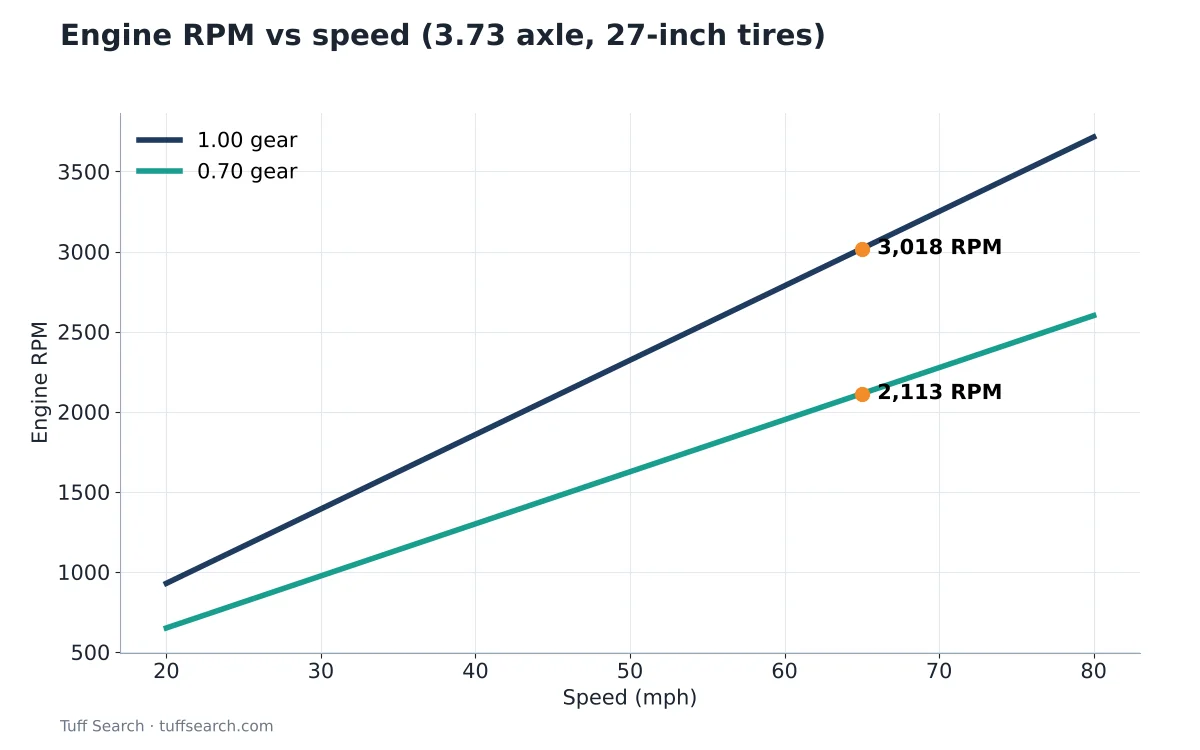
65 mph, 1.00 transmission gear, 3.73 axle ratio, 27-inch tire: 65 × 1.00 × 3.73 × 336.13 ÷ 27 ≈ 3,018 RPM.
Try it with your numbersRPM CalculatorCalculate engine RPM from vehicle speed, tire diameter, gear ratio and final drive – or speed from RPM. Formulas and…Open calculatorExample 2: Overdrive (0.70 gear)
Same vehicle in a 0.70 overdrive gear: 65 × 0.70 × 3.73 × 336.13 ÷ 27 ≈ 2,113 RPM. Overdrive lets the engine turn about 30% slower at the same speed.
Finding speed from RPM
Speed (mph) = RPM × Tire diameter ÷ (Gear ratio × Axle ratio × 336)
At 2,500 RPM with a 27-inch tire and 3.73 axle: about 53.8 mph in a 1.00 gear and about 76.9 mph in a 0.70 gear.
Working out tire diameter from a metric size
For a tire marked 225/45R17: the sidewall height is 225 × 0.45 = 101.25 mm. Diameter = wheel size in mm + 2 × sidewall = (17 × 25.4) + (2 × 101.25) = 634.3 mm, or about 24.97 inches.
Fitting that smaller tire in place of the 27-inch tire in Example 2 raises engine speed at 65 mph from about 2,113 to about 2,284 RPM.
What changes engine RPM
| Change | Effect on RPM at the same speed |
|---|---|
| Larger diameter tires | Lower RPM |
| Smaller diameter tires | Higher RPM |
| Numerically higher axle ratio (e.g. 4.10 instead of 3.73) | Higher RPM, quicker acceleration |
| Overdrive gear (below 1.00) | Lower RPM |
Speedometer note
Changing tire size changes how far the vehicle travels per wheel turn, so the speedometer may read incorrectly until it is recalibrated. Real tires also squash slightly under load, so measured RPM can differ a little from the calculation.
Calculate yours
Use the RPM calculator to try different gears and tire sizes. For engine geometry, see how to calculate compression ratio.
Frequently asked questions
Multiply speed in mph by the transmission gear ratio and the axle ratio, multiply by 336, then divide by the tire diameter in inches.
It converts miles per hour and inches into revolutions per minute: 63,360 inches per mile ÷ (60 minutes × π) ≈ 336.13.
Yes. A larger tire covers more ground per turn, so the engine turns slower at the same speed.
Convert km/h to mph (divide by 1.609) and tire diameter to inches first, or use a metric constant.