
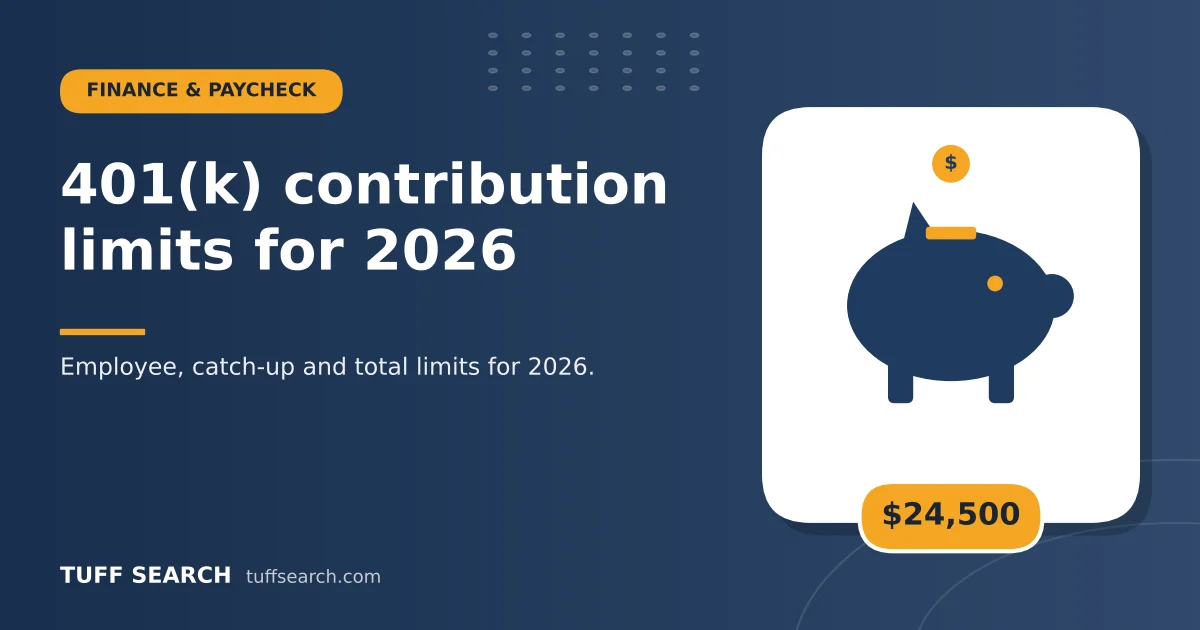
The IRS raises 401(k) limits most years to keep pace with inflation. For 2026 the main employee limit went up again, and higher earners face a new rule about how catch-up contributions must be made. Here is what the numbers mean and how to turn them into a per-paycheck amount.
2026 401(k) limits at a glance
| Limit | 2026 amount |
|---|---|
| Employee elective deferral (under 50) | $24,500 |
| Catch-up contribution, age 50 and over | $8,000 |
| Higher catch-up, ages 60, 61, 62 and 63 | $11,250 (instead of $8,000) |
| Total contributions from you and your employer (section 415(c)) | $72,000, plus any catch-up |
The $24,500 employee limit is a per-person limit across all of your 401(k) and 403(b) plans combined; 457(b) plans have their own separate limit. If you change jobs mid-year, contributions to both employers’ 401(k) plans count toward the same $24,500.
Maximum employee contribution by age
| Your age at the end of 2026 | Maximum you can defer |
|---|---|
| Under 50 | $24,500 |
| 50 to 59 | $32,500 ($24,500 + $8,000) |
| 60 to 63 | $35,750 ($24,500 + $11,250) |
| 64 and over | $32,500 ($24,500 + $8,000) |
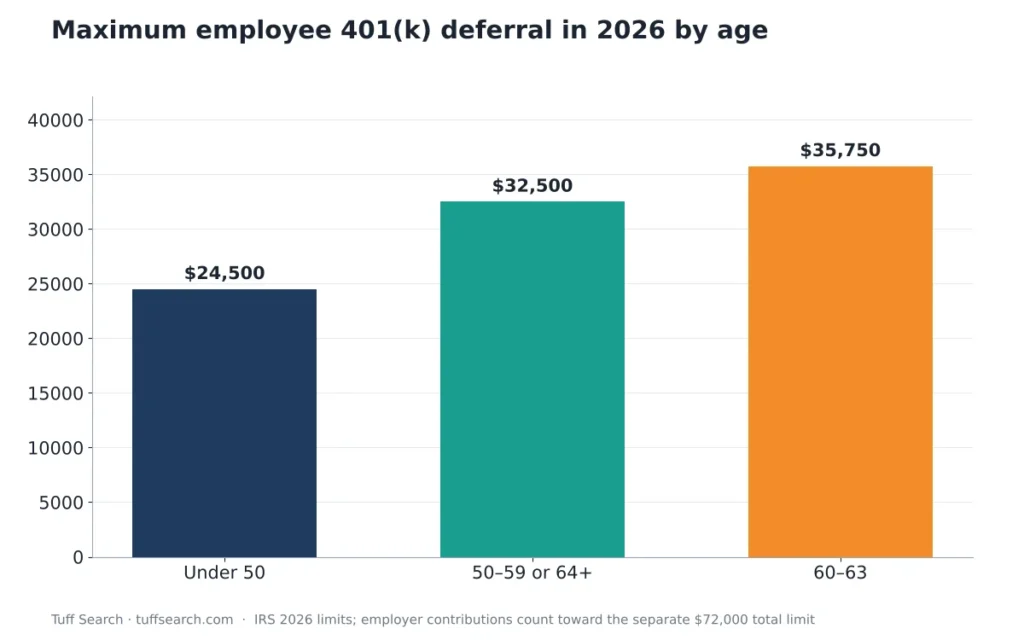
Maximum employee deferral by age in 2026, including catch-up contributions.
The Roth catch-up rule for higher earners
Starting in 2026, if your FICA wages (Box 3 of your W-2) from the employer that sponsors your plan were more than $150,000 in 2025, any catch-up contributions you make in 2026 must go in as Roth (after-tax) contributions. Your regular $24,500 can still be pre-tax. If your plan does not offer a Roth option, you may not be able to make catch-up contributions at all, so check with your plan administrator.
How much is that per paycheck?
Divide your target by the number of pay periods left in the year.
| Target | Weekly (52) | Biweekly (26) | Semi-monthly (24) | Monthly (12) |
|---|---|---|---|---|
| $24,500 | $471.15 | $942.31 | $1,020.83 | $2,041.67 |
| $32,500 | $625.00 | $1,250.00 | $1,354.17 | $2,708.33 |
| $35,750 | $687.50 | $1,375.00 | $1,489.58 | $2,979.17 |
If your employer matches contributions per paycheck, maxing out early in the year could mean missing part of the match in later months unless the plan has a “true-up” feature. Spreading contributions evenly avoids that risk.
Does the employer match count toward $24,500?
No. Employer matching and profit-sharing contributions count toward the $72,000 total limit, not the $24,500 employee limit.
Capturing your full employer match
Many plans match a share of what you contribute, up to a limit. Example: a 50% match on contributions up to 6% of pay. On a $60,000 salary, contributing 6% ($3,600) brings in $1,800 from your employer. Contributing only 3% ($1,800) brings in $900 – leaving $900 a year on the table. Check your plan’s summary for its exact formula, and see how contributions grow over time in compound interest explained.
Pre-tax or Roth?
Both types share the same $24,500 limit. Pre-tax contributions lower your taxable income now; Roth contributions are taxed now but qualified withdrawals are tax-free later. Use the 401(k) calculator to see how different contribution rates grow over time, and check the effect on each paycheck with a paycheck calculator.
Important
Important: This article explains how the calculations work using 2026 federal figures. It is not tax, legal or financial advice. Your actual withholding depends on your W-4, your employer’s payroll system and your state, so check your pay stub and official IRS guidance.
Frequently asked questions
Employees can contribute up to $24,500. People aged 50 and over can add an $8,000 catch-up, and those aged 60 to 63 can add $11,250 instead.
$72,000 for 2026 from all sources combined, plus any catch-up contributions you are eligible for.
From 2026, people whose prior-year FICA wages from the plan sponsor exceeded $150,000 must make catch-up contributions as Roth contributions.
No. The employee deferral limit is per person across all 401(k) and 403(b) plans, not per plan.
Related calculators
Related articles
- Compound Interest Explained: Formula and Examples
- Pre-Tax vs Roth 401(k): How Each Changes Your Paycheck
- How to Calculate Take-Home Pay From Your Salary (2026)