

BMR and TDEE are the two numbers that come up whenever people talk about calorie needs. They are related, but they answer different questions. Mixing them up is one of the most common reasons calorie plans go wrong.
What BMR means
Basal metabolic rate (BMR) is the energy your body uses at complete rest to keep you alive: breathing, circulation, brain function and maintaining body temperature. It is the calories you would burn if you stayed in bed all day.
What TDEE means
Total daily energy expenditure (TDEE) is everything you burn in a day. It is BMR plus the energy used for movement, exercise and digesting food. TDEE is your maintenance calories: eat about this much and your weight tends to stay stable.
TDEE = BMR × Activity factor
The Mifflin-St Jeor formula for BMR
Mifflin-St Jeor, published in 1990, is one of the most widely used equations for estimating resting energy expenditure in adults.
Men: BMR = (10 × weight in kg) + (6.25 × height in cm) − (5 × age) + 5
Women: BMR = (10 × weight in kg) + (6.25 × height in cm) − (5 × age) − 161
Worked example
A 30-year-old man, 80 kg, 180 cm, who exercises 3 to 5 days a week (moderately active, factor 1.55):
- 10 × 80 = 800
- 6.25 × 180 = 1,125
- 5 × 30 = 150
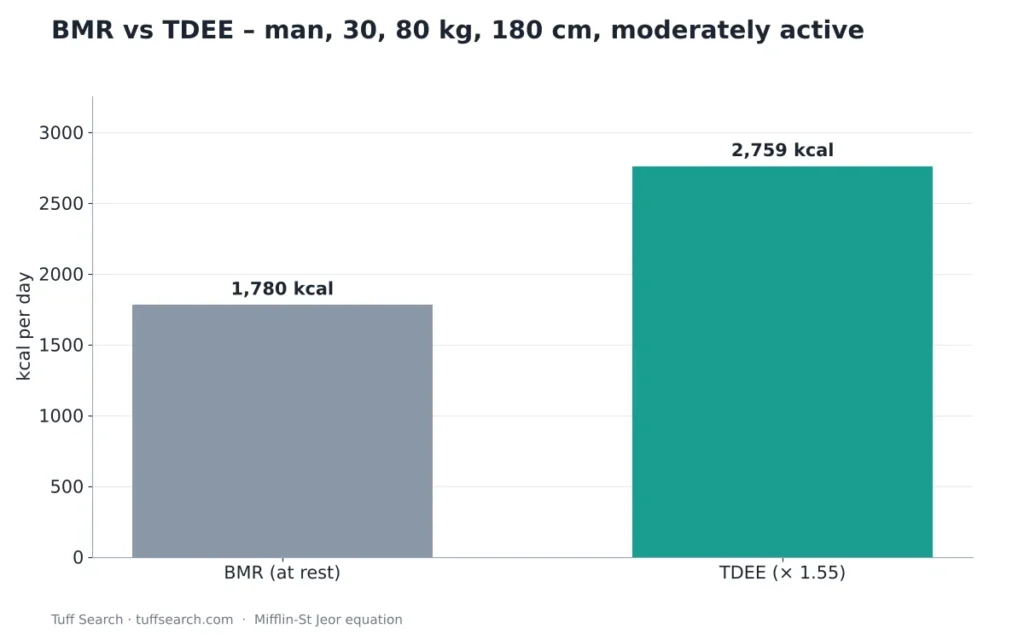
- BMR = 800 + 1,125 − 150 + 5 = 1,780 kcal a day
- TDEE = 1,780 × 1.55 = 2,759 kcal a day
A 35-year-old woman, 65 kg, 165 cm, lightly active (factor 1.375): BMR = 650 + 1,031.25 − 175 − 161 = 1,345 kcal; TDEE ≈ 1,850 kcal a day.
Example
Example: the same person’s BMR and TDEE (Mifflin-St Jeor, activity factor 1.55).
Side-by-side comparison
| BMR | TDEE | |
|---|---|---|
| Measures | Energy used at complete rest | Energy used in a full day |
| Includes activity? | No | Yes |
| Typical use | Starting point for calculations | Setting calorie targets |
| Example (man above) | 1,780 kcal | 2,759 kcal |
Which number should you use?
- To maintain weight: aim for your TDEE.
- To lose weight gradually: eat somewhat below your TDEE, not below your BMR without medical guidance.
- To gain weight or muscle: eat slightly above your TDEE.
- Use BMR on its own only as an input; most people should not plan meals around it.
Why your real number may differ
Equations estimate averages. Muscle mass, genetics, health conditions, medications and sleep all shift your real energy use. Treat the result as a starting point: track your weight for two to three weeks and adjust by small amounts if it moves in a direction you did not expect.
Turning TDEE into a daily target
Once you know your TDEE, a maintenance target is simply that number. For gradual weight loss, many people start 10–20% below it – see calorie deficit explained. To check the BMR step by hand, use the Mifflin-St Jeor equation calculator.
Calculate both in one step
The TDEE calculator applies Mifflin-St Jeor and your activity level automatically. If you follow a low-carb plan, the keto calculator turns your TDEE into fat, protein and carb targets.
Important
Important: This article is general educational information, not medical or nutrition advice. Talk to a doctor or registered dietitian before changing your diet, especially if you are pregnant, under 18, or have a medical condition.
Frequently asked questions
Yes, always. TDEE is BMR multiplied by an activity factor of at least 1.2, so it is at least 20% higher than BMR.
Not as a rule. Eating below your BMR for long periods is very restrictive. A moderate deficit below your TDEE is a common approach; ask a healthcare professional for a plan that suits you.
No equation is perfect. Mifflin-St Jeor is widely used for healthy adults; formulas that use lean body mass can suit people who know their body-fat percentage.
Recalculate after a weight change of a few kilograms or when your activity level changes, because both affect the result.
Related calculators
Related articles
- Calorie Deficit Explained: How to Set a Safe Target
- TDEE Activity Multipliers: How to Pick the Right Level
- How to Calculate Your Target Weight From BMI (Formula)