
Your salary offer and the money that lands in your bank account are two different numbers. The gap is made up of taxes and deductions that your employer takes out before paying you. Once you know what those are and how each one is calculated, you can estimate your take-home pay for any salary in a few minutes.
This guide walks through the calculation step by step using 2026 federal figures, then shows a full worked example. If you just want the answer, the Tuff Search paycheck calculators do the maths for your state.
The take-home pay formula
Take-home pay = Gross pay − Pre-tax deductions − Federal income tax − Social Security − Medicare − State and local tax − After-tax deductions
Every paycheck follows this order. Pre-tax deductions come out first because they lower the income that some taxes are calculated on. After-tax deductions come out last.
Step 1: Start with gross pay
Gross pay is your pay before anything is taken out. For a salaried employee it is the annual salary divided by the number of pay periods in the year:
| Pay frequency | Pay periods per year | $60,000 salary per paycheck |
|---|---|---|
| Weekly | 52 | $1,153.85 |
| Biweekly (every two weeks) | 26 | $2,307.69 |
| Semi-monthly (twice a month) | 24 | $2,500.00 |
| Monthly | 12 | $5,000.00 |
Biweekly and semi-monthly sound similar but are not the same: biweekly gives 26 paychecks a year, semi-monthly gives 24, so each semi-monthly check is larger.
Step 2: Subtract pre-tax deductions
Common pre-tax deductions are traditional 401(k) contributions, health insurance premiums paid through a cafeteria plan, and HSA or FSA contributions. Traditional 401(k) contributions reduce the income used for federal income tax but not for Social Security and Medicare. Section 125 health premiums usually reduce both.
Step 3: Work out federal income tax
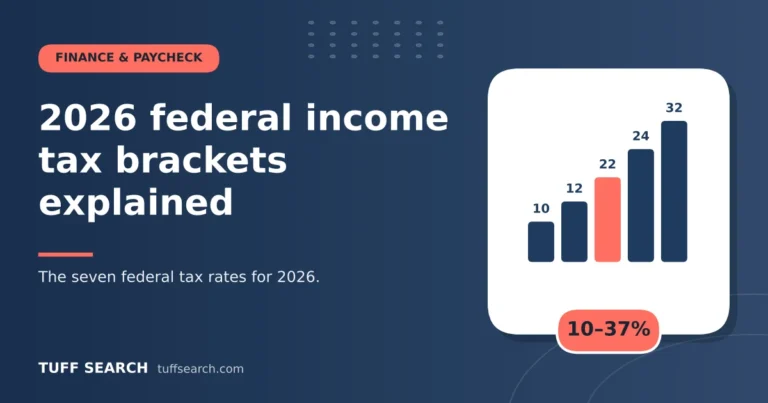
For 2026 a single filer gets a standard deduction of $16,100. Subtract it from your annual taxable wages, then apply the tax brackets. Each rate only applies to the slice of income inside its bracket, which is why your overall rate is always lower than your top bracket.
| 2026 rate | Single filer – taxable income |
|---|---|
| 10% | $0 – $12,400 |
| 12% | $12,401 – $50,400 |
| 22% | $50,401 – $105,700 |
| 24% | $105,701 – $201,775 |
| 32% | $201,776 – $256,225 |
| 35% | $256,226 – $640,600 |
| 37% | Over $640,600 |
Your employer does not calculate an annual figure each payday. It uses the withholding tables in IRS Publication 15-T and the answers on your Form W-4, so the amount on a single paycheck can differ slightly from the annual estimate. Over a full year the two should end up close if your W-4 is accurate.
Step 4: Subtract Social Security and Medicare (FICA)
- Social Security: 6.2% of wages up to the 2026 wage base of $184,500. Nothing more is withheld once you pass that amount in a year.
- Medicare: 1.45% of all wages, with no cap.
- Additional Medicare Tax: an extra 0.9% on wages above $200,000 in a calendar year.
Step 5: Subtract state and local income tax
This is the step that varies most. Some states have no income tax on wages, some use one flat rate and others use brackets. A few cities and counties add their own tax. Pick your state in the paycheck calculator hub to apply the correct 2026 rules.
Step 6: Subtract after-tax deductions
Roth 401(k) contributions, union dues, wage garnishments and some insurance plans are taken from pay after tax. They reduce your take-home pay but not your taxes.
Worked example: $60,000 salary in a state with no income tax
Assumptions: single filer, 2026 standard deduction, no pre-tax deductions, paid biweekly, working in a state such as Texas that has no state income tax on wages.
| Line | Annual | Per biweekly paycheck |
|---|---|---|
| Gross salary | $60,000.00 | $2,307.69 |
| Federal income tax | −$5,020.00 | −$193.08 |
| Social Security (6.2%) | −$3,720.00 | −$143.08 |
| Medicare (1.45%) | −$870.00 | −$33.46 |
| Take-home pay | $50,390.00 | $1,938.08 |
How the federal figure is worked out: $60,000 − $16,100 standard deduction = $43,900 taxable income. The first $12,400 is taxed at 10% ($1,240) and the remaining $31,500 at 12% ($3,780), for a total of $5,020. That is an effective federal rate of about 8.4% of gross pay even though the top bracket reached is 12%.
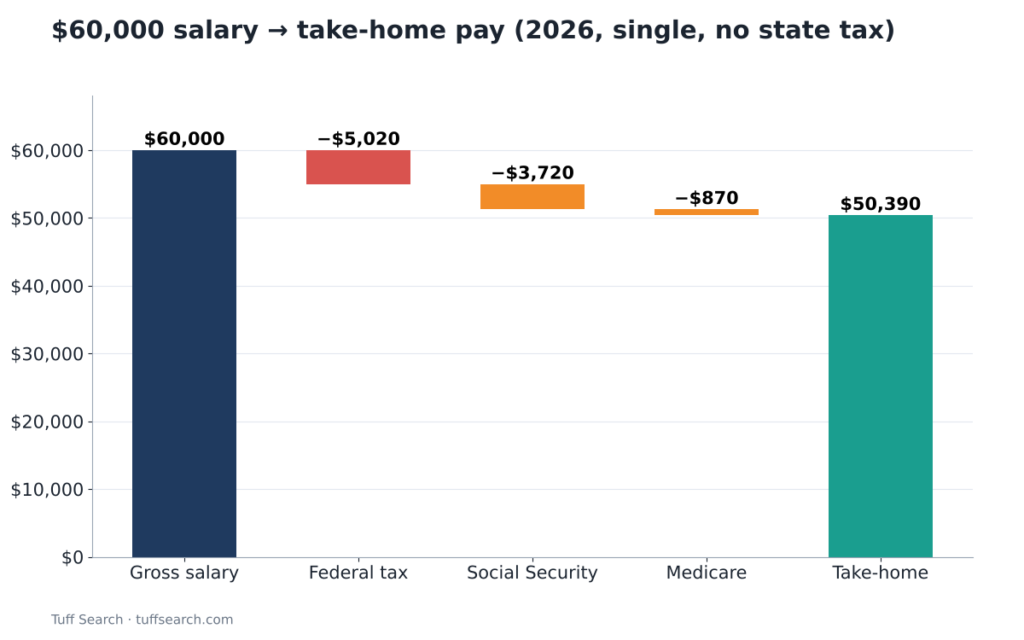
Worked example: $60,000 salary, single filer, no state income tax (2026 figures).
What changes with a 401(k) contribution
If the same person puts 5% ($3,000) into a traditional 401(k), taxable income falls to $40,900 and federal tax falls to $4,660. Social Security and Medicare stay at $4,590 because traditional 401(k) money is still subject to FICA. Take-home pay becomes $47,750: the contribution costs $3,000 but take-home pay only drops by $2,640, because $360 of federal tax is saved. You can test your own numbers with the 401(k) calculator.
Common mistakes when estimating take-home pay
- Using your top tax bracket on all of your income. Brackets are marginal, so only the income inside each bracket is taxed at that rate.
- Forgetting FICA. Social Security and Medicare together take 7.65% of most people’s wages.
- Mixing up biweekly and semi-monthly pay periods.
- Ignoring state or local tax when you move or take a remote job.
- Treating a bonus like regular pay. Bonuses are often withheld at a flat 22% federal rate, so the bonus check can look different from your normal one.
Paychecks with overtime, bonuses or a raise
Extra pay follows the same steps but can look different on the stub. Overtime is paid at 1.5 times your regular rate after 40 hours – see how overtime pay is calculated. Bonuses are often withheld at a flat 22% federal rate – see how bonuses are taxed. And a raise never lowers your take-home pay through federal brackets – see will a raise put me in a higher tax bracket?
When to use a calculator instead
The manual method is great for understanding where your money goes. For a quick, accurate figure that includes your state’s 2026 rules, use the paycheck calculator for your state and compare the result with your latest pay stub.
Important
Important: This article explains how the calculations work using 2026 federal figures. It is not tax, legal or financial advice. Your actual withholding depends on your W-4, your employer’s payroll system and your state, so check your pay stub and official IRS guidance.
Frequently asked questions
Yes. Take-home pay and net pay both mean the amount you receive after all taxes and deductions are taken out of your gross pay.
For a single filer in a state with no income tax and no pre-tax deductions, about $9,610 a year in 2026: $5,020 federal income tax, $3,720 Social Security and $870 Medicare. That leaves about $50,390, or $1,938.08 every two weeks.
Your employer uses your W-4 answers and the IRS withholding tables for each pay period, and your pay may include deductions such as health insurance or retirement contributions. Compare each line of your pay stub with the calculator inputs.
No. Traditional 401(k) contributions reduce federal income tax (and income tax in most states), but Social Security and Medicare are still calculated on the full wages.
Related calculators
Related articles
- How Overtime Pay Is Calculated (Time and a Half)
- How Bonuses Are Taxed: The 22% Rate Explained (2026)
- Will a Raise Put Me in a Higher Tax Bracket? (2026)