
Hearing that you are “in the 22% bracket” makes it sound as though 22% of your income goes to federal tax. It does not. The U.S. uses marginal tax brackets, which means each rate applies only to a slice of your income. This guide lists the 2026 brackets and shows exactly how they are applied.
2026 standard deduction
Before brackets are applied, most people subtract the standard deduction from their income. For tax year 2026 the standard deduction is:
| Filing status | 2026 standard deduction |
|---|---|
| Single or married filing separately | $16,100 |
| Married filing jointly | $32,200 |
| Head of household | $24,150 |
2026 federal income tax brackets
| Rate | Single | Married filing jointly |
|---|---|---|
| 10% | $0 – $12,400 | $0 – $24,800 |
| 12% | $12,401 – $50,400 | $24,801 – $100,800 |
| 22% | $50,401 – $105,700 | $100,801 – $211,400 |
| 24% | $105,701 – $201,775 | $211,401 – $403,550 |
| 32% | $201,776 – $256,225 | $403,551 – $512,450 |
| 35% | $256,226 – $640,600 | $512,451 – $768,700 |
| 37% | Over $640,600 | Over $768,700 |
The ranges apply to taxable income, which is your income after the standard deduction (or itemised deductions) and certain pre-tax contributions.
How marginal brackets work
Think of your taxable income as water filling a set of buckets. The first bucket (10%) fills up to $12,400. Anything above that spills into the 12% bucket, and so on. You only pay the higher rate on the part that reaches the higher bucket.
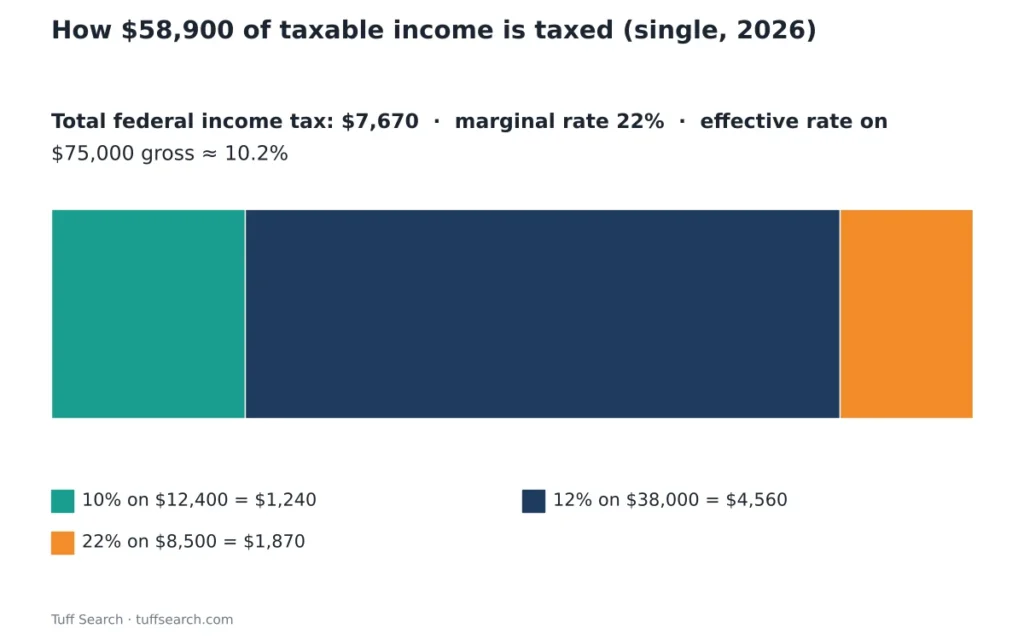
Only the income inside each bracket is taxed at that bracket’s rate.
Example 1: Single filer earning $75,000
- Taxable income: $75,000 − $16,100 = $58,900.
- 10% on the first $12,400 = $1,240.
- 12% on the next $38,000 ($12,400 to $50,400) = $4,560.
- 22% on the remaining $8,500 ($50,400 to $58,900) = $1,870.
- Total federal income tax = $7,670.
This person’s marginal rate is 22%, but the tax is only about 10.2% of their $75,000 gross income. That second number is the effective rate.
Example 2: Married couple filing jointly earning $120,000
- Taxable income: $120,000 − $32,200 = $87,800.
- 10% on the first $24,800 = $2,480.
- 12% on the remaining $63,000 = $7,560.
- Total federal income tax = $10,040 (about 8.4% of gross income).
Marginal rate vs effective rate
| Marginal rate | Effective rate | |
|---|---|---|
| What it means | The rate on your next dollar of income | Total tax divided by income |
| Example (single, $75,000) | 22% | About 10.2% of gross |
| Use it for | Deciding the tax cost of a raise, bonus or extra 401(k) contribution | Comparing your overall tax burden |
Will a raise push me into a higher bracket and lower my pay?
No. Moving into a higher bracket only changes the rate on the extra income. If a single filer’s taxable income rises from $50,000 to $52,000, the first $400 of the raise is taxed at 12% and the remaining $1,600 at 22%. Your take-home pay still goes up.
How brackets affect each paycheck
Your employer spreads your expected annual tax across your paychecks using IRS withholding tables and your W-4. Social Security, Medicare and state tax are added on top. To see the full picture for your state, use a Tuff Search paycheck calculator.
Important
Important: This article explains how the calculations work using 2026 federal figures. It is not tax, legal or financial advice. Your actual withholding depends on your W-4, your employer’s payroll system and your state, so check your pay stub and official IRS guidance.
Frequently asked questions
There are seven rates: 10%, 12%, 22%, 24%, 32%, 35% and 37%. For single filers the 10% bracket covers taxable income up to $12,400 and the 37% rate starts above $640,600.
$16,100 for single filers, $32,200 for married couples filing jointly and $24,150 for heads of household.
No. Each rate only applies to the income inside that bracket, so your overall (effective) rate is always lower than your top (marginal) rate.
No. Brackets are for federal income tax only. Social Security (6.2%) and Medicare (1.45%) are separate payroll taxes.
Related calculators
Related articles
- How to Calculate Take-Home Pay From Your Salary (2026)
- FICA Tax 2026: Social Security and Medicare Explained
- Hourly to Salary: How to Convert Your Pay (With Examples)