
Living in a state without an income tax means one less deduction on every paycheck. But federal taxes still apply, and a few of these states collect other payroll contributions. Here is what changes and what does not.
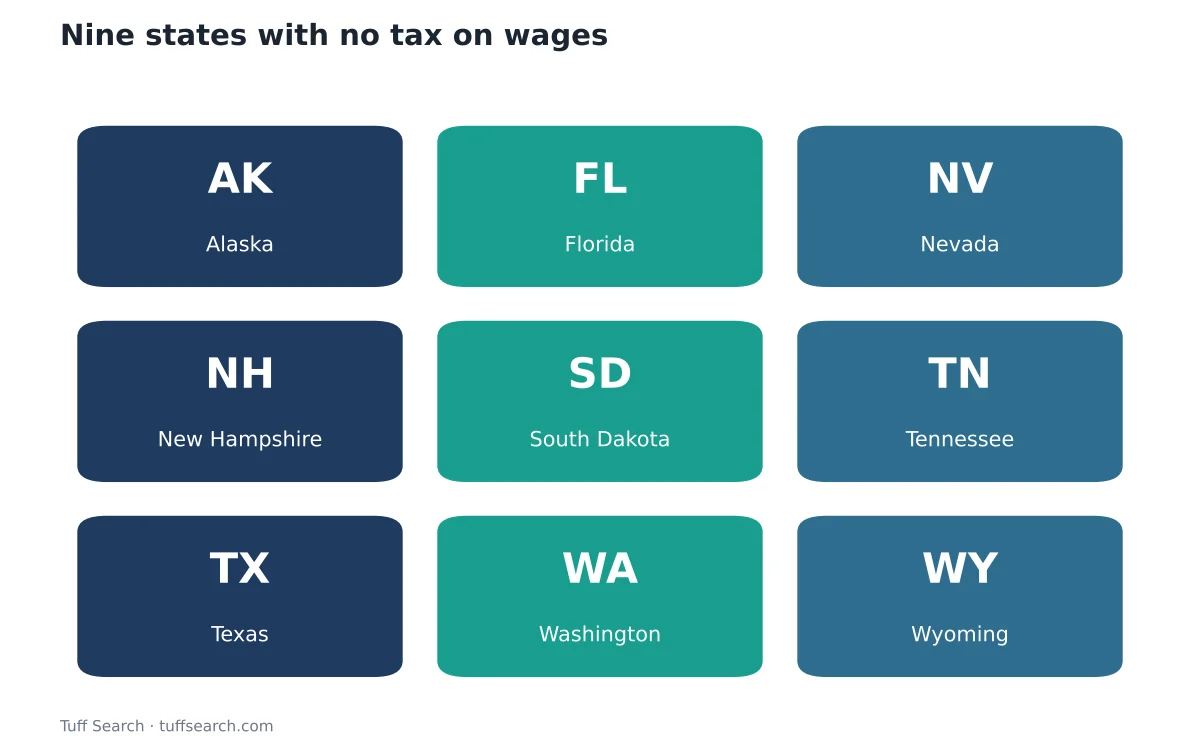
The nine states with no tax on wages
| State | Note |
|---|---|
| Alaska | No state income tax; employees pay a small unemployment insurance contribution |
| Florida | No personal income tax |
| Nevada | No personal income tax |
| New Hampshire | No tax on wages; its tax on interest and dividends has been repealed |
| South Dakota | No personal income tax |
| Tennessee | No tax on wages; the Hall tax on investment income was repealed |
| Texas | No personal income tax |
| Washington | No tax on wages; taxes certain long-term capital gains above a high threshold |
| Wyoming | No personal income tax |
What still comes out of your paycheck
- Federal income tax, based on your W-4 and the 2026 brackets.
- Social Security: 6.2% of wages up to $184,500.
- Medicare: 1.45% of all wages, plus 0.9% above $200,000.
- Pre-tax and after-tax deductions such as 401(k) contributions and health insurance.
- State-specific payroll programs in some states, for example Washington’s paid family and medical leave and WA Cares long-term care premiums, and Alaska’s employee unemployment insurance contribution.
Worked example: $60,000 salary
Single filer, 2026 standard deduction, no pre-tax deductions, in Texas:
| Line | Annual | Biweekly |
|---|---|---|
| Gross pay | $60,000.00 | $2,307.69 |
| Federal income tax | −$5,020.00 | −$193.08 |
| Social Security | −$3,720.00 | −$143.08 |
| Medicare | −$870.00 | −$33.46 |
| State income tax | $0.00 | $0.00 |
| Take-home pay | $50,390.00 | $1,938.08 |
For comparison only: if a state charged a flat 4% on the full $60,000, that would take another $2,400 a year, about $92 per biweekly paycheck. Real state taxes use their own deductions and rates, so use the calculator for your state.
No income tax is not the same as low taxes
States without an income tax raise money in other ways, such as sales taxes, property taxes or taxes on businesses. Your overall cost depends on where you shop, whether you own a home and how you earn your income.
Remote work and moving
Income tax generally follows where you live and where you physically work. If you live in a no-tax state but work in a state that taxes wages, or you move partway through the year, you may owe tax to another state. Update your payroll address promptly when you move.
Check your take-home pay
See the exact figures with the Texas, Florida or Tennessee paycheck calculators, or pick any state from the paycheck calculator hub. For how each line is calculated, read how to calculate take-home pay.
Important
Important: This article explains how the calculations work using 2026 federal figures. It is not tax, legal or financial advice. Your actual withholding depends on your W-4, your employer’s payroll system and your state, so check your pay stub and official IRS guidance.
Frequently asked questions
Alaska, Florida, Nevada, New Hampshire, South Dakota, Tennessee, Texas, Washington and Wyoming do not tax wages.
Yes. Federal income tax, Social Security and Medicare apply in every state.
Washington does not tax wages, but it taxes certain long-term capital gains above a high threshold and collects some payroll premiums.
It depends on where you live and physically work and on each state’s rules. Check with the states involved or a tax professional.
Related calculators
- Texas Paycheck Calculator
- Florida Paycheck Calculator
- Tennessee Paycheck Calculator
- Washington Paycheck Calculator
- Paycheck Calculators
Related articles
- How to Calculate Take-Home Pay From Your Salary (2026)
- 2026 Federal Income Tax Brackets Explained With Examples
- FICA Tax 2026: Social Security and Medicare Explained
Sources
- Tax Foundation – State individual income tax rates and brackets
- Washington Department of Revenue – Capital gains tax
- New Hampshire Department of Revenue Administration
- IRS – Social Security and Medicare withholding rates (Topic 751)