
Whether you are paid overtime does not depend on your job title or on being paid a salary. It depends on whether you are ‘exempt’ or ‘non-exempt’ under the Fair Labor Standards Act (FLSA). This guide explains the difference, the tests used and the common misunderstandings.
Non-exempt employees
Non-exempt employees are covered by the FLSA’s minimum wage and overtime rules. They must be paid at least 1.5 times their regular rate for hours worked over 40 in a workweek. Most hourly workers are non-exempt, and so are some salaried workers. See how overtime pay is calculated for the maths.
Exempt employees
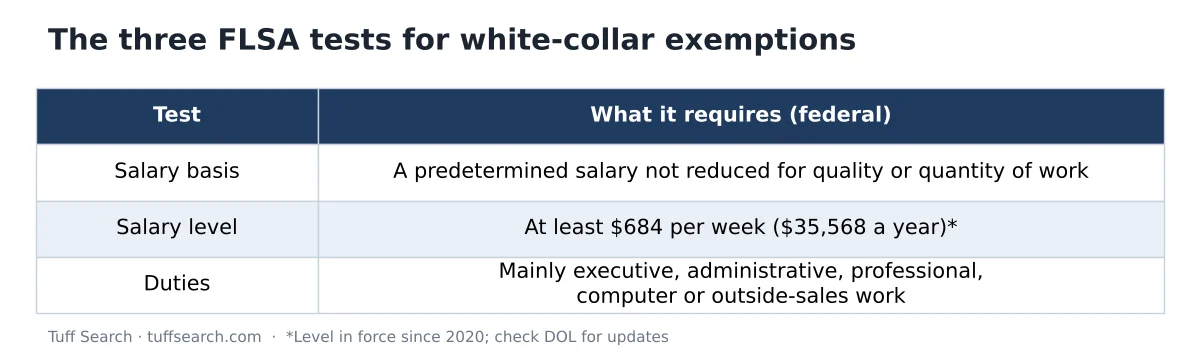
Exempt employees are not entitled to overtime under federal law. The most common exemptions are the ‘white-collar’ exemptions for executive, administrative, professional, computer and outside sales employees. To qualify, a job usually has to pass three tests.
The salary tests
The federal minimum salary for the white-collar exemptions has been $684 a week ($35,568 a year) since 2020; a 2024 rule that would have raised it was struck down by a federal court. A separate ‘highly compensated employee’ test applies to higher earners with a lighter duties test. Some jobs, such as outside sales, teachers, doctors and lawyers, are not subject to the salary level requirement. Because these rules change, check the Department of Labor’s current guidance.
The duties tests
- Executive: primarily manages the business or a department, regularly directs at least two full-time employees (or equivalent), and has real input into hiring and firing.
- Administrative: primarily office or non-manual work related to management or business operations, with discretion and independent judgement on significant matters.
- Learned professional: primarily work requiring advanced knowledge in a field of science or learning, usually gained through specialised study.
- Computer employee: systems analysts, programmers, software engineers and similar roles (with an alternative hourly pay test).
- Outside sales: primarily making sales away from the employer’s place of business.
Common misunderstandings
- ‘Salaried means no overtime’ – false. A salaried employee who fails the duties or salary-level test is non-exempt.
- ‘A manager title makes you exempt’ – false. Actual duties decide, not the title.
- ‘Employees can agree to waive overtime’ – generally not; FLSA rights cannot be waived by agreement.
- ‘Comp time instead of overtime pay’ – private employers generally cannot replace overtime pay with time off later; special rules apply to public employers.
State rules can be stricter
Several states, including California, New York and Washington, set higher salary thresholds or stricter duties tests than federal law, and some require daily overtime. When state and federal law differ, the rule more generous to the employee applies. California’s labour department explains its overtime rules on its website.
What employers should do
- Classify each role by its real duties and pay, and document the reasoning.
- Review classifications when duties change or thresholds are updated.
- Track hours for non-exempt staff accurately, including work done from home.
- Include overtime in labour budgets – the labour cost calculator estimates the full cost of an employee, and labour cost explained walks through it.
Important
Important: This article explains how the calculations work using 2026 federal figures. It is not tax, legal or financial advice. Your actual withholding depends on your W-4, your employer’s payroll system and your state, so check your pay stub and official IRS guidance.
Frequently asked questions
Non-exempt employees must be paid overtime for hours over 40 a week; exempt employees are not entitled to it under federal law.
No. They must also meet the salary level and duties tests.
Federally, $684 per week ($35,568 a year) has applied since 2020; some states set higher thresholds.
Generally exemptions require a salary basis, but some professions and computer employees have different rules.
Check your job’s actual duties and pay against the DOL tests, or ask your employer’s HR department how your role is classified.
Related calculators
- Labour Cost Calculator
- Paycheck Calculators
- Employee Turnover Rate Calculator
- California Paycheck Calculator
Related articles
- How Overtime Pay Is Calculated: Time and a Half Explained
- Labour Cost Explained: How to Calculate the True Cost of an Employee
- How to Calculate Take-Home Pay From Your Gross Salary (2026 Guide)