
When a rate moves from 4% to 5%, did it rise by 1% or by 25%? Both statements appear in the news, and only one is precise. The difference between percentage points and percent matters whenever you compare interest rates, tax rates, test scores, polls or health risks.
The short answer
- A percentage point (pp) is the simple difference between two percentages: 5% − 4% = 1 percentage point.
- Percent change is the change relative to where you started: (5 − 4) ÷ 4 × 100 = 25%.
Percentage-point change = New % − Old % | Percent change = (New − Old) ÷ Old × 100
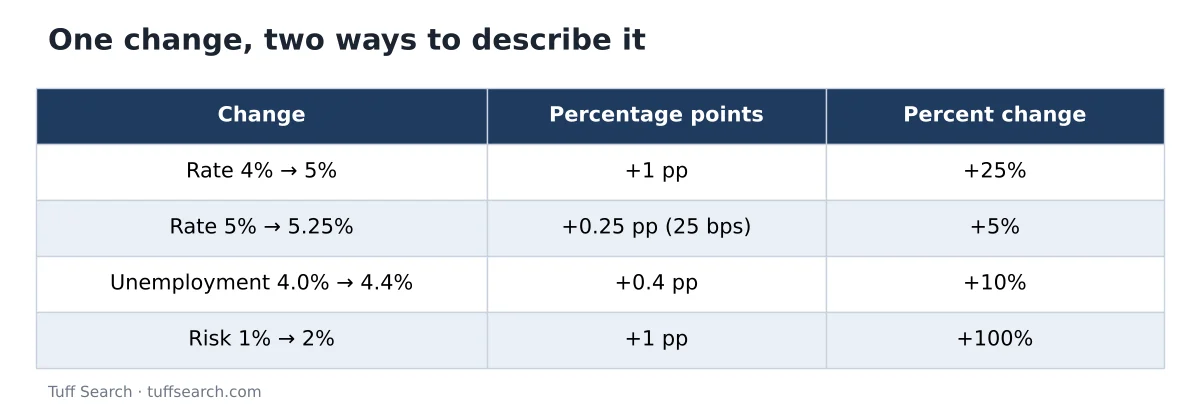
So a mortgage rate that rises from 4% to 5% has gone up 1 percentage point, which is a 25 percent increase in the rate. Saying it “rose 1%” is ambiguous: it could be read as 4% to 4.04%.
Why the difference matters
Interest rates and basis points
Finance avoids the confusion by using basis points: one basis point is one hundredth of a percentage point (0.01%). A central bank that “raises rates by 25 basis points” moves its rate from, say, 5.00% to 5.25%. That is a 0.25 percentage-point rise and a 5% relative rise. Convert between the three with the basis point calculator.
Taxes
If a tax rate goes from 20% to 22%, it rises 2 percentage points – a 10% increase in the rate. Someone paying $2,000 at 20% would pay $2,200 at 22% on the same income: $200 more, which is 10% more tax.
Health and risk
“Doubles your risk” sounds alarming, but if the risk goes from 1 in 100 (1%) to 2 in 100 (2%), the absolute increase is 1 percentage point – one extra case per 100 people. Both numbers are true; the absolute change usually tells you more about your own situation. The relative risk calculator shows relative and absolute risk side by side.
Polls and surveys
A candidate moving from 45% to 48% has gained 3 percentage points. A margin of error of “±3 points” also means percentage points, not percent of the result.
Try it with your numbersBasis Point CalculatorConvert basis points to percent, decimals and dollars, and see what a rate change in bps means for a loan, mortgage or…Open calculatorWorked examples
| Before | After | Percentage-point change | Percent change |
|---|---|---|---|
| 4% | 5% | +1 pp | +25% |
| 10% | 12% | +2 pp | +20% |
| 50% | 45% | −5 pp | −10% |
| 3.5% | 3.0% | −0.5 pp | −14.3% |
| 0.5% | 1.0% | +0.5 pp | +100% |
Notice how the same percentage-point change produces a bigger percent change when the starting value is small. That is why small rates can “double” with a tiny absolute move.
Percent change vs percent difference vs percent error
Percent change compares a new value with an old one. Percent difference compares two values with no clear “before” by dividing by their average. Percent error compares a measured value with a true or accepted value. Each has its own formula; the percent error calculator covers the error case step by step.
How to avoid mistakes
- Ask “percent of what?” Percent change always needs a starting value.
- When comparing two rates, say “percentage points” for the simple difference.
- In finance, use basis points for small rate changes.
- When reading risk claims, look for the absolute numbers as well as the relative change.
- Do not add percent changes across years: +10% then −10% leaves you 1% below where you started (1.10 × 0.90 = 0.99).
Quick reference
- 1 percentage point = 100 basis points.
- 1 basis point = 0.01 percentage point = 0.0001 as a decimal.
- A change of X percentage points from a starting rate R is a percent change of X ÷ R × 100.
Frequently asked questions
No. A percentage point is the arithmetic difference between two percentages; a percent change is that difference divided by the starting value.
6%. As a percent change, that is a 20% increase in the rate.
100. One basis point is 0.01 percentage point.
Because the relative change was +100%. Check the absolute change too – going from 1% to 2% is only one extra case per 100 people.