
Body mass index (BMI) is quick and useful for large groups, but it only uses height and weight. It cannot tell muscle from fat, and it says nothing about where fat is stored – which matters because fat around the waist is more closely linked with heart disease and type 2 diabetes. These simple measurements fill in the gaps.
What BMI misses
BMI = Weight (kg) ÷ Height (m)²
- Muscle: a muscular athlete can have an “overweight” BMI with little body fat.
- Fat distribution: two people with the same BMI can carry fat very differently.
- Age, sex and ethnicity: body fat at a given BMI differs between groups, and some health services use lower cut-offs for people of certain ethnic backgrounds.
The CDC describes BMI as a screening tool, not a diagnosis. It works best alongside other measures – and if you are working toward a weight goal, the reverse BMI calculator shows the weight range for a target BMI.
1. Waist circumference
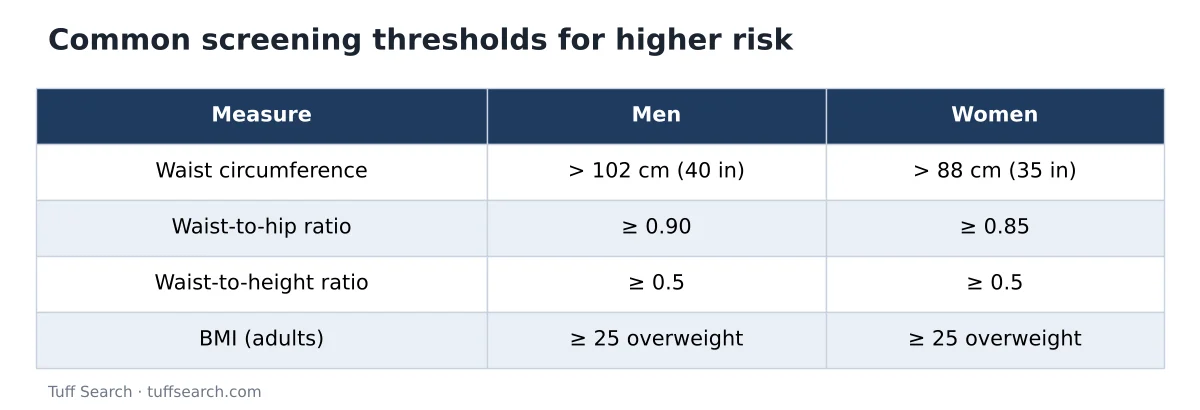
A larger waist suggests more fat around the organs. The NHLBI uses these thresholds for higher risk in adults:
- Men: more than 40 inches (102 cm)
- Women (not pregnant): more than 35 inches (88 cm)
It is the simplest alternative – one measurement with a tape. Learn the correct technique in how to measure your waist and hips.
Try it with your numbersBody Shape CalculatorEnter shoulder, bust, waist and hip measurements to see your body shape (hourglass, pear, apple, rectangle or inverted…Open calculator2. Waist-to-hip ratio
Waist-to-hip ratio = Waist ÷ Hips
A World Health Organization expert report uses a ratio of 0.90 or more for men and 0.85 or more for women as a sign of substantially increased risk. Example: a waist of 86 cm and hips of 100 cm give 0.86.
3. Waist-to-height ratio
Waist-to-height ratio = Waist ÷ Height (same units)
A popular rule is to keep your waist to less than half your height – a ratio below 0.5. It works for both sexes and many adult groups, and it needs no special tables. Someone 175 cm tall should aim for a waist under 87.5 cm.
4. Body fat percentage
Body fat percentage separates fat from lean mass directly. Methods range from accurate clinical scans (such as DEXA) to home bioimpedance scales and skinfold callipers, which are convenient but less precise. The U.S. Navy estimates body fat from neck, waist and (for women) hip measurements – one reason military fitness tests include a body composition check. See the Navy PRT calculator for how the Navy fitness test works.
Worked example
| Measure | Value | Result |
|---|---|---|
| Height / weight | 175 cm, 80 kg | BMI 26.1 – overweight range |
| Waist | 86 cm | Below the 102 cm threshold for men |
| Waist-to-hip | 86 ÷ 100 | 0.86 – below 0.90 |
| Waist-to-height | 86 ÷ 175 | 0.49 – below 0.5 |
For this muscular man, BMI alone suggests a problem, but his waist-based measures look healthy. The opposite can happen too: a “normal” BMI with a large waist can still carry extra risk.
Which measure should you use?
- For a quick check at home: waist circumference or waist-to-height ratio.
- To understand your shape: the body shape calculator uses bust, waist and hip measurements.
- For detailed tracking: body fat percentage measured the same way each time.
- For medical decisions: your doctor, who will combine these with blood pressure, blood tests and history.
Important
Important: This article is general educational information, not medical or nutrition advice. Talk to a doctor or registered dietitian before changing your diet, especially if you are pregnant, under 18, or have a medical condition.
Frequently asked questions
Waist circumference, waist-to-height ratio and waist-to-hip ratio add information about where fat is stored, which BMI cannot show. Body fat percentage separates fat from muscle.
Below 0.5 – a waist less than half your height – is a widely used guide for adults.
Below 0.90 for men and below 0.85 for women, based on a World Health Organization expert report.
Not always. Because BMI cannot tell muscle from fat, muscular people can have a high BMI with little body fat.
Related calculators
Related articles
- How to Measure Your Waist and Hips Correctly
- How to Calculate Your Target Weight From BMI (Formula)
- TDEE vs BMR: What’s the Difference and Which to Use?