
Body Fat Calculator
Last updated
Show steps
Enter your height and a few tape measurements and this body fat calculator estimates your body fat percentage using the U.S. Navy circumference method. Add your weight to see how many pounds or kilograms are fat and how much is lean mass.
How to measure for the most accurate result
- Use a flexible, non-stretch tape. Measure on bare skin, standing relaxed, in the morning before eating.
- Neck: just below the larynx (Adam's apple), with the tape sloping slightly down at the front.
- Waist – men: horizontally at the level of the navel, at the end of a normal breath out. Do not suck in.
- Waist – women: at the narrowest point of the abdomen (usually just above the navel).
- Hips – women: at the widest part of the buttocks, with feet together.
- Take each measurement two or three times and use the average, rounding to the nearest 0.5 cm or ¼ inch.
Small errors matter: a 1 inch change in waist measurement can move the result by around 1–2 percentage points, so consistency is more important than precision when you track progress.
Body fat percentage chart for men and women
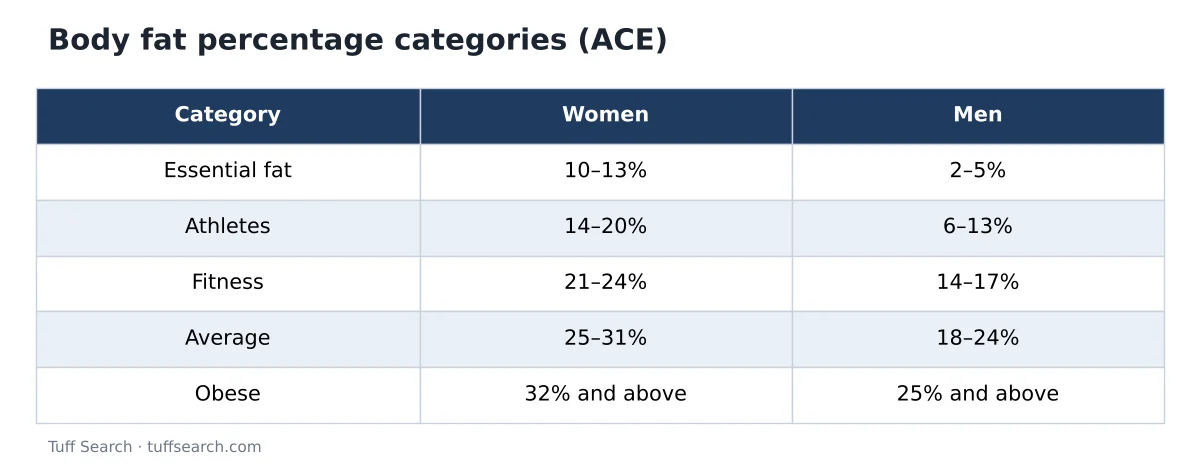
Women naturally carry more essential fat than men because of reproductive and hormonal needs, so the ranges differ. Essential fat is the minimum needed for normal body function; going below it is unhealthy. Body fat also tends to rise with age, and some charts give age-adjusted ranges.
Using body fat to guide your goals
- To lose fat while keeping muscle, combine a moderate calorie deficit with enough protein and strength training.
- Track body fat and waist size every 2–4 weeks; the scale alone can hide fat loss when muscle increases.
- Fat mass ÷ weight is more useful than weight alone for athletes, who may have a high BMI but low body fat.
Body fat estimates are for general information only and are not a medical assessment. Speak to a doctor or registered dietitian before making big changes to diet or exercise, especially if you have a health condition or a history of disordered eating.
Body fat vs BMI
BMI uses only height and weight, so it cannot tell muscle from fat. Body fat percentage looks at composition. Two people who are both 178 cm and 90 kg have a BMI of 28.4, but one with a 81 cm waist and a 40 cm neck might be a lean, muscular athlete, while one with a 104 cm waist is likely carrying much more fat. Using both measures – plus waist-to-height ratio – gives a clearer picture than any single number.
Why the result can change from day to day
- Bloating after meals and water retention change the waist measurement.
- Tape position: a centimetre higher or lower at the waist changes the reading.
- Posture: standing tall vs relaxed changes the neck and waist.
- Time of day: measure first thing in the morning for consistency.
- Look at the trend across several weeks rather than any single reading.
Health risks of very high or very low body fat
High body fat, especially around the abdomen (visceral fat), is linked with higher risk of type 2 diabetes, heart disease and some cancers. Very low body fat is also a concern: in women, falling well below the essential-fat range can disrupt periods and bone health, and in anyone it can affect hormones, immunity and energy. Athletes who aim for very low body fat for competitions should do so with professional support.
Sources
- Hodgdon JA, Beckett MB (1984), Naval Health Research Center – Prediction of percent body fat for U.S. Navy women from body circumferences and height (companion report covers men) – DTIC — apps.dtic.mil/sti/tr/pdf/ADA146456.pdf
- American Council on Exercise – Percent body fat calculator and categories — acefitness.org/education-and-resources/lifestyle/tools-calculators/percent-body-fat-calculator
- CDC – About Body Mass Index — cdc.gov/bmi/about/index.html
Results are estimates for general information. Last reviewed: .

Written & built by
Zeeshan Nawaz
Calculator Developer · Tuff Search
Builds and tests Tuff Search calculators, turning published formulas and official sources into tools anyone can check.
FAQ
Frequently asked questions
Quick answers about the Body Fat Calculator.
Measure your height, neck and waist (and hips for women) with a tape and enter them in the Navy method equations, or use the calculator above.
For general fitness, roughly 21–31% for women and 14–24% for men falls in the ACE 'fitness' and 'average' bands. Ranges vary with age.
It is a good estimate for most people and useful for tracking change, but individual results can differ from DEXA by several percentage points.
Women need more essential fat for reproductive and hormonal health, so their healthy ranges are higher.
Everything that is not fat – muscle, bone, organs and water. It equals body weight minus fat mass.
Every two to four weeks, at the same time of day and in the same conditions.
Still have a question? Email support@tuffsearch.com
Keep exploring
Related calculators
More calculators people use alongside this one.
- BMI CalculatorCalculate your body mass index in kg or lb, see your BMI
- Body Shape CalculatorEnter shoulder, bust, waist and hip measurements to see
- Navy PRT CalculatorEstimate your Navy PRT points for push-ups, plank and
- Protein CalculatorCalculate how much protein you need a day in grams from
- TDEE CalculatorEstimate your total daily energy expenditure with the
Zeeshan Nawaz
Calculator Developer · Tuff Search
Builds and tests Tuff Search calculators. Each tool is based on published formulas and official sources, and is checked against worked test cases before it goes live.
- Body Fat CalculatorHealthYou are here
- Dog Age CalculatorBiology
- Fuel Cost CalculatorDaily Life