
Dog Age Calculator
Last updated
Show steps
Enter your dog's age and size and this dog age calculator converts it into human years using the size-based rule vets commonly use, and also shows the newer DNA-based estimate for comparison.
How to calculate dog years
Dogs mature very quickly: a one-year-old dog is physically and sexually mature, much like a teenager, so the first year counts for about 15 human years. Growth slows in the second year, which adds roughly 9 more. After that, dogs age at a steadier pace that depends on size – small dogs age more slowly and tend to live longer than large and giant breeds. The American Kennel Club summarises this guideline from the American Veterinary Medical Association (AVMA).
- Up to 1 year: multiply the age by 15 (6 months ≈ 7.5 human years).
- From 1 to 2 years: add 9 human years for the second year (2 years = 24).
- After 2 years: add about 4 per year for small dogs, 5 for medium, 6 for large and 7 for giant breeds.
Example: a 7-year-old Border Collie (medium) is 24 + 5 × 5 = 49 in human years. A 10-year-old Chihuahua (small) is 24 + 4 × 8 = 56, while a 10-year-old Labrador (large) is 24 + 6 × 8 = 72.
Dog age chart
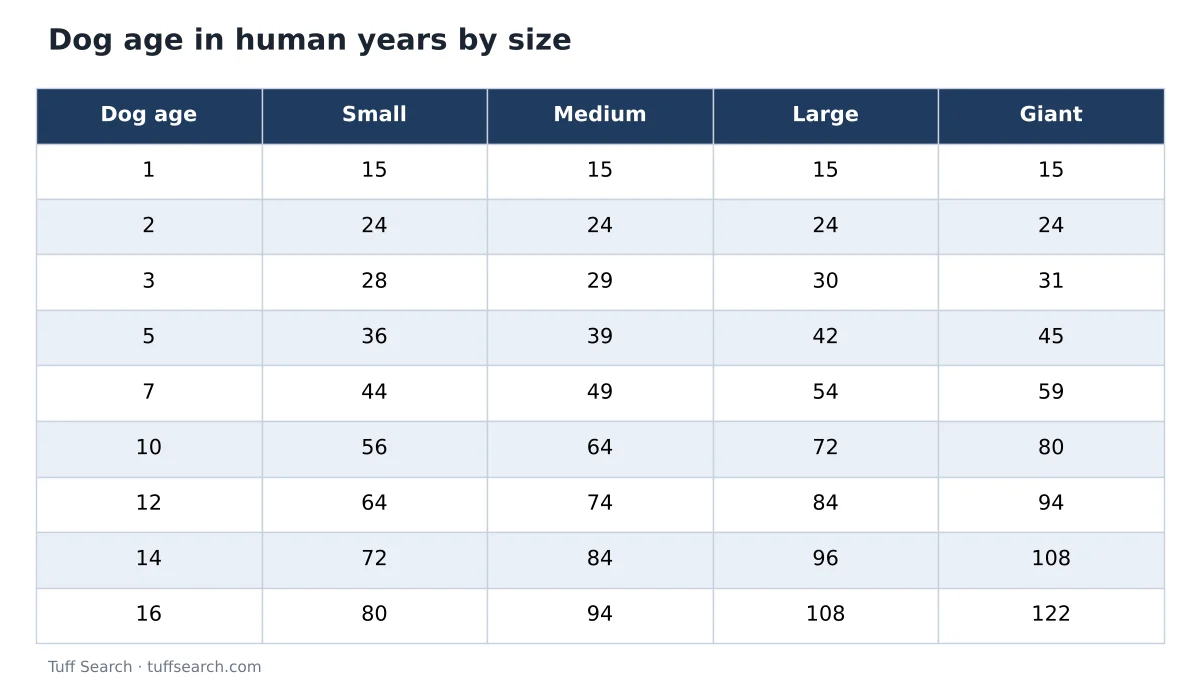
Giant breeds such as Great Danes and Mastiffs often grow more slowly at first but age faster later, so published charts differ in the early years. Treat every chart as an approximation.
The DNA-based dog age formula
In 2020, researchers at the University of California San Diego compared age-related chemical changes in DNA (methylation) in 104 Labrador Retrievers and in humans. They proposed: human age = 16 × ln(dog age) + 31. By this formula a 1-year-old dog matches a 31-year-old human, a 2-year-old about 42 and a 7-year-old about 62. It shows that young dogs age much faster than the old rule suggests and older dogs more slowly. The study only looked at one breed, so it may not suit small or giant dogs – which is why the calculator shows it as a second estimate.
Why '1 dog year = 7 human years' is wrong
The 7-year rule probably came from comparing average lifespans (about 10–12 years for dogs and 70–80 for humans). It badly underestimates young dogs – a 1-year-old dog can breed, while a 7-year-old child cannot – and ignores size, which has a big effect on how fast dogs age.
Dog life stages
| Life stage | Small breeds | Large / giant breeds | Focus |
|---|---|---|---|
| Puppy | Birth to about 9–12 months | Birth to 12–24 months | Vaccines, training, growth diet |
| Young adult | 1–3 years | 1–3 years | Exercise, weight, dental care |
| Mature adult | 4–7 years | 3–5 years | Weight control, yearly check-ups |
| Senior | From about 7–10 years | From about 5–6 years | Twice-yearly vet visits, joints, blood tests |
Large and giant breeds are often considered seniors from about 5–6 years, small dogs from about 7 or later. Your vet may recommend more frequent check-ups and screening tests for senior dogs to catch problems such as arthritis, dental disease, kidney disease and cognitive decline early.
How to estimate the age of a rescue dog
- Teeth: puppies have all adult teeth by about 6–7 months; yellowing and tartar build up with age, but dental care varies a lot.
- Eyes: a bluish haze in the lens (lenticular sclerosis) is common from middle age.
- Coat: greying around the muzzle often starts in middle age, though some dogs grey early.
- Body: muscle tone, joint stiffness and activity level give further clues.
- A vet can combine these signs for the best estimate.
Why do small dogs live longer than big dogs?
Across most mammal species, bigger animals live longer – but within dogs the opposite is true. Large and giant breeds grow very fast in their first year and appear to age faster afterwards, with earlier onset of age-related diseases. Researchers are still studying why; growth hormones and the energy cost of rapid growth are among the leading ideas. In practice, it means a Great Dane is 'old' at an age when a Jack Russell Terrier is still middle-aged.
Caring for your dog at each stage
| Stage | Health checks | Everyday care |
|---|---|---|
| Puppy | Vaccination course, parasite control, neutering discussion | Socialisation, training, puppy food |
| Adult | Yearly check-up, dental checks, vaccines as advised | Healthy weight, daily exercise, teeth cleaning |
| Senior | Check-ups every 6 months, blood and urine tests, joint checks | Softer bedding, shorter but regular walks, diet for age |
Ask your vet which tests and schedule suit your dog's breed and health.
Sources
- American Kennel Club – How to calculate dog years to human years — akc.org/expert-advice/health/how-to-calculate-dog-years-to-human-years
- UC San Diego via ScienceDaily (2020) – summary of Wang et al., Cell Systems: dog-to-human aging by DNA methylation — sciencedaily.com/releases/2020/07/200702113649.htm
- American Kennel Club – When do dogs stop growing? — akc.org/expert-advice/health/when-does-my-puppy-finish-growing
Results are estimates for general information. Last reviewed: .

Written & built by
Zeeshan Nawaz
Calculator Developer · Tuff Search
Builds and tests Tuff Search calculators, turning published formulas and official sources into tools anyone can check.
FAQ
Frequently asked questions
Quick answers about the Dog Age Calculator.
Use 15 for the first year, 24 at two, then add about 4–7 years for each extra year depending on size.
About 56 for a small dog, 64 for medium, 72 for large and 80 for a giant breed.
Yes. After the first couple of years, small dogs age more slowly and usually live longer than large breeds.
No. That rule is a rough lifespan comparison and is especially wrong for young dogs.
Roughly 7 or older for small dogs and 5–6 for large and giant breeds.
Many small breeds live 12–16 years, while giant breeds often live 7–10 years. Breed, genetics and care all matter.
Still have a question? Email support@tuffsearch.com
Keep exploring
Related calculators
More calculators people use alongside this one.
- Cat Age CalculatorConvert cat years to human years with a vet-based age
- Dog Size CalculatorEstimate your puppy's adult weight from its age and
- Dog Pregnancy CalculatorFind your dog’s due date from the mating date (63 days,
- Dog Heat Cycle CalculatorEstimate your dog's next heat from her last season and
Zeeshan Nawaz
Calculator Developer · Tuff Search
Builds and tests Tuff Search calculators. Each tool is based on published formulas and official sources, and is checked against worked test cases before it goes live.
- Dog Age CalculatorBiologyYou are here
- Fuel Cost CalculatorDaily Life
- Customer Acquisition Cost (CAC) CalculatorMarketing