
Most people lose weight quickly in the first weeks of a diet, then progress slows or stops even though they are doing the same things. This is normal and has clear reasons. Understanding them makes it easier to adjust without cutting calories to unsafe levels.
1. The first drop is partly water
Eating fewer calories, especially fewer carbohydrates, reduces the body’s stored glycogen, which is held with water. That gives a fast early drop on the scale that is not all fat. After this, the rate of loss naturally looks slower.
2. A smaller body needs fewer calories
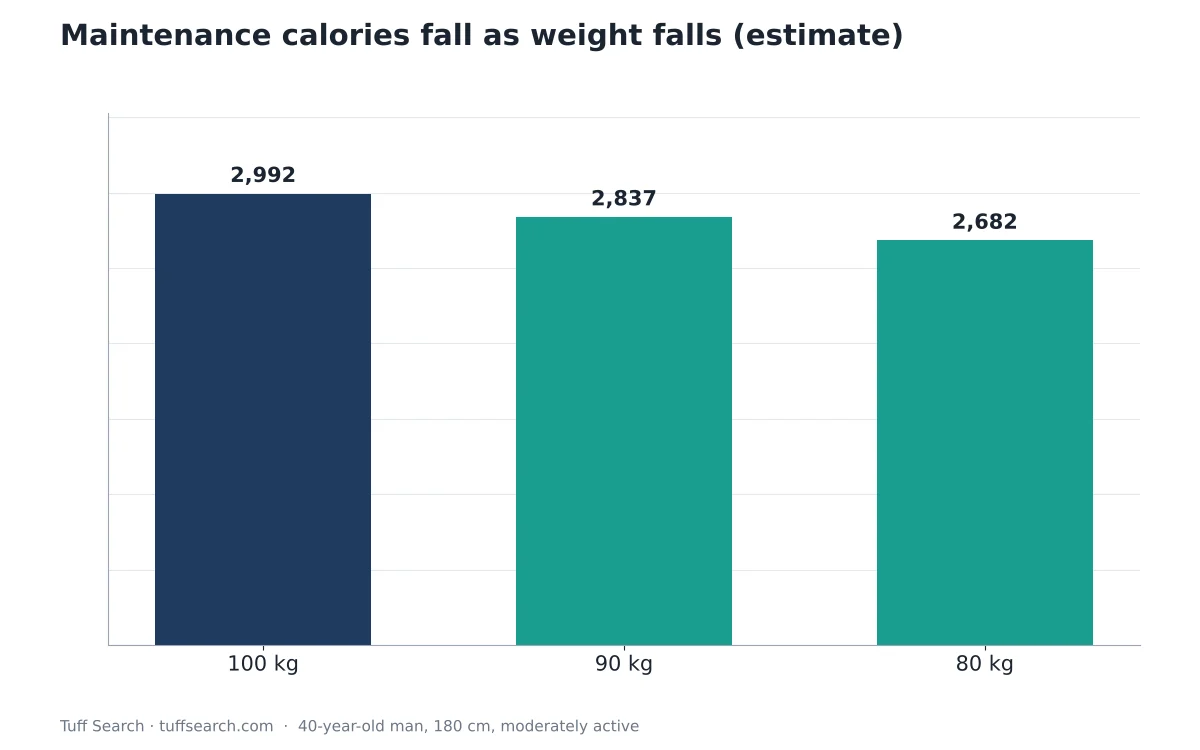
Your maintenance calories (TDEE) depend largely on your weight. In the example above, losing 20 kg lowers estimated maintenance by about 310 kcal a day. If you keep eating the same amount, your daily deficit shrinks by that much – so a 500 kcal deficit at the start becomes nearer 190 kcal. Recalculate your TDEE every 4–5 kg (about 10 lb) with the TDEE calculator.
Try it with your numbersCalorie Deficit CalculatorFind how many calories to eat to lose weight: your TDEE, a safe daily deficit and a realistic timeline to your goal weight, with safety limits.Open calculator3. Metabolic adaptation
Beyond the simple effect of weighing less, the body may reduce energy use a little further during prolonged dieting – through lower spontaneous movement (fidgeting, walking around), small hormonal changes and more efficient muscles. Research led by Kevin Hall at the US National Institutes of Health built this into a dynamic model showing that weight loss slows over time, which is why the old ‘3,500 calories = 1 lb’ rule over-predicts long-term loss. The NIDDK Body Weight Planner uses a similar approach.
4. Tracking drift
Portions tend to creep up and snacks get forgotten as a diet goes on. Studies regularly find people underestimate how much they eat. A week of careful weighing and logging often reveals the gap.
5. Water and hormones hide fat loss
Salt, hard training, stress, poor sleep and the menstrual cycle can all make the body hold extra water for days, masking real fat loss. Compare weekly averages, not single days, and track your waist as well.
What to do when weight loss stalls
- Wait 2–3 weeks before changing anything – short stalls are usually water.
- Recalculate maintenance calories at your current weight.
- Check tracking accuracy for a week (weigh food, count drinks and cooking oils).
- Add daily movement – walking is easy to increase; the walking calorie calculator estimates what it burns.
- Keep protein high and do resistance training to protect muscle; see how much protein you need.
- Prioritise sleep and stress management, which affect appetite.
- Consider a planned maintenance break of a week or two if dieting has been long and hard.
What not to do
Avoid slashing calories further when you are already eating little – very low intakes make it hard to get enough nutrients, increase muscle loss and are difficult to sustain. Our guide to calorie deficits explains safe ranges, and TDEE vs BMR explains the numbers behind your target.
Important
Important: This article is general educational information, not medical or nutrition advice. Talk to a doctor or registered dietitian before changing your diet, especially if you are pregnant, under 18, or have a medical condition.
Frequently asked questions
Usually because your maintenance calories have fallen as you lost weight, tracking has drifted, or water retention is hiding fat loss.
Short stalls of 1–3 weeks are common and often water-related. Longer plateaus usually need a recalculated target or more activity.
Yes, mostly because a smaller body uses less energy; there can also be a modest extra adaptation.
Not automatically. Recalculate first and consider increasing activity; avoid very low calorie intakes without medical supervision.
It helps preserve muscle, which supports maintenance calories and body shape while losing weight.
Related calculators
Related articles
- How Much Protein Do You Need Per Day? How to Work It Out
- Calorie Deficit Explained: How to Set a Safe and Realistic Target
- TDEE vs BMR: What’s the Difference and Which Number Should You Use?