Inflation is the general rise in prices over time. It means the same amount of money buys less in the future than it does today. Cash that earns little or no interest quietly loses value, which is why understanding inflation matters for every saver.
How much buying power does inflation take?
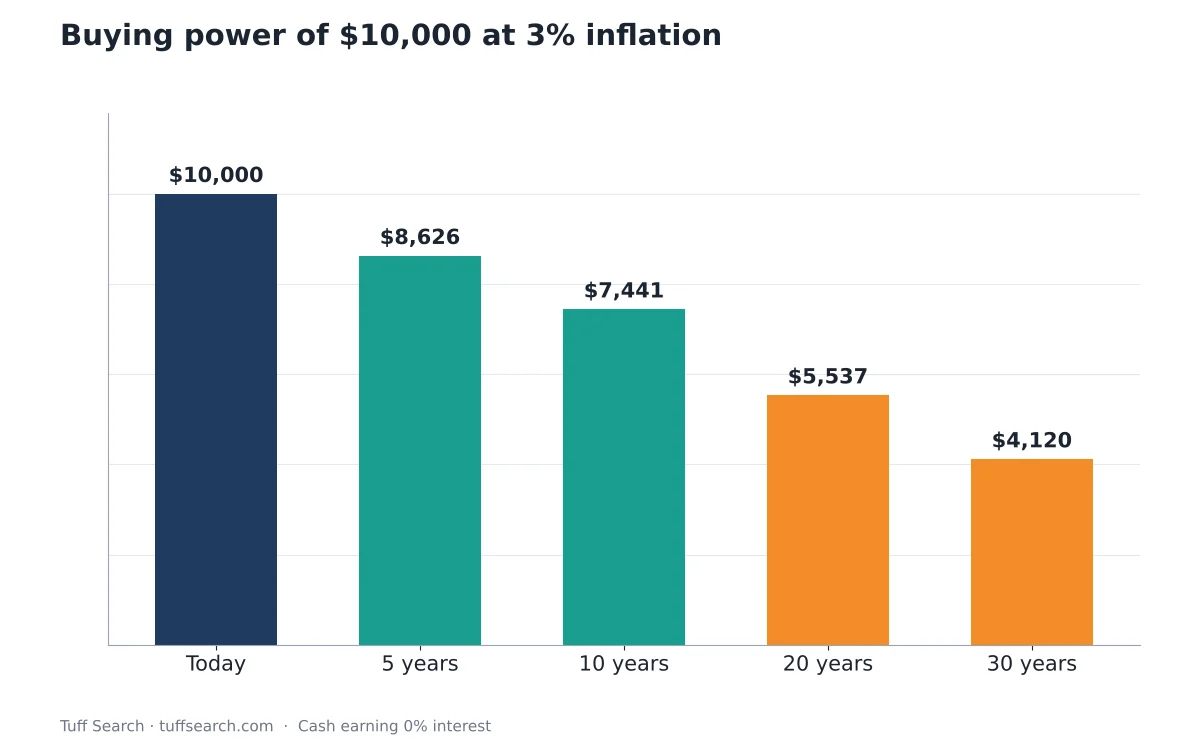
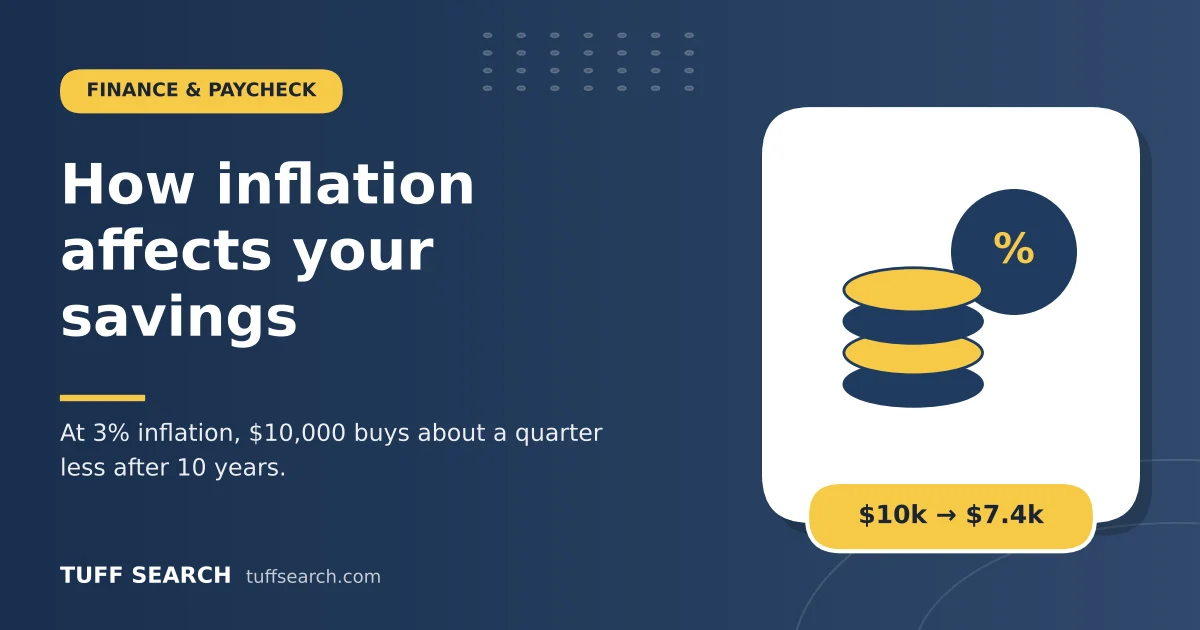
The calculation is: future buying power = amount ÷ (1 + inflation rate)^years. At 3% a year, $10,000 has the buying power of about $7,441 of today’s money after 10 years. At 2% it would be about $8,203; at 5%, about $6,139. A quick shortcut is the Rule of 72: divide 72 by the inflation rate to estimate how many years it takes for prices to double – about 24 years at 3%.
Nominal vs real returns
The interest rate your bank shows is the nominal rate. What matters for buying power is the real rate – the return after inflation:
Real return = (1 + nominal rate) ÷ (1 + inflation rate) − 1
A savings account paying 4% when inflation is 3% gives a real return of (1.04 ÷ 1.03) − 1 ≈ 0.97%. If the account paid 1% while inflation was 3%, the real return would be about −1.9% – the balance grows, but it buys less each year.
Try it with your numbersCompound Interest CalculatorSee how money grows with compound interest. Add monthly contributions, pick daily to annual compounding and view yearly balances and real value.Open calculatorWhere inflation figures come from
In the US, the most widely quoted measure is the Consumer Price Index (CPI) from the Bureau of Labor Statistics, which tracks the prices of a basket of goods and services. Your personal inflation rate may differ – rent, childcare or fuel may rise faster or slower than the average depending on where you live and what you buy. Check the latest CPI release for current figures rather than relying on old numbers.
How to protect your savings
- Keep your emergency fund in an account with a competitive APY. It needs to be safe and accessible, but it should not sit at near-zero interest. Our guide to how much to keep in an emergency fund helps you size it.
- Compare APYs regularly – see APR vs APY for how to compare rates fairly.
- Invest long-term money that you will not need for years in a diversified way suited to your goals and risk tolerance; over long periods, investments such as stocks have historically tended to outpace inflation, though with ups and downs and no guarantee.
- Use tax-advantaged retirement accounts such as a 401(k) or IRA so more of your return compounds; the 401(k) calculator shows how contributions grow.
- Keep deposits within insurance limits – FDIC insurance protects bank deposits up to the coverage limits.
Inflation and other prices
Inflation also affects the value of things you own. A home that rises 3% a year in value during 3% inflation has not grown in real terms. The appreciation calculator works out the annual growth rate of an asset so you can compare it with inflation.
A worked long-term example
Suppose you save $10,000 for 20 years. In a 0% account at 3% inflation, it buys about $5,537 of today’s goods. In an account earning 4.5% with 3% inflation, the real return is about 1.46% a year, so after 20 years its buying power is roughly $13,350 in today’s money. The difference is the real return compounding over time.
Important
Important: This article explains how the calculations work using 2026 federal figures. It is not tax, legal or financial advice. Your actual withholding depends on your W-4, your employer’s payroll system and your state, so check your pay stub and official IRS guidance.
Frequently asked questions
If the account’s interest rate is lower than inflation, your balance buys less each year even though the number grows.
Your return after inflation: (1 + nominal rate) ÷ (1 + inflation rate) − 1.
At 3% inflation, about $7,441 in today’s buying power if it earns no interest.
Keep emergency savings safe and accessible; long-term money may need investments with higher expected returns. This depends on your goals and risk tolerance.
Most often the Consumer Price Index (CPI), published monthly by the Bureau of Labor Statistics.
Related calculators
Related articles
- The Rule of 72: How to Estimate When Your Money Will Double
- How Much Should Be in Your Emergency Fund? A Simple Way to Work It Out
- How to Calculate Take-Home Pay From Your Gross Salary (2026 Guide)