

A salary of $55,000 sounds more than $25 an hour – but is it? The answer depends on the hours you actually work, whether you are paid overtime, and the value of benefits. This guide compares the two pay types and shows how to compare offers fairly.
How salaried pay works
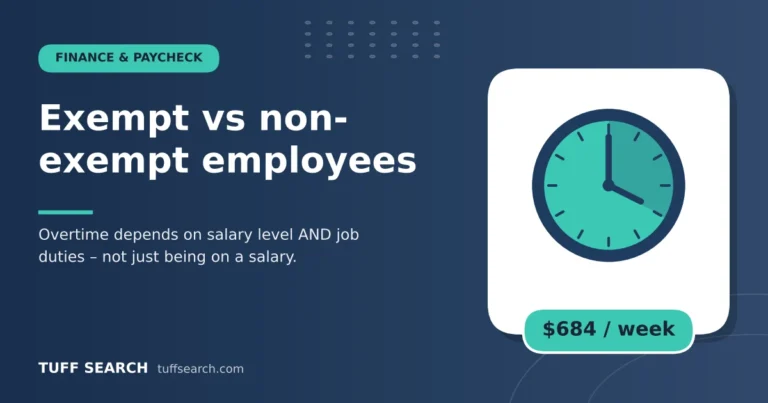
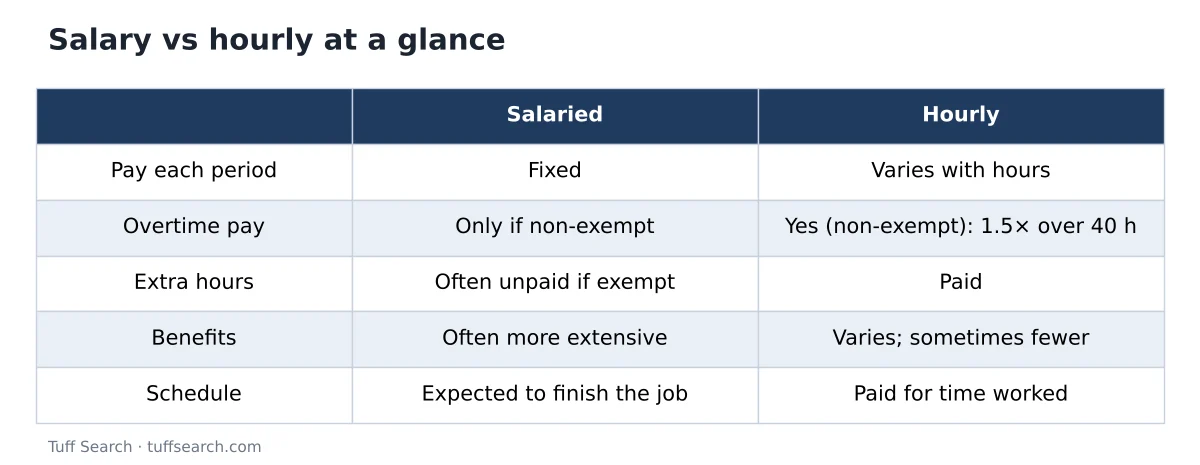
Salaried employees receive the same gross pay each period whatever hours they work. Many salaried roles are ‘exempt’ from overtime under the Fair Labor Standards Act, so extra hours are not paid. But salary alone does not decide this – some salaried workers are non-exempt and must receive overtime.
How hourly pay works
Hourly workers are paid for every hour they work, and non-exempt hourly employees must receive at least 1.5 times their regular rate for hours over 40 in a workweek. Income can rise with overtime or fall if hours are cut. See how overtime pay is calculated for the details.
Try it with your numbersHourly to Salary CalculatorConvert hourly pay to annual, monthly, biweekly and weekly salary, or a salary back to an hourly rate. Adjust hours, unpaid leave and overtime.Open calculatorPros and cons
| Pros | Cons | |
|---|---|---|
| Salary | Predictable income; often better benefits and paid leave; paid during short slow periods | Long weeks can lower your effective hourly rate; overtime often unpaid if exempt |
| Hourly | Paid for every hour; overtime pay; clearer boundary between work and personal time | Income can vary; hours may be cut; benefits sometimes limited |
Compare offers by the effective hourly rate
Divide the annual salary by the hours you will really work. A $55,000 salary for 45 hours a week all year is 55,000 ÷ (45 × 52) = about $23.50 an hour. A $25-an-hour job at 40 hours a week pays $52,000; if it also has 5 hours of overtime a week at time and a half, it pays $52,000 + (5 × $37.50 × 52) = $61,750 for the same 45-hour week. Use hourly to salary for the conversion formulas.
Don’t forget benefits
- Health insurance: employer contributions can be worth thousands of dollars a year.
- Retirement: a 401(k) match is extra pay – see 401(k) contribution limits and the 401(k) calculator.
- Paid time off and holidays: paid leave raises your effective hourly rate.
- Bonuses, commissions and shift differentials.
- Commuting time and cost, and the flexibility of the schedule.
Take-home pay
Both pay types are taxed the same way – income tax, Social Security and Medicare apply to wages whether hourly or salaried. To see the take-home pay for a specific offer in your state, use our paycheck calculators and read how to calculate take-home pay.
Which is better?
Neither is better for everyone. Salary suits people who value stable income and benefits and whose hours are predictable. Hourly pay suits people who want to be paid for every hour, earn overtime or work variable schedules. Compare offers on effective hourly pay, benefits and the hours you will realistically work.
Important
Important: This article explains how the calculations work using 2026 federal figures. It is not tax, legal or financial advice. Your actual withholding depends on your W-4, your employer’s payroll system and your state, so check your pay stub and official IRS guidance.
Frequently asked questions
Not automatically. Compare the effective hourly rate, overtime eligibility and benefits for each offer.
Only if they are non-exempt. Exempt status depends on salary level and job duties.
Divide the annual salary by the hours you work in a year – 2,080 for 40 hours a week.
$25 an hour at 40 hours a week is $52,000, so it is slightly more before considering overtime and benefits.
No. Wages are taxed the same way regardless of pay type.
Related calculators
Related articles
- How Overtime Pay Is Calculated: Time and a Half Explained
- Hourly to Salary: How to Convert an Hourly Wage Into Annual Pay
- 401(k) Contribution Limits for 2026: Catch-Up Rules Explained