
Pythagorean Theorem Calculator
Last updated
Show steps
Enter any two sides of a right triangle and this Pythagorean theorem calculator finds the third side using a² + b² = c², with the working, both acute angles, the area and the perimeter.
Use the calculator above for your own numbers. Below, we explain how the Pythagorean Theorem Calculator works, with worked examples and sources.
How the Pythagorean theorem works
In any right triangle, the area of the square on the hypotenuse equals the sum of the areas of the squares on the other two sides: a² + b² = c². It only works for right triangles (one angle exactly 90°).
- Identify the hypotenuse – the longest side, opposite the right angle.
- Square the two known sides.
- Add them to find c², or subtract to find a missing leg.
- Take the square root.
Finding a missing leg
Rearrange the formula: a = √(c² − b²). With c = 13 and b = 5: 13² − 5² = 169 − 25 = 144, and √144 = 12.
Pythagorean triples
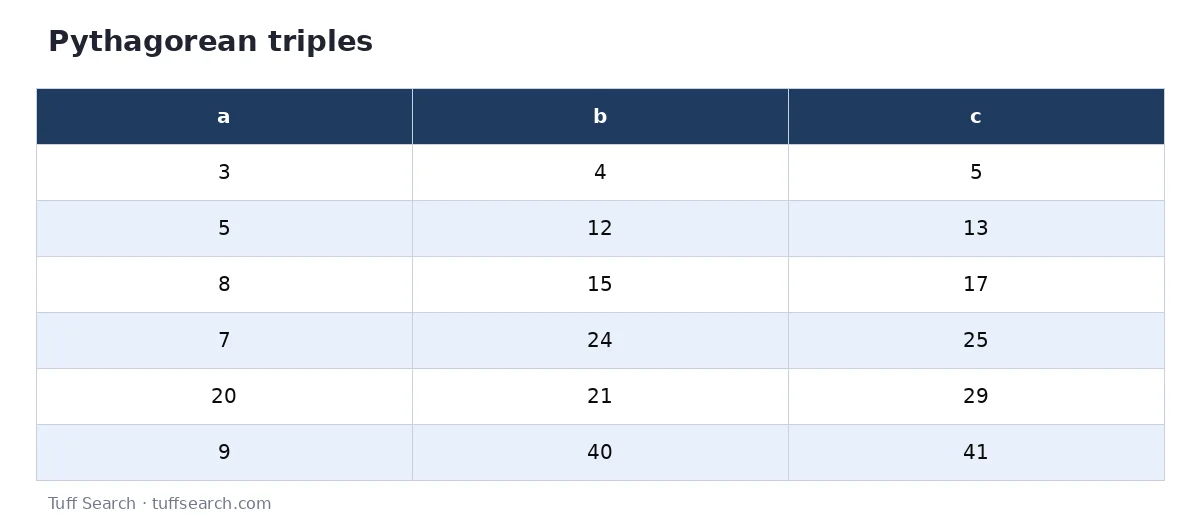
Some whole-number sets fit the theorem exactly. Multiplying a triple by any number gives another (6-8-10 is 3-4-5 doubled).
| a | b | c |
|---|---|---|
| 3 | 4 | 5 |
| 5 | 12 | 13 |
| 8 | 15 | 17 |
| 7 | 24 | 25 |
| 20 | 21 | 29 |
| 9 | 40 | 41 |
Everyday uses
- TV size: a 55-inch 16:9 screen measures 55 in on the diagonal. Scaling the 16:9 triangle (diagonal √(16² + 9²) ≈ 18.358) gives a width of about 47.9 in and a height of about 27 in.
- Ladders: a 12 ft ladder with its foot 3 ft from the wall reaches √(144 − 9) ≈ 11.62 ft up the wall.
- Squaring a room: for a 12 ft × 15 ft room, the corner-to-corner diagonal should be √(144 + 225) ≈ 19.21 ft. If the two diagonals match, the corners are square.
- Builders use the 3-4-5 rule: mark 3 ft along one wall and 4 ft along the other; if the marks are 5 ft apart, the corner is 90°.
Common mistakes
- Using the theorem on a triangle that has no right angle.
- Treating a leg as the hypotenuse – c is always the longest side.
- Adding the sides before squaring: (a + b)² is not a² + b².
- Forgetting the final square root.
Sources
- Khan Academy – Geometry — khanacademy.org/math/geometry
- OpenStax – Algebra and Trigonometry 2e (Rice University) — openstax.org/details/books/algebra-and-trigonometry-2e
Questions or feedback about this calculator? Contact us – we read every message. Results are estimates for information only. Last reviewed: .

Written & built by
Zeeshan Nawaz
Calculator Developer · Tuff Search
Builds and tests Tuff Search calculators, turning published formulas and official sources into tools anyone can check.
FAQ
Frequently asked questions
Quick answers about the Pythagorean Theorem Calculator.
The side opposite the right angle, and always the longest side of a right triangle.
No. Only right triangles. For other triangles use the law of cosines.
Subtract the square of the known leg from the square of the hypotenuse, then take the square root.
Three whole numbers that satisfy a² + b² = c², such as 3, 4, 5.
Yes. Most right triangles have an irrational side, shown here as a square root and a rounded decimal.
Still have a question? Email support@tuffsearch.com
Keep exploring
Related calculators
More calculators people use alongside this one.
Zeeshan Nawaz
Calculator Developer · Tuff Search
Builds and tests Tuff Search calculators. Each tool is based on published formulas and official sources, and is checked against worked test cases before it goes live.
- Pythagorean Theorem CalculatorMath CalculatorsYou are here
- Dog Age CalculatorBiology
- Fuel Cost CalculatorDaily Life