
Your pay stub shows how your gross pay becomes your net pay. Checking it each time you are paid is the easiest way to catch mistakes, such as a wrong tax setting or a deduction you did not sign up for.
The main sections
| Section | What it shows |
|---|---|
| Employee and employer details | Names, address, employee ID and sometimes the last digits of your Social Security number |
| Pay period and pay date | The dates worked and the date you were paid |
| Earnings | Hours, rate, regular pay, overtime, bonuses and gross pay |
| Taxes | Federal income tax, Social Security, Medicare, state and local taxes |
| Deductions | Pre-tax items (401(k), health insurance) and after-tax items (Roth 401(k), union dues) |
| Net pay | The amount deposited or paid to you |
| Year to date (YTD) | Running totals for the calendar year |
Common abbreviations
| Abbreviation | Meaning |
|---|---|
| FIT / FITW / Fed W/H | Federal income tax withheld |
| SS / OASDI / FICA-SS | Social Security (old-age, survivors and disability insurance) |
| MED / MEDI / FICA-MED | Medicare |
| SIT / SWT | State income tax |
| LIT / CITY | Local or city income tax |
| SDI | State disability insurance (in states that have it) |
| 401K / 401K-R | Traditional or Roth 401(k) contribution |
| YTD | Year to date |
Worked example: one biweekly paycheck
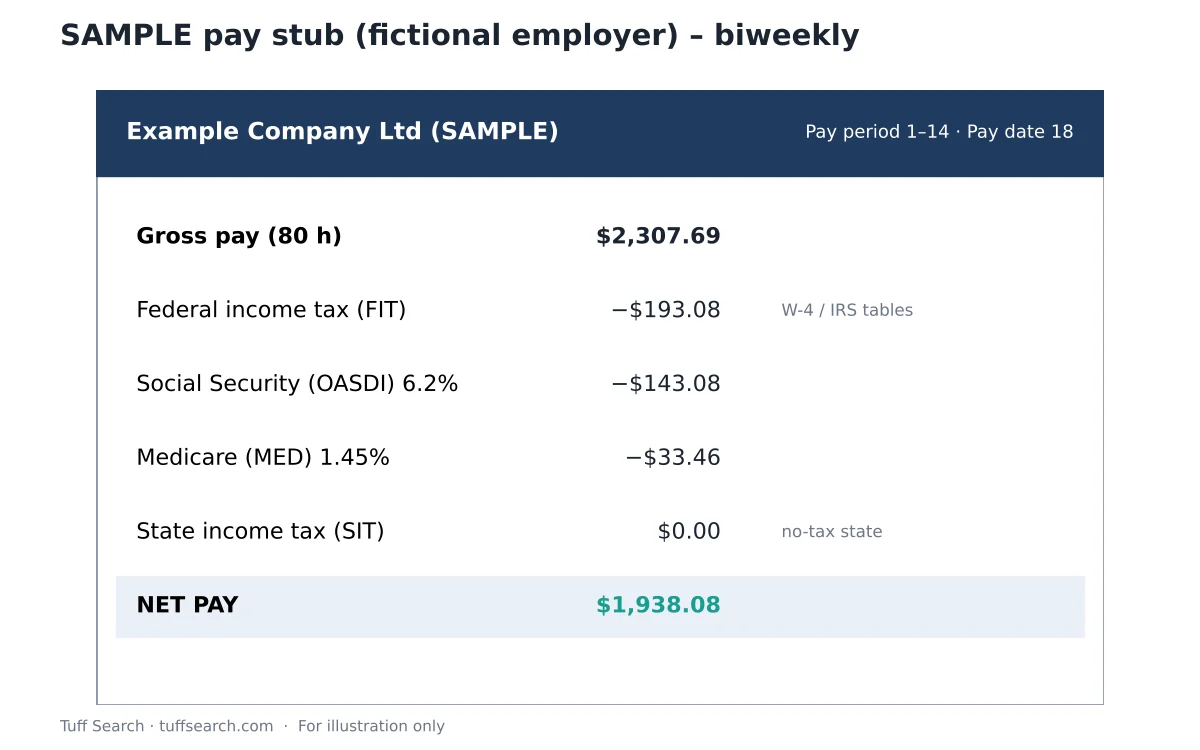
Single filer earning $60,000 a year, paid biweekly, in a state with no income tax and with no pre-tax deductions:
| Line | This period | Explanation |
|---|---|---|
| Gross pay | $2,307.69 | $60,000 ÷ 26 |
| Federal income tax | −$193.08 | Annual estimate $5,020 ÷ 26 (your employer uses IRS tables, so it may differ by a few cents) |
| Social Security | −$143.08 | 6.2% of gross |
| Medicare | −$33.46 | 1.45% of gross |
| Net pay | $1,938.08 | Gross minus taxes |
A five-point check every payday
- Hours and rate: are they right, including any overtime?
- Social Security and Medicare: are they 6.2% and 1.45% of the right wages (allowing for pre-tax health premiums)?
- Federal tax: does it look in line with what a paycheck calculator gives for your W-4 settings?
- Deductions: do you recognise every item and amount?
- YTD totals: do they add up from your previous stub?
Why federal tax might look wrong
Federal withholding depends on the answers on your Form W-4, such as filing status, dependents and extra withholding. If you start a second job, get married or have a child, update your W-4 so the right amount is withheld. Bonuses are often withheld at a flat 22%, which can make that stub look different.
What to do if something is wrong
Contact your payroll or HR team with the stub and the line you are querying. Keep copies of your stubs at least until you have checked them against your Form W-2 at the end of the year.
Overtime and bonus lines
Overtime usually appears as a separate earnings line at 1.5 times your regular rate, and bonuses may appear on their own stub with 22% federal withholding. See how overtime pay is calculated and how bonuses are taxed.
Check your numbers
Compare your stub with the result from the paycheck calculator for your state. To understand each line in more depth, read FICA tax in 2026 and 2026 federal income tax brackets.
Important
Important: This article explains how the calculations work using 2026 federal figures. It is not tax, legal or financial advice. Your actual withholding depends on your W-4, your employer’s payroll system and your state, so check your pay stub and official IRS guidance.
Frequently asked questions
Year to date: the total for that line from 1 January to the current pay date.
Old-Age, Survivors and Disability Insurance, which is Social Security tax: 6.2% of wages up to $184,500 in 2026.
Common reasons include different hours, a bonus, a new deduction, a W-4 change, or reaching the Social Security wage base.
At least until you have checked them against your W-2. Many people keep them longer for loans or disputes.
Related calculators
Related articles
- How Overtime Pay Is Calculated (Time and a Half)
- How Bonuses Are Taxed: The 22% Rate Explained (2026)
- FICA Tax 2026: Social Security and Medicare Explained