
A $5,000 bonus rarely arrives as $5,000. Employers treat bonuses as “supplemental wages” and use special withholding rules for them. The good news is that withholding is only an estimate: your bonus is not taxed at a special rate when you file your return. This guide explains what is taken out, why, and what happens at tax time.
Bonuses are supplemental wages
The IRS calls pay outside your regular wages – bonuses, commissions, severance, back pay and some overtime – supplemental wages. Your employer can withhold federal income tax on them in one of two ways, depending on how the payment is made.
Method 1: the 22% flat rate (percentage method)
If the bonus is paid separately from your regular wages, or clearly identified as a separate amount, the employer can simply withhold 22% for federal income tax. This is the method most people see. If your supplemental wages for the year go over $1 million, the part above $1 million must be withheld at 37%.
Method 2: the aggregate method
Here the employer adds the bonus to your regular paycheck and calculates withholding on the total, as if you earned that combined amount every pay period, then subtracts what would have been withheld on your normal pay. Because a single large paycheck is annualised as if it were your usual income, this method can withhold more than 22% for some people and less for others.
Social Security and Medicare still apply
Bonuses are subject to FICA taxes in the same way as regular pay:
- Social Security: 6.2%, until your total wages for the year reach the 2026 wage base of $184,500.
- Medicare: 1.45% on all wages, plus an extra 0.9% on wages above $200,000 in the year.
If your salary plus bonus goes past the Social Security wage base, no more Social Security tax is withheld for the rest of the year – which is why some high earners see their paychecks rise late in the year.
Try it with your numbersPaycheck CalculatorsEstimate 2026 take-home pay in any state.Open calculatorWorked example: a $5,000 bonus
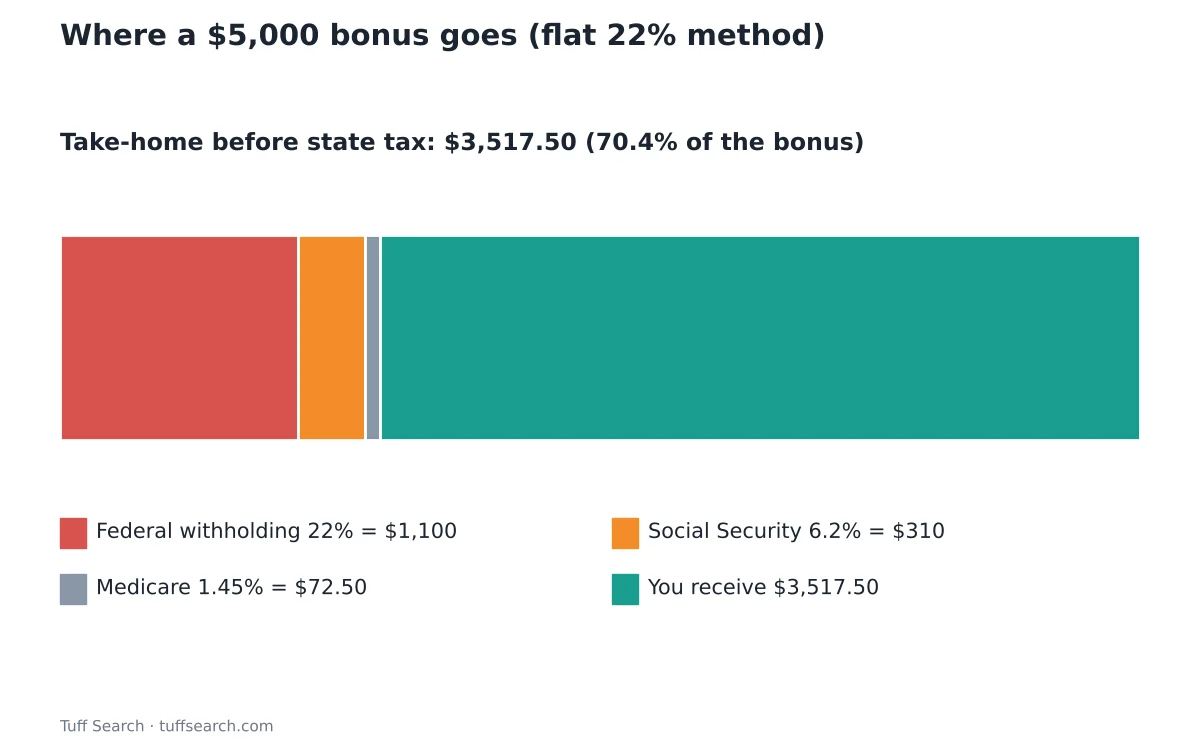
Using the flat 22% method, with no state income tax and wages below the Social Security cap:
| Item | Rate | Amount |
|---|---|---|
| Bonus | $5,000.00 | |
| Federal income tax withholding | 22% | −$1,100.00 |
| Social Security | 6.2% | −$310.00 |
| Medicare | 1.45% | −$72.50 |
| Take-home (before state tax) | $3,517.50 |
Most states that tax wages also tax bonuses, often with their own supplemental withholding rate or by adding the bonus to regular pay. A few states, such as Texas and Florida, have no state income tax on wages at all.
Withholding is not your final tax
When you file your return, your bonus is simply added to your other income and taxed through the normal brackets. The 22% withheld is a prepayment. If 22% is more than the tax your bonus actually causes, the difference comes back in your refund; if it is less, you owe the difference.
Example
a single filer with $50,000 of taxable income before the bonus is in the 12% bracket. The 2026 12% bracket runs to $50,400, so the first $400 of a $5,000 bonus is taxed at 12% and the remaining $4,600 at 22%. Actual federal tax on the bonus: $48 + $1,012 = $1,060. The employer withheld $1,100, so about $40 comes back. For someone whose income stays inside the 12% bracket, the over-withholding is larger – up to 10 cents on every bonus dollar.
| Your top federal bracket (2026) | Withheld on $5,000 | Approximate actual tax | Difference at filing |
|---|---|---|---|
| 10% | $1,100 | $500 | About $600 back |
| 12% | $1,100 | $600 | About $500 back |
| 22% | $1,100 | $1,100 | About even |
| 24% | $1,100 | $1,200 | About $100 owed |
| 32% | $1,100 | $1,600 | About $500 owed |
The table assumes the whole bonus falls in one bracket and ignores credits and other income; your own result depends on your full tax return.
Can you reduce the tax on a bonus?
- Put part of it into a traditional 401(k), if your plan allows contributions from bonuses. That lowers federal income tax now, but not Social Security or Medicare. The 2026 employee limit is $24,500 (plus catch-up contributions if you are 50 or older). Try the numbers in the 401(k) calculator.
- Check your W-4 if you regularly receive large bonuses and owe tax every April – you can ask for extra withholding on regular paychecks instead.
- Keep records: if too much is withheld, you get it back when you file; there is no need to change anything just to recover over-withholding.
Estimate your bonus paycheck
To see the effect on a specific pay period, enter the bonus as extra gross pay in the paycheck calculator for your state and compare the result with your pay stub. For the basics of how federal brackets work, read our guide to 2026 federal income tax brackets.
Frequently asked questions
22% is the flat federal withholding rate the IRS allows for supplemental wages up to $1 million a year. It is a withholding rate, not a special tax rate – your bonus is taxed at your normal rates when you file.
If the 22% withheld is more than the tax your bonus actually adds, you get the difference back as part of your refund. People in the 10% or 12% bracket usually do.
No. They are ordinary income. Withholding can be higher on the bonus check, but the final tax is calculated on your total income for the year.
Yes, 6.2% Social Security and 1.45% Medicare apply, unless your wages for the year have already passed the Social Security wage base ($184,500 in 2026).
Related calculators
Related articles
- 2026 Federal Income Tax Brackets Explained With Examples
- How to Calculate Take-Home Pay From Your Salary (2026)
- FICA Tax 2026: Social Security and Medicare Explained
Sources
- IRS – Publication 15 (Circular E), Employer’s Tax Guide
- IRS – Publication 15-T, Federal Income Tax Withholding Methods
- IRS – Social Security and Medicare withholding rates (Topic 751)
- Social Security Administration – Contribution and benefit base
- IRS – 401(k) and profit-sharing plan contribution limits