A calorie deficit simply means eating fewer calories than your body uses. It is the basic principle behind weight loss – but the size of the deficit, how you reach it and how you adjust over time all affect whether it works and how you feel. This guide explains how to set a realistic target from your own numbers.
This is general information. If you are pregnant, breastfeeding, under 18, have a medical condition or have a history of disordered eating, talk to a doctor or registered dietitian before changing how much you eat.
Step 1: Estimate the calories you burn (TDEE)
Your total daily energy expenditure (TDEE) is your resting energy (BMR) plus the energy used for movement and digesting food. A common way to estimate it is the Mifflin-St Jeor equation multiplied by an activity factor:
BMR = 10 × weight (kg) + 6.25 × height (cm) − 5 × age + 5 (men) or − 161 (women)
Example
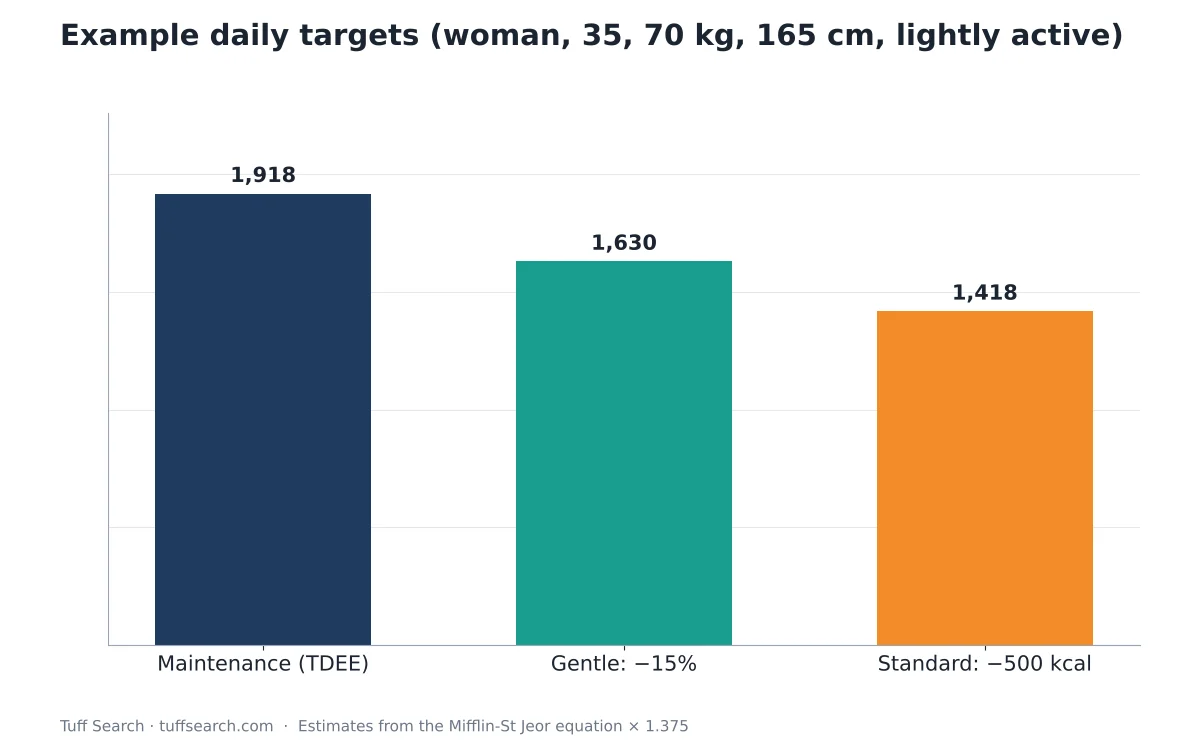
a 35-year-old woman, 70 kg and 165 cm. BMR = 700 + 1,031 − 175 − 161 ≈ 1,395 calories. With light activity (× 1.375), TDEE ≈ 1,918 calories a day. You can run the same steps in the Mifflin-St Jeor calculator or the TDEE calculator. For the difference between the two numbers, see TDEE vs BMR.
Step 2: Choose a deficit
| Approach | How to set it | Example (TDEE 1,918) |
|---|---|---|
| Gentle | 10–15% below TDEE | About 1,630–1,725 calories |
| Standard | About 500 calories below TDEE | About 1,418 calories |
| Faster | Larger deficits | Best done with professional guidance |
A man aged 40, 85 kg and 180 cm with moderate activity (× 1.55) has a TDEE of about 2,759 calories. A 500-calorie deficit puts him near 2,259 – a much higher number for the same approach, which is why copying someone else’s calorie target rarely works.
Try it with your numbersTDEE CalculatorEstimate your total daily energy expenditure with the Mifflin-St Jeor equation and activity levels, then set calorie…Open calculatorHow fast will you lose weight?
An old rule says a 3,500-calorie deficit equals about 1 pound (0.45 kg) of fat, so 500 calories a day would mean about 1 pound a week. It is a reasonable starting estimate for the first weeks, but it overstates long-term loss: as you get lighter, you burn fewer calories, so the same intake produces a smaller deficit. The NIH’s Body Weight Planner models this slowing more realistically.
Public-health guidance generally favours gradual, steady weight loss – often described as about 1–2 pounds (0.5–1 kg) a week – because it is more likely to last. Very low-calorie diets should only be followed under medical supervision.
Keep muscle while you lose fat
- Eat enough protein. The adult minimum is 0.8 g per kg of body weight, and many people aim higher while losing weight. See how much protein you need.
- Do some strength training two or more days a week.
- Avoid very large deficits, which make it harder to keep muscle and stick to the plan.
Make the deficit sustainable
- Build meals around vegetables, fruit, whole grains, lean protein and pulses – they fill you up for fewer calories.
- Watch drinks: sugary drinks and alcohol add calories without much fullness.
- Move more in everyday life – walking adds up. The walking calorie calculator estimates how much.
- Weigh yourself at the same time of day and look at the weekly trend, not daily swings caused by water.
- Recalculate your TDEE after every 4–5 kg (about 10 lb) of loss.
When weight loss stalls
Plateaus are normal. Check portion sizes and weekend eating, recalculate your TDEE for your new weight, and add activity before cutting food further. If you feel very tired, dizzy, cold or preoccupied with food, the deficit may be too large – ease off and talk to a professional.
Frequently asked questions
Eating fewer calories than your body uses in a day, so it draws on stored energy. It is the basis of weight loss.
For many adults it is a common starting point that leads to gradual loss. Smaller people with lower TDEE may prefer a percentage-based deficit of 10–15%.
Estimate your TDEE, then subtract 10–20% or about 500 calories. Your result depends on your size, age, sex and activity.
As you lose weight your body uses fewer calories, so the same intake gives a smaller deficit. Recalculate your TDEE and review portions and activity.
Related calculators
Related articles
- TDEE vs BMR: What’s the Difference and Which to Use?
- How Much Protein Do You Need Per Day?
- How to Calculate Your Target Weight From BMI (Formula)