Compound interest is interest earned on interest. In the first year you earn interest on the money you put in; in the second year you also earn interest on the first year’s interest, and so on. The effect is small at first and enormous over decades, which is why it is the foundation of saving for retirement – and why credit card debt grows so quickly.
The compound interest formula
A = P × (1 + r/n)^(n × t)
- A = the amount at the end
- P = the starting amount (principal)
- r = the annual interest rate as a decimal (5% = 0.05)
- n = the number of times interest is added per year (1 = yearly, 12 = monthly)
- t = the number of years
Simple vs compound interest
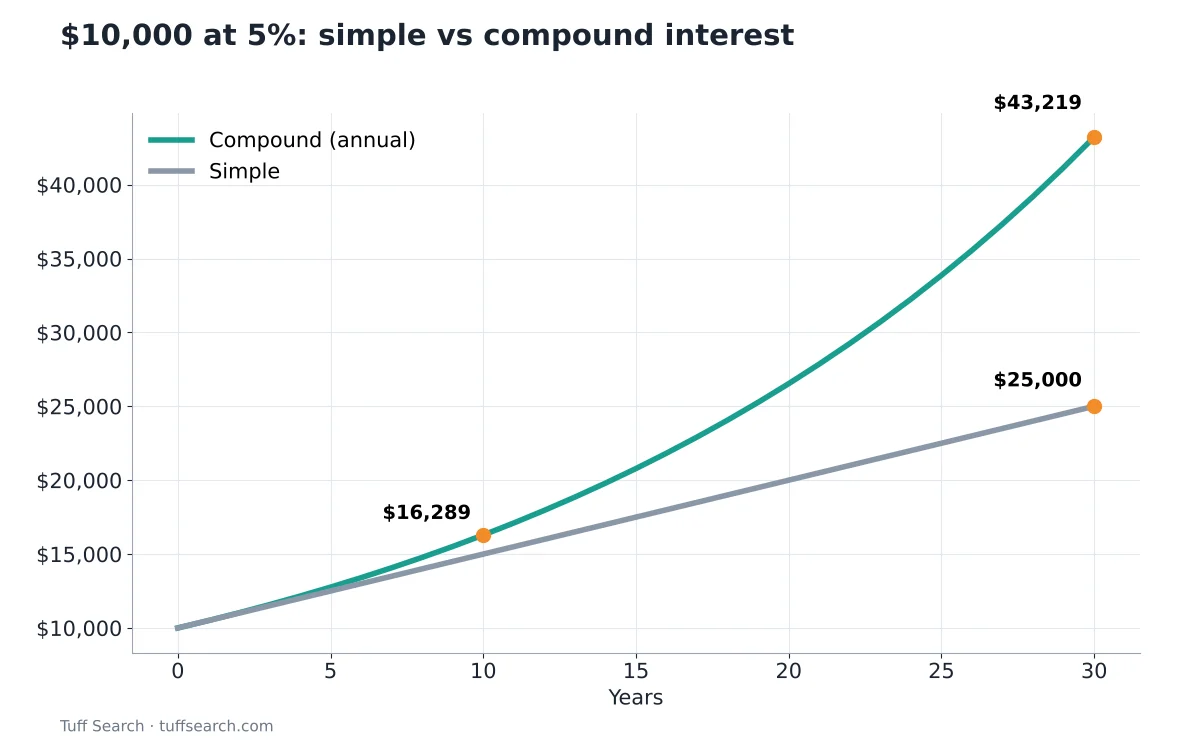
Simple interest is paid only on the original amount: $10,000 at 5% earns $500 every year. Compound interest is paid on the growing balance.
| Years | Simple interest (5%) | Compound interest (5%, yearly) | Difference |
|---|---|---|---|
| 1 | $10,500.00 | $10,500.00 | $0.00 |
| 5 | $12,500.00 | $12,762.82 | $262.82 |
| 10 | $15,000.00 | $16,288.95 | $1,288.95 |
| 20 | $20,000.00 | $26,532.98 | $6,532.98 |
| 30 | $25,000.00 | $43,219.42 | $18,219.42 |
After 30 years the compound balance is 4.32 times the starting amount; the simple-interest balance is 2.5 times. The extra $18,219 is interest earned on earlier interest.
Worked example step by step
$10,000 at 5% compounded yearly for 10 years:
- Convert the rate: 5% = 0.05.
- Add 1: 1.05.
- Raise to the number of periods: 1.05^10 = 1.628895.
- Multiply by the principal: $10,000 × 1.628895 = $16,288.95.
Does compounding frequency matter?
Interest added monthly grows slightly faster than interest added yearly, because each month’s interest starts earning sooner. The difference is real but small: 5% compounded monthly is equivalent to 5.116% a year. To compare accounts or loans that compound on different schedules, convert each to its effective annual rate with the EAR calculator. A higher stated rate usually matters far more than a more frequent schedule.
Adding regular contributions
Most people save a little every month rather than making one deposit. The future value of regular monthly deposits is:
FV = PMT × [(1 + i)^N − 1] ÷ i
Here PMT is the monthly deposit, i the monthly rate (annual rate ÷ 12) and N the number of months. Saving $200 a month at a 6% annual return for 30 years: i = 0.005, N = 360, so FV = 200 × (1.005^360 − 1) ÷ 0.005 ≈ $200,903. You paid in $72,000; about $128,900 is growth.
Why starting early matters
| Start saving $200/month at 6% | Years to age 65 | Total paid in | Balance at 65 |
|---|---|---|---|
| Age 25 | 40 | $96,000 | ≈ $398,300 |
| Age 35 | 30 | $72,000 | ≈ $200,900 |
| Age 45 | 20 | $48,000 | ≈ $92,400 |
Starting ten years earlier costs an extra $24,000 of deposits but roughly doubles the final balance. These figures use a steady 6% return for illustration; real investment returns go up and down and are not guaranteed.
Compound interest working against you
The same maths applies to debt. A credit card with a 24% APR compounded daily has an effective annual rate of about 27.1%. An unpaid balance of $3,000 would grow by roughly $813 in a year. Paying more than the minimum stops interest from compounding on interest.
Quick ways to estimate growth
- The Rule of 72: divide 72 by the interest rate to estimate the years it takes money to double. At 6%, about 12 years.
- For property or other assets that rise in value, the same formula applies – the appreciation calculator projects future value at any growth rate.
- For retirement savings with employer matching and contribution limits, use the 401(k) calculator.
Important
Important: This article explains how the calculations work using 2026 federal figures. It is not tax, legal or financial advice. Your actual withholding depends on your W-4, your employer’s payroll system and your state, so check your pay stub and official IRS guidance.
Frequently asked questions
Interest that is added to your balance and then earns interest itself, so your money grows faster each year.
A = P × (1 + r/n)^(n × t), where P is the principal, r the annual rate as a decimal, n the compounding periods per year and t the number of years.
$16,288.95 with yearly compounding, compared with $15,000 with simple interest.
Only slightly. At 5%, monthly compounding gives an effective rate of 5.116% and daily compounding about 5.127%.
Related calculators
Related articles
- The Rule of 72: How Long Until Your Money Doubles?
- How to Calculate Take-Home Pay From Your Salary (2026)
- 2026 Federal Income Tax Brackets Explained With Examples