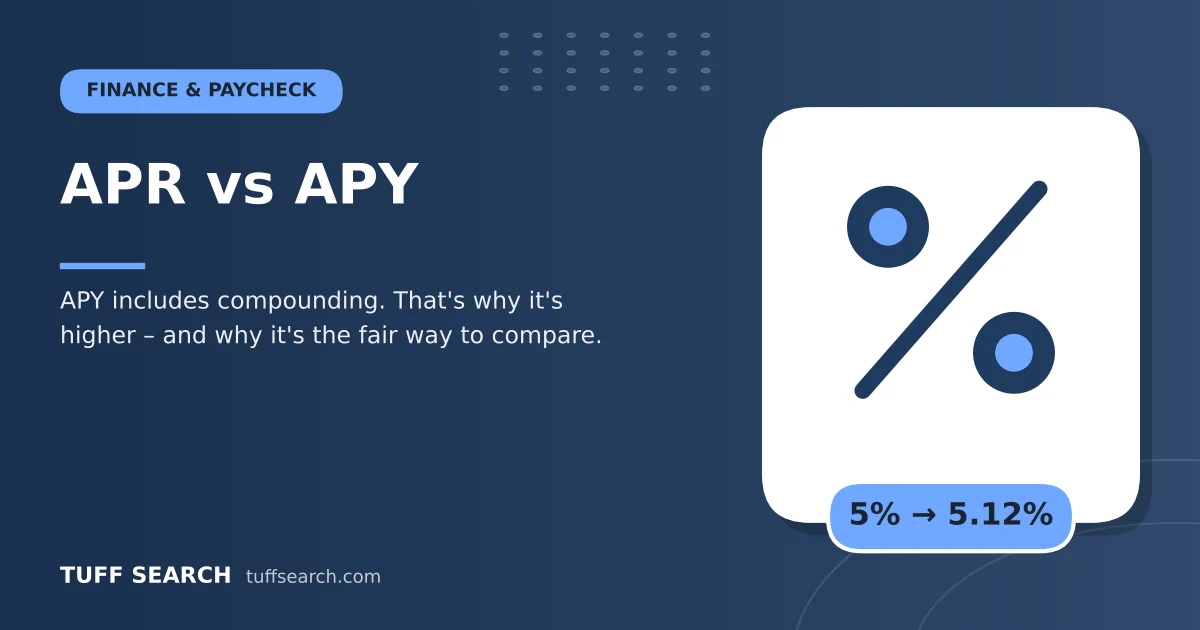
Banks and lenders quote two kinds of yearly rate, and mixing them up can make a loan look cheaper or a savings account look better than it really is. The difference comes down to one thing: compounding.
The short answer
- APR (annual percentage rate) is the yearly rate without the effect of compounding. In the US, lenders must disclose it on loans and credit cards, and for loans it can include certain fees.
- APY (annual percentage yield) is the rate you actually earn in a year once interest is compounded. US banks must quote it for savings accounts and CDs under the Truth in Savings rules.
When interest compounds more than once a year, APY is higher than the stated rate. For savings, a higher APY is better; for debt, the effective rate you pay is higher than the APR suggests.
The APY formula
APY = (1 + APR ÷ n)ⁿ − 1, where n = compounding periods per year
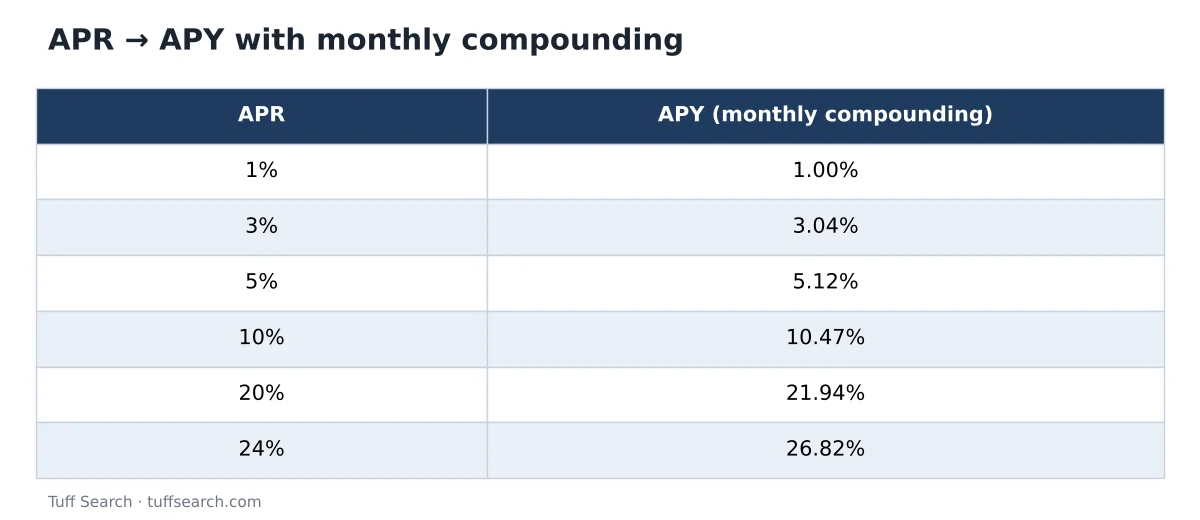
A savings account paying 5% compounded monthly: (1 + 0.05 ÷ 12)¹² − 1 = 5.12%. Compounded daily, it is 5.13%. On $10,000 for a year, 5% simple interest earns $500, while 5% compounded monthly earns about $512.
Credit cards: APR understates the cost
Credit card interest is usually calculated daily on your balance and added monthly, so unpaid interest itself earns interest. A card with a 24% APR compounded monthly has an effective annual rate of about 26.8% if you carry a balance all year. That is why paying the full statement balance each month – which avoids interest entirely on most cards – is so valuable.
Loans: APR includes fees
For mortgages and many other loans, APR adds certain fees and charges to the interest rate, so it shows the total yearly cost of borrowing better than the rate alone. When comparing loans, compare APRs; when comparing savings accounts, compare APYs. Comparing an APR on one product with an APY on another is not a fair comparison.
How to convert between them
- APR → APY: use the formula above, or the EAR calculator, which works out the effective annual rate for any compounding frequency.
- APY → APR (monthly): APR = 12 × ((1 + APY)^(1/12) − 1). A 4.07% APY is a 4.00% APR compounded monthly.
- Small differences in rates are often quoted in basis points – 1 basis point is 0.01%. The basis point calculator converts them.
Why compounding matters more over time
Over one year the gap between APR and APY looks small, but over many years compounding drives most of the growth in savings – see compound interest explained and the Rule of 72 for quick doubling estimates. For long-term retirement saving, the 401(k) calculator shows how contributions and growth add up.
Important
Important: This article explains how the calculations work using 2026 federal figures. It is not tax, legal or financial advice. Your actual withholding depends on your W-4, your employer’s payroll system and your state, so check your pay stub and official IRS guidance.
Frequently asked questions
When interest compounds more than once a year, APY is higher than the stated rate because it includes interest on interest.
They are not better or worse – they measure different things. Compare APY for savings and APR for loans.
About 5.12% if compounded monthly, or 5.13% if compounded daily.
US rules require lenders to disclose APR. Because interest compounds, the effective cost of a carried balance is higher than the APR.
They use the same idea – the effective yearly rate including compounding. APY is the term used for deposits.
Related calculators
Related articles
- Compound Interest Explained: The Formula, Examples and Why Time Matters
- The Rule of 72: How to Estimate When Your Money Will Double
- How to Calculate Take-Home Pay From Your Gross Salary (2026 Guide)