
“I turned down overtime because it would put me in a higher bracket” is one of the most common money myths. With federal income tax, earning more can never leave you with less, because the U.S. uses marginal brackets. This guide shows exactly how a raise is taxed, using 2026 figures, and points out the few situations where extra income really can cost you.
Why a raise can’t shrink your take-home pay
Each tax rate applies only to the slice of income inside its bracket. When a raise pushes you into the next bracket, only the dollars above the bracket line are taxed at the higher rate. Everything you earned before the raise is taxed exactly as it was.
| 2026 rate | Single filer – taxable income |
|---|---|
| 10% | $0 – $12,400 |
| 12% | $12,401 – $50,400 |
| 22% | $50,401 – $105,700 |
| 24% | $105,701 – $201,775 |
Example: a raise from $65,000 to $70,000
Assumptions: single filer, 2026 standard deduction of $16,100, no pre-tax deductions, no state income tax.
| Before raise | After raise | |
|---|---|---|
| Salary | $65,000 | $70,000 |
| Taxable income | $48,900 | $53,900 |
| Top bracket reached | 12% | 22% |
| Federal income tax | $5,620 | $6,570 |
| Social Security + Medicare (7.65%) | $4,972.50 | $5,355 |
| Take-home pay | $54,407.50 | $58,075 |
The raise moved this person from the 12% bracket into the 22% bracket, yet take-home pay rose by $3,667.50. Of the extra $5,000 of taxable income, $1,500 still fell inside the 12% bracket (up to $50,400) and only $3,500 was taxed at 22%.
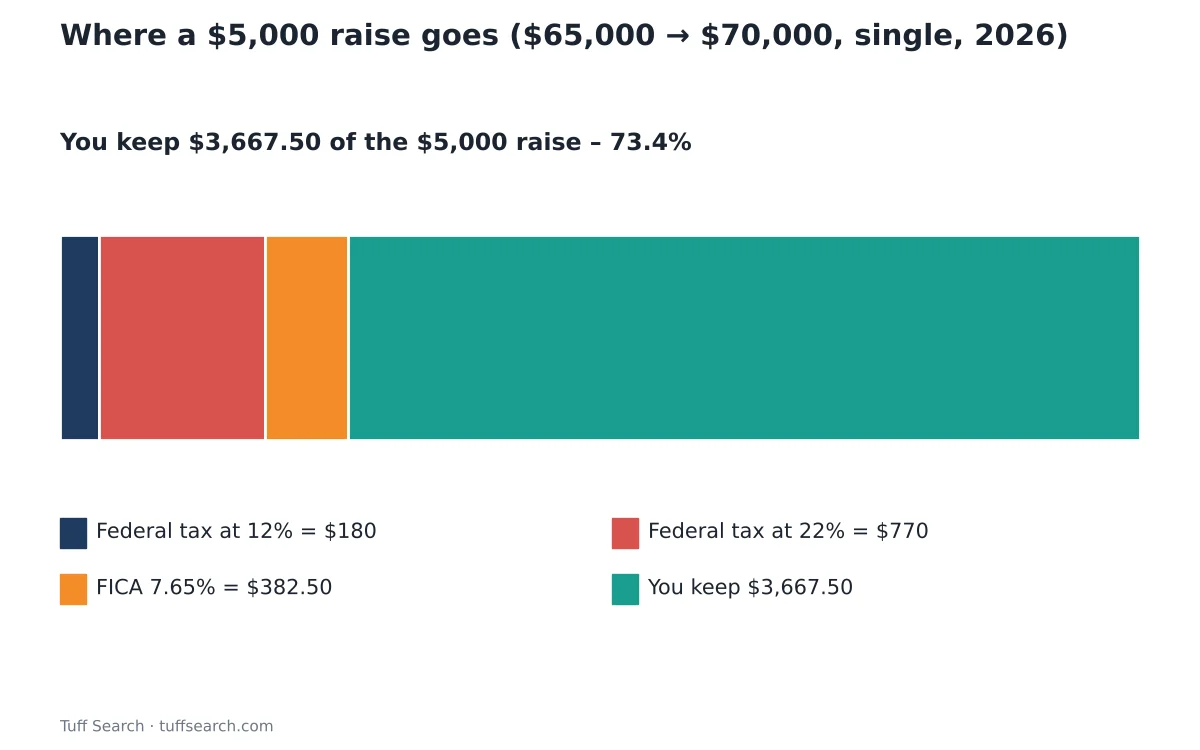
- $1,500 × 12% = $180
- $3,500 × 22% = $770
- Extra federal income tax = $950
- Extra FICA: $5,000 × 7.65% = $382.50
- Raise kept: $5,000 − $950 − $382.50 = $3,667.50
Your marginal rate tells you what you keep
To estimate how much of any raise you keep, add up your marginal rates: federal bracket + 7.65% FICA + your state’s top rate on that income. For someone in the 22% federal bracket in a state with a 5% income tax, each extra dollar is taxed at roughly 22% + 7.65% + 5% = 34.65%, so they keep about 65 cents of every extra dollar. That is very different from losing money. Oregon shows why the state part matters: its income tax runs in brackets from 4.75% to 9.9%, so a raise can move you into a higher Oregon bracket as well — the Oregon paycheck calculator shows what you keep after federal and state tax.
Why your first bigger paycheck can look odd
Payroll systems estimate withholding as if each paycheck were your pay for the whole year. A raise that starts mid-year, or a raise paid alongside back pay, can produce one paycheck with higher-than-expected withholding. It evens out on your tax return. Compare a normal post-raise paycheck, not the first one, with the paycheck calculator for your state.
Where extra income really can cost you
Tax brackets are not the problem, but some other rules do change sharply with income. These are often called benefit cliffs or phase-outs:
- Means-tested benefits and credits, such as some health insurance subsidies, childcare assistance, SNAP or the Earned Income Tax Credit, can shrink or stop as income rises.
- Deductions with income limits phase out above certain levels – for example, the overtime deduction for 2025–2028 starts phasing out above $150,000 of modified adjusted gross income for single filers.
- Income-driven student loan payments are usually recalculated from your income.
- The Additional Medicare Tax of 0.9% applies to wages above $200,000 (single).
If you receive any income-tested benefit, check its income limits before a large raise or extra shifts, and ask the program how a change is counted. For most people with ordinary wages, the answer is simple: more pay means more take-home pay.
Ways to keep more of a raise
- Increase your traditional 401(k) contribution by part of the raise – you will barely notice the difference in take-home pay. Model it in the 401(k) calculator.
- Use pre-tax benefits such as an HSA if you are eligible.
- Update your W-4 if your income changes a lot, so you are not surprised at tax time.
Important
Important: This article explains how the calculations work using 2026 federal figures. It is not tax, legal or financial advice. Your actual withholding depends on your W-4, your employer’s payroll system and your state, so check your pay stub and official IRS guidance.
Frequently asked questions
Not because of federal income tax brackets – only the extra income is taxed at the higher rate. Losing a means-tested benefit or credit is the main way extra income can leave you worse off.
It depends on your brackets and state. For a single filer moving from $65,000 to $70,000 with no state income tax, about $3,667.50 in 2026.
The rate applied to your next dollar of income – your highest federal tax bracket. Your effective rate, total tax divided by income, is always lower.
No, for federal income tax purposes you always keep more by earning more. Check benefit rules separately if you receive any income-tested support.
Related calculators
Related articles
- How to Calculate Take-Home Pay From Your Salary (2026)
- 2026 Federal Income Tax Brackets Explained With Examples
- FICA Tax 2026: Social Security and Medicare Explained
Sources
- IRS – Federal income tax rates and brackets
- IRS – Standard deduction (Topic 551)
- IRS – Social Security and Medicare withholding rates (Topic 751)
- IRS – Questions and answers for the Additional Medicare Tax