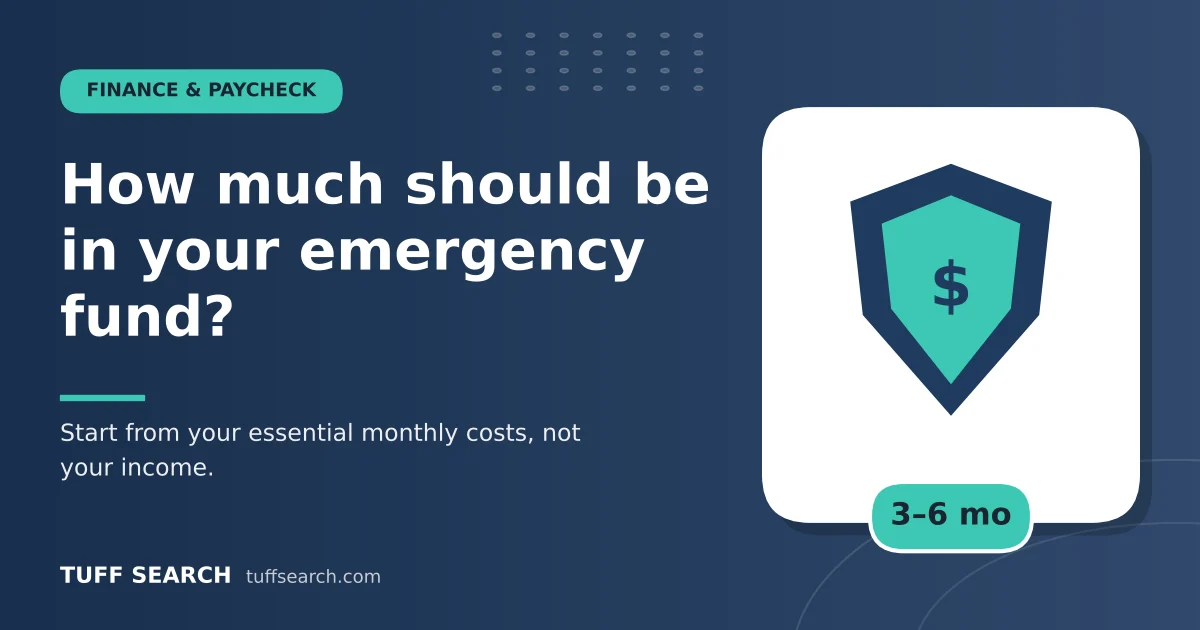
An emergency fund is money set aside for the things you cannot plan for: a job loss, a car repair, a medical bill or a sudden move. The right size depends on your costs and how risky your income is, not on a single magic number. This guide shows a simple way to work out your own target and a realistic plan to get there.
Step 1: Add up your essential monthly costs
Use the spending you could not easily cut in an emergency, not your full budget:
- Rent or mortgage, property tax and insurance
- Utilities, phone and internet
- Groceries (not eating out)
- Transport: car payment, fuel, insurance or transit
- Minimum debt payments
- Health insurance, prescriptions and childcare
Example
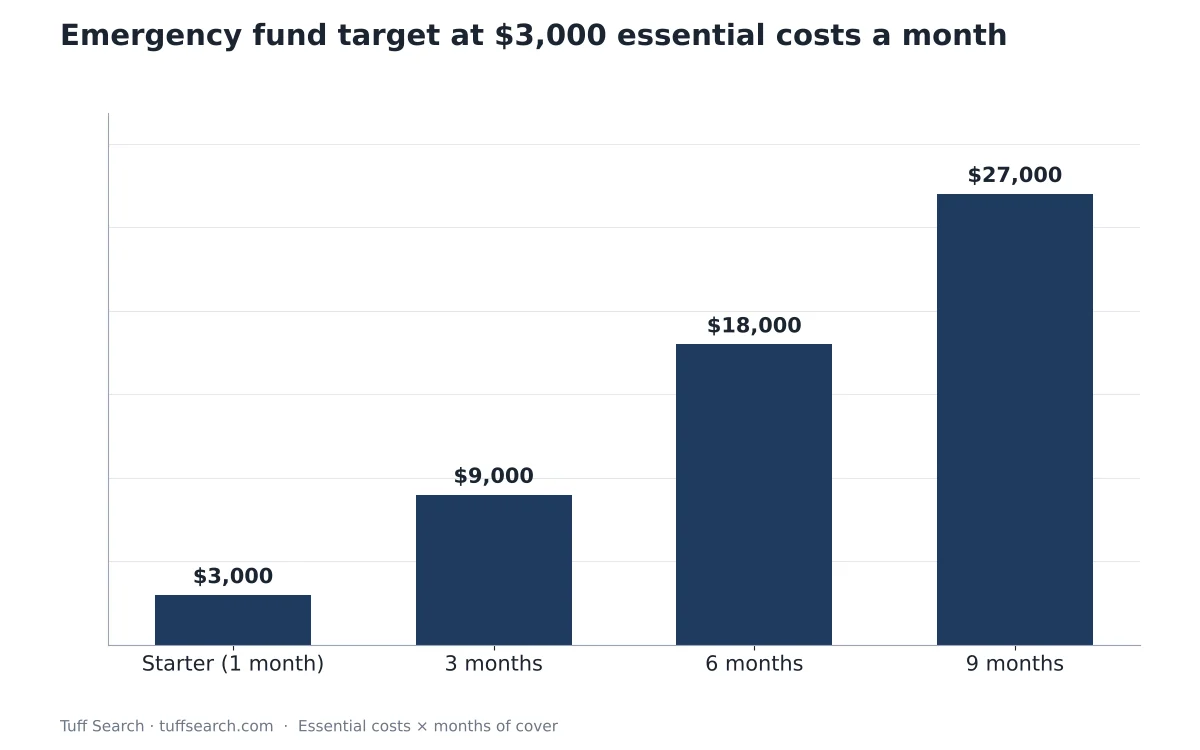
rent $1,400, utilities and phone $250, groceries $500, car and fuel $450, insurance $150, minimum debt payments $250 = $3,000 a month.
Step 2: Choose how many months to cover
A common rule of thumb is three to six months of essential costs. The Consumer Financial Protection Bureau notes that the right amount depends on your situation, and suggests looking at the unexpected expenses you have actually had in the past. Use the table to decide where you sit:
| Your situation | Suggested cover |
|---|---|
| Getting started or paying off high-interest debt | A starter fund of $500–$1,000 or one month |
| Stable job, two incomes, no dependants | About 3 months |
| Single income, children or other dependants | About 6 months |
| Self-employed, commission-based or seasonal work | 6 months or more |
| Older car, older home or a health condition | Toward the upper end |
Emergency fund target = Essential monthly costs × Months of cover
Step 3: Check your personal runway
If you lost your income, how long would your savings last? Start-ups call this runway, and the same maths works for households: runway = savings ÷ (monthly spending − any income you would still have). Someone with $18,000 saved, $3,000 of costs and $1,500 of part-time income has a net burn of $1,500 a month and about 12 months of runway. The burn rate calculator works this out for you and shows how cutting costs extends the runway.
Step 4: Build it in stages
- Set a starter goal of one month of essentials, or $1,000 if that feels out of reach.
- Automate a transfer on payday – even $50 a paycheck adds up to $1,300 in a year on a biweekly schedule.
- Add windfalls: part of a tax refund or a bonus can jump-start the fund.
- Once you reach one month, split extra savings between the fund and paying down high-interest debt.
- Keep going until you reach your full target, then redirect the transfer to other goals.
| Monthly saving | Months to $3,000 | Months to $9,000 | Months to $18,000 |
|---|---|---|---|
| $150 | 20 | 60 | 120 |
| $300 | 10 | 30 | 60 |
| $500 | 6 | 18 | 36 |
| $750 | 4 | 12 | 24 |
The table ignores interest, so a fund in a savings account will grow a little faster.
Where to keep your emergency fund
- Somewhere safe and easy to reach within a day or two, such as a high-yield savings account or money market deposit account.
- At a bank or credit union with deposit insurance. In the U.S., FDIC insurance covers deposits up to $250,000 per depositor, per insured bank, for each account ownership category.
- Separate from your everyday checking account, so you are not tempted to spend it.
- Not in stocks: an emergency often coincides with a market fall.
Compare savings rates on an equal footing with the EAR calculator, which converts rates with different compounding into an effective annual rate.
What counts as an emergency?
Use it for events that are unexpected, necessary and urgent: losing your job, an essential car or home repair, a medical bill, emergency travel. Planned costs – holidays, a new phone, annual insurance premiums – are better covered by separate “sinking fund” savings so your emergency fund stays intact. If you do use it, make refilling it the next priority.
Important
Important: This article explains how the calculations work using 2026 federal figures. It is not tax, legal or financial advice. Your actual withholding depends on your W-4, your employer’s payroll system and your state, so check your pay stub and official IRS guidance.
Frequently asked questions
A common guide is three to six months of essential expenses. People with less secure income or dependants often aim for six months or more.
Many people build a small starter fund first, then pay down high-interest debt, then finish the full emergency fund. A starter fund stops a small emergency from going on a credit card.
In an insured savings account you can access quickly, separate from your everyday account – not in investments that can fall in value.
It is about three months of cover if your essential costs are around $3,300 a month. Divide your fund by your essential monthly costs to see how many months it covers.
Related calculators
Related articles
- How Bonuses Are Taxed: The 22% Rate Explained (2026)
- How to Calculate Take-Home Pay From Your Salary (2026)
- 2026 Federal Income Tax Brackets Explained With Examples