
Fat is an essential nutrient: it supplies energy, helps you absorb vitamins A, D, E and K, and provides fatty acids your body cannot make. But not all fats affect your health the same way. The type of fat you eat matters at least as much as the total amount.
The main types of fat
| Type | Found mainly in | Effect and advice |
|---|---|---|
| Monounsaturated | Olive and canola oil, avocado, almonds, peanuts | Linked with healthier cholesterol when it replaces saturated fat – make it a main source |
| Polyunsaturated (omega-3 and omega-6) | Oily fish, walnuts, flaxseed, chia, sunflower and soybean oil | Essential fats; include regularly |
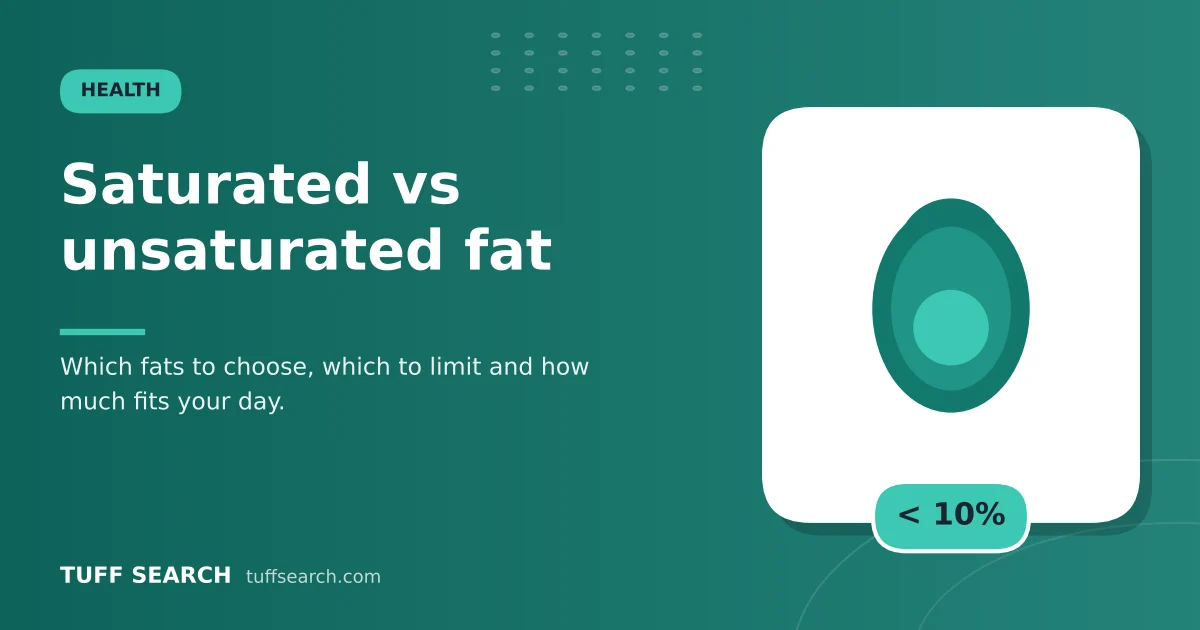
| Saturated | Butter, ghee, cheese, fatty and processed meat, coconut and palm oil, pastries | Raises LDL cholesterol – keep below 10% of calories |
| Trans (artificial) | Partially hydrogenated oils – now largely removed from U.S. foods | Raises LDL and lowers HDL – avoid |
Unsaturated fats are usually liquid at room temperature; saturated fats are usually solid. Most foods contain a mix, so butter is mostly saturated and olive oil mostly monounsaturated.
How much fat should you eat?
U.S. dietary guidance sets an acceptable range of 20–35% of daily calories from fat for adults, with saturated fat below 10% of calories. Fat has 9 calories per gram, so:
Fat grams = Daily calories × Fat % ÷ 9
| Daily calories | Total fat 20–35% | Saturated fat limit (10%) |
|---|---|---|
| 1,800 | 40–70 g | Under 20 g |
| 2,000 | 44–78 g | Under 22 g |
| 2,200 | 49–86 g | Under 24 g |
| 2,500 | 56–97 g | Under 28 g |

The American Heart Association suggests going further – about 5–6% of calories from saturated fat (around 11–13 g on 2,000 calories) – for people who need to lower their LDL cholesterol. Find your own range with the fat intake calculator.
Try it with your numbersFat Intake CalculatorWork out how many grams of fat to eat per day from your calories and goal, with saturated fat limits and healthy fat…Open calculatorWhy saturated fat matters
Eating a lot of saturated fat raises LDL cholesterol, which can build up in artery walls. Research suggests the benefit comes from what replaces it: swapping saturated fat for unsaturated fat is linked with lower LDL and lower heart-disease risk, while swapping it for refined carbohydrates such as white bread and sugary snacks is not. Learn what your cholesterol numbers mean in HDL vs LDL cholesterol.
Simple swaps
| Instead of | Try |
|---|---|
| Butter for cooking | Olive or canola oil |
| Fatty or processed meat | Fish, chicken without skin, beans or lentils |
| Full-fat cheese snacks | A handful of unsalted nuts |
| Pastries and biscuits | Fruit, plain yogurt or wholegrain toast with nut butter |
| Creamy sauces | Tomato-based sauces or a drizzle of olive oil |
Reading food labels
On U.S. Nutrition Facts labels, the % Daily Value for saturated fat is based on 20 g for a 2,000-calorie diet. A serving with 5% DV or less is low; 20% DV or more is high. Check the ingredients for “partially hydrogenated oil” – a sign of trans fat in older or imported products.
Fat on special diets
Low-carb and keto diets get most of their calories from fat, often well above 35%. If you follow one, the type of fat still matters: base it on unsaturated sources and keep an eye on saturated fat. See how to calculate keto macros and check your numbers with the keto calculator.
Important
Important: This article is general educational information, not medical or nutrition advice. Talk to a doctor or registered dietitian before changing your diet, especially if you are pregnant, under 18, or have a medical condition.
Frequently asked questions
Saturated fat is usually solid at room temperature and raises LDL cholesterol; unsaturated fat is usually liquid and is linked with healthier cholesterol when it replaces saturated fat.
Less than 10% of daily calories – under about 22 g on a 2,000-calorie diet. The American Heart Association suggests 5–6% for people who need to lower LDL.
Olive and canola oil, avocado, nuts, seeds and oily fish such as salmon, sardines and mackerel.
No. Fat is essential. The aim is to get most of it from unsaturated sources and keep saturated and trans fat low.
Related calculators
Related articles
- HDL vs LDL Cholesterol: Good vs Bad Explained
- How to Calculate Keto Macros: Fat, Protein and Carbs
- How Much Protein Do You Need Per Day?