A ketogenic diet is defined by its macronutrient split: very low carbohydrate, moderate protein and high fat. Rather than guessing, you can calculate your own targets in four steps. The method below is the same logic used by most keto calculators.
Step 1: Find your calorie target
Start with your total daily energy expenditure (TDEE), the calories you burn in a typical day. The TDEE calculator estimates it from your age, height, weight and activity level. Then decide your goal: maintain (eat about your TDEE), lose weight (a moderate deficit) or gain (a small surplus).
Step 2: Set net carbs
Net carbs are total carbohydrates minus fibre. Many keto approaches keep net carbs somewhere around 20 to 50 grams a day; lower amounts are typically used at the start. Carbs provide 4 kcal per gram.
Try it with your numbersKeto CalculatorCalculate daily keto macros from your age, sex, height, weight, activity and goal.Open calculatorStep 3: Set protein
Protein supports muscle and keeps you full. A common approach is to base it on body weight, for example roughly 1.2 to 2.0 grams per kilogram depending on activity. Protein also provides 4 kcal per gram. Too little can lead to muscle loss; there is no need for extreme amounts.
Step 4: Fill the remaining calories with fat
Fat (g) = [Calorie target − (Net carbs g × 4) − (Protein g × 4)] ÷ 9
Fat provides 9 kcal per gram, which is why the fat figure in grams looks smaller than you might expect even when it supplies most of the energy.
Worked example
A person weighing 70 kg with a calorie target of 2,000 kcal, 25 g net carbs and protein at 1.6 g per kg:
| Macro | Grams | Calories | Share of calories |
|---|---|---|---|
| Net carbs | 25 g | 100 kcal | 5% |
| Protein (70 × 1.6) | 112 g | 448 kcal | 22.4% |
| Fat ((2,000 − 100 − 448) ÷ 9) | 161 g | 1,452 kcal | 72.6% |
| Total | 2,000 kcal | 100% |
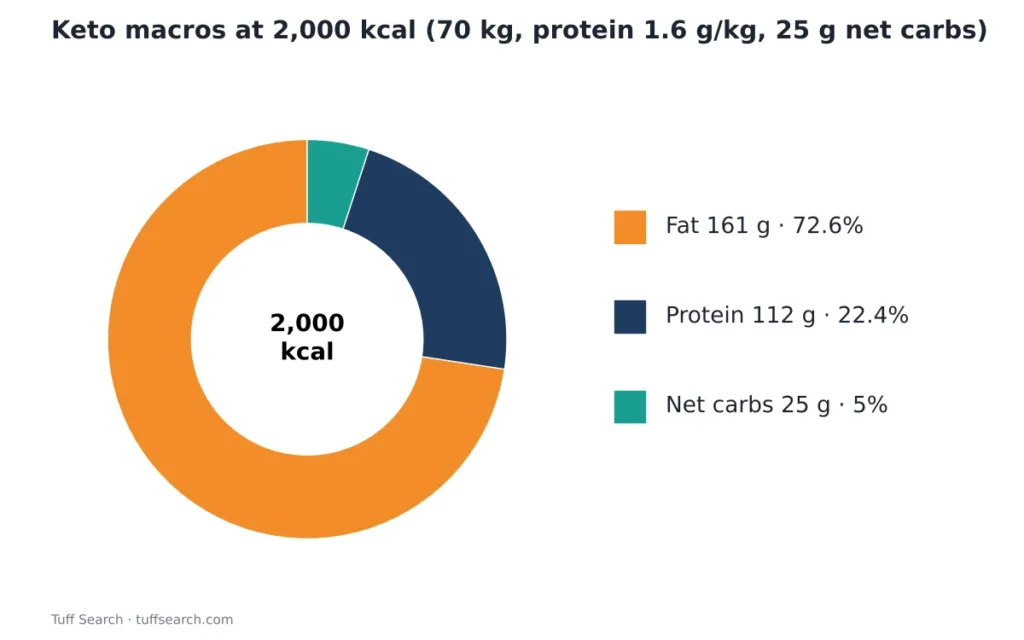
Worked example: 2,000 kcal, 25 g net carbs, 112 g protein, 161 g fat.
Why percentages alone can mislead
You will often see keto described as “70% fat, 25% protein, 5% carbs”. Percentages are useful for a quick picture, but grams are what you actually track. Setting carbs and protein in grams first and letting fat fill the rest keeps your protein steady even when your calorie target changes.
Adjusting for weight loss
When you reduce calories to lose weight, keep net carbs and protein about the same and lower the fat. For example, cutting the target above from 2,000 to 1,700 kcal would reduce fat from about 161 g to about 128 g while protein stays at 112 g.
Who should get advice first
Keto is not suitable for everyone. People with diabetes (especially those on insulin or other glucose-lowering medicines), kidney or liver disease, a history of eating disorders, and anyone pregnant or breastfeeding should speak to a doctor before starting.
Let the calculator do it
The keto calculator runs these steps for you and lets you change carb and protein settings to see how fat adjusts.
Important
Important: This article is general educational information, not medical or nutrition advice. Talk to a doctor or registered dietitian before changing your diet, especially if you are pregnant, under 18, or have a medical condition.
Frequently asked questions
A common pattern is about 5–10% of calories from carbs, 20–25% from protein and the rest from fat. Setting carbs and protein in grams first is more precise than using fixed percentages.
Many keto plans keep net carbs roughly between 20 and 50 grams a day. The right amount varies from person to person.
Fat is mainly the energy that fills the rest of your calories. Hitting carbs and protein matters more; eating somewhat less fat than the target simply increases your calorie deficit.
No. Net carbs are total carbohydrates minus fibre. Some people also subtract certain sugar alcohols.
Related calculators
Related articles
- Keto Calculator vs Calorie Calculator: Which Fits You?
- How to Calculate Your Target Weight From BMI (Formula)
- TDEE vs BMR: What’s the Difference and Which to Use?