There are two common ways to put a number on a goal weight. Reverse BMI gives the weight that matches a chosen BMI for your height. Ideal body weight (IBW) formulas, such as Devine, give a single reference weight. They come from different places and suit different purposes.
How reverse BMI works
Weight (kg) = Target BMI × Height (m)²
Using the adult healthy BMI range of 18.5 to 24.9 gives a weight range rather than one number. Our guide on calculating target weight from BMI explains the steps in detail.
How ideal body weight (Devine) works
Men: 50 kg + 2.3 kg for each inch over 5 feet
Women: 45.5 kg + 2.3 kg for each inch over 5 feet
The Devine formula was published in 1974 to help estimate medication doses. It is still used in clinical settings, but it was not designed as a personal weight goal.
Try it with your numbersReverse BMI CalculatorEnter your height and a target BMI to find the matching body weight in kg or lb.Open calculatorWorked comparison
| Man, 5 ft 10 in (1.778 m) | Woman, 5 ft 5 in (1.651 m) | |
|---|---|---|
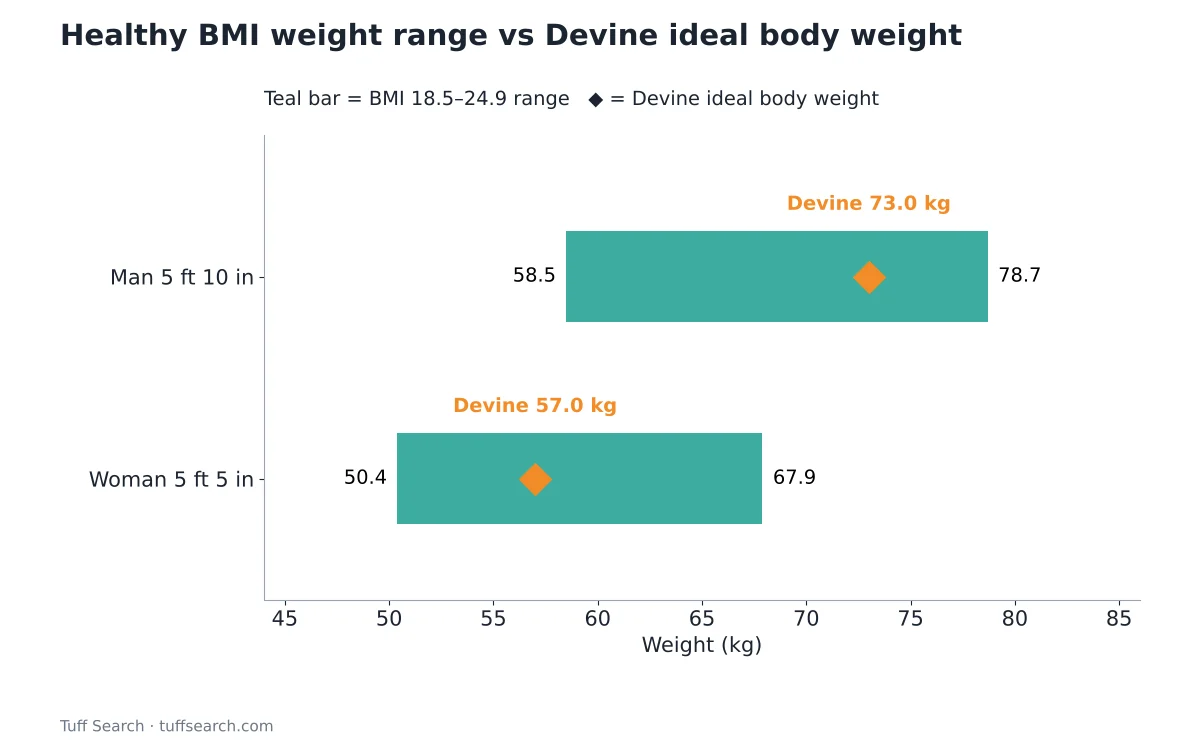
| Devine IBW | 50 + 2.3 × 10 = 73.0 kg | 45.5 + 2.3 × 5 = 57.0 kg |
| BMI at that weight | 23.1 | 20.9 |
| Healthy BMI range (18.5–24.9) | 58.5 – 78.7 kg | 50.4 – 67.9 kg |
In both examples the Devine weight falls inside the healthy BMI range. The BMI range shows how much room there is around that single number.
Key differences
| Reverse BMI | Ideal body weight (Devine) | |
|---|---|---|
| Output | A weight for any chosen BMI, or a range | One reference weight |
| Considers sex | No | Yes |
| Original purpose | Population health screening | Medication dosing |
| Works below 5 ft | Yes | Not designed for it |
| Best for | Setting a realistic range | A quick single reference point |
Which should you use?
- Use reverse BMI if you want a range to aim for and to see where a specific BMI target lands.
- Use an IBW formula if you need a single reference figure, for example when a healthcare professional asks for it.
- Use neither as a strict rule. Neither measures body fat, muscle or fat distribution.
Both methods use only height (and sex, for ideal body weight). Waist measurements add information about where weight is carried – see alternatives to BMI and how to measure your waist and hips.
A better approach
Treat both as rough guides. Combine them with waist measurement, how you feel and advice from a healthcare professional. The reverse BMI calculator shows the healthy range for your height, and the TDEE calculator estimates the calories needed to move toward it.
Important
Important: This article is general educational information, not medical or nutrition advice. Talk to a doctor or registered dietitian before changing your diet, especially if you are pregnant, under 18, or have a medical condition.
Frequently asked questions
Not exactly. Ideal body weight formulas give one reference number, while the healthy BMI range covers a span of weights for your height.
Men: 50 kg plus 2.3 kg per inch over 5 feet. Women: 45.5 kg plus 2.3 kg per inch over 5 feet.
They were built for different purposes and use different inputs. Devine adjusts for sex; BMI does not.
Both can misjudge people with a lot of muscle, because neither measures body composition.
Related calculators
Related articles
- How to Calculate Your Target Weight From BMI (Formula)
- Alternatives to BMI: Waist, Ratios and Body Fat
- How to Measure Your Waist and Hips Correctly