A sourdough starter is a living culture of wild yeast and lactic acid bacteria that you grow from flour and water. It replaces commercial yeast, gives sourdough its flavour and, once established, can be kept going for years. Making one takes only a few minutes a day for one to two weeks.
What you need
- Wholegrain flour to start (wholemeal wheat or rye ferments faster), then strong white or all-purpose flour if you prefer
- Water – tap water is fine for most people; if yours is heavily chlorinated, use filtered water or leave it out uncovered for a few hours
- A clean glass jar of about 1 litre, with a loose lid
- A kitchen scale – measuring by weight makes feeding consistent
- A rubber band to mark the level after each feed
Day-by-day method
Day 1: Mix
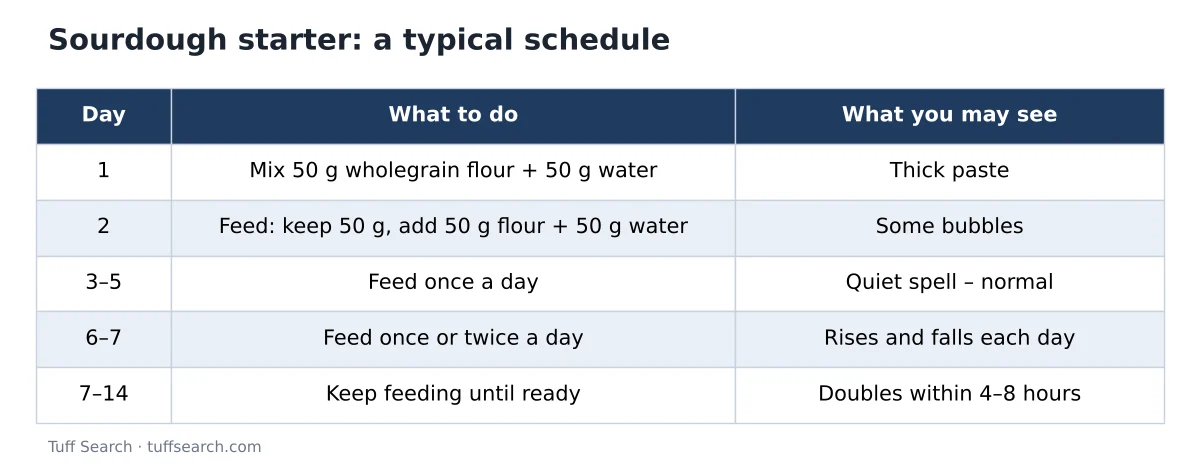
Stir 50 g of wholegrain flour and 50 g of lukewarm water into a thick paste. Scrape down the sides, cover loosely and leave somewhere warm – about 24–27°C (75–80°F) is ideal.
Day 2: First feed
You may see a few bubbles. Discard all but 50 g of the mixture, then add 50 g flour and 50 g water and stir well. Discarding keeps the starter from growing out of control and gives the microbes fresh food.
Days 3–5: The quiet spell
Keep feeding once a day in the same way. Many starters bubble a lot on day 2 or 3, then go quiet. That early burst often comes from bacteria that die off as the mixture becomes more acidic. It is normal – keep going.
Days 6–14: Becoming active
As yeast takes hold, the starter will rise after each feed and then fall. When it starts rising reliably, switch to feeding twice a day (roughly every 12 hours). You can move to white flour at this stage if you like.
How to tell your starter is ready
- It doubles in volume within about 4–8 hours of a feed, several days in a row.
- It is full of bubbles throughout, not only on top.
- It smells pleasantly sour or yeasty, like yogurt or beer.
- It has a domed top at its peak, then falls back.
The “float test” (dropping a spoonful in water) is popular but unreliable, especially with wholegrain starters. Rising predictably is the better sign.
Feeding ratios explained
Bakers describe feeds as starter : flour : water by weight. Equal parts (1:1:1) gives a 100%-hydration starter that peaks fairly quickly. Larger feeds such as 1:2:2 or 1:5:5 dilute the starter more, so it takes longer to peak – handy if you want it ready the next morning.
| Feed (starter : flour : water) | Example | Peaks |
|---|---|---|
| 1 : 1 : 1 | 50 g : 50 g : 50 g | Fastest |
| 1 : 2 : 2 | 25 g : 50 g : 50 g | Slower |
| 1 : 5 : 5 | 10 g : 50 g : 50 g | Slowest – good overnight |
Using your starter in bread
Use the starter near its peak. Because your starter is half flour and half water, it changes the true hydration of your dough. The sourdough calculator accounts for the flour and water in the starter and scales any recipe to the loaf size you want. The same starter makes excellent pizza dough – the pizza size calculator helps you decide how much to make.
Looking after it long-term
- Baking often: keep it at room temperature and feed once or twice a day.
- Baking weekly: keep it in the fridge and feed once a week; take it out and feed it once or twice before baking.
- Going away: a well-fed starter can sit in the fridge for a couple of weeks; it may need a few feeds to recover.
Troubleshooting
| Problem | Likely cause | Fix |
|---|---|---|
| No activity after a week | Too cold, or chlorinated water | Move somewhere warmer; use wholegrain flour and filtered water |
| Grey liquid on top (“hooch”) | Hungry starter | Stir it in or pour it off, then feed |
| Smells of nail varnish | Very hungry | Feed more often or at a bigger ratio |
| Rises fast, then collapses | Warm kitchen | Use a 1:2:2 feed or cooler water |
| Fuzzy mould, or pink or orange streaks | Contamination | Throw it away and start again with a clean jar |
Frequently asked questions
Usually 7 to 14 days, depending on temperature and flour. Warm kitchens and wholegrain flour speed it up.
To keep the amount manageable and give the yeast and bacteria enough fresh flour. Without discarding, you would need ever-larger feeds.
When it reliably doubles within about 4–8 hours of feeding for several days in a row and smells pleasantly sour.
Usually yes. If your water is heavily chlorinated, use filtered water or let tap water stand uncovered for a few hours first.