


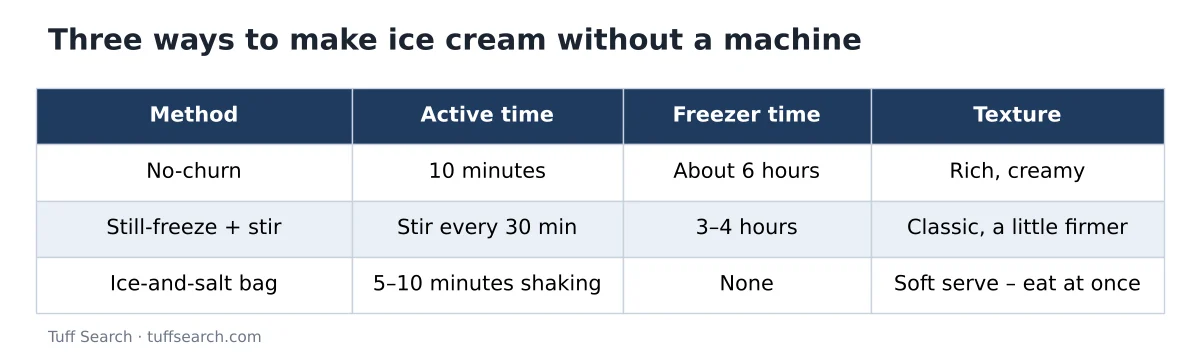
You do not need an ice cream maker to make good ice cream at home. A machine does two jobs – it freezes the mix quickly and stirs air into it while breaking up ice crystals. Each method below handles those two jobs in a different way.
Method 1: Two-ingredient no-churn ice cream
This is the easiest method and gives a soft, scoopable result because whipped cream supplies the air and sweetened condensed milk keeps ice crystals small.
- 480 ml (2 cups) cold heavy or double cream
- 1 can (about 397 g / 14 oz) sweetened condensed milk
- 1–2 teaspoons vanilla extract, or another flavouring
- Whip the cream to soft peaks – it should hold its shape but still be smooth.
- In another bowl, stir the condensed milk with the vanilla.
- Fold a third of the cream into the condensed milk to loosen it, then gently fold in the rest.
- Spread into a loaf tin or container, cover and freeze for about 6 hours or overnight.
Fold in mix-ins such as chopped chocolate or a ribbon of fruit purée just before freezing.
Method 2: Still-freezing a classic custard
This method uses a traditional base and replaces the machine’s churning with stirring by hand.
- Make a custard base with milk, cream, sugar and egg yolks. Cook it gently, stirring, until it thickens and reaches 71°C (160°F) – the temperature recommended for egg dishes.
- Strain it, cool it quickly and chill thoroughly, ideally overnight.
- Pour into a shallow metal or plastic container and freeze.
- After 30–45 minutes, beat the edges into the middle with a fork or whisk. Repeat every 30 minutes for 2–3 hours, until evenly frozen.
- Cover the surface and freeze until firm enough to scoop.
The more often you stir, the smaller the ice crystals and the smoother the texture. A hand blender for a few seconds during one of the stirs helps too.
Try it with your numbersIce Cream CalculatorBalance a homemade ice cream or gelato recipe: fat, milk solids, sugar, total solids, sweetness (POD) and softness…Open calculatorMethod 3: Ice cream in a bag
A fun, fast method for small batches and for children. Salt lowers the freezing point of ice, making the outer bag cold enough to freeze the mix in minutes.
- Small bag: 240 ml (1 cup) half-and-half or single cream, 2 tablespoons sugar, ½ teaspoon vanilla – sealed well
- Large bag: ice to half-fill it plus about 80 g (⅓ cup) of coarse salt
Put the small bag inside the large one, seal and shake for 5–10 minutes (wear gloves or use a towel – it gets very cold). Rinse the salt off the small bag before opening. Eat it straight away.
Why homemade ice cream goes icy – and how to stop it
Ice cream is a frozen foam: ice crystals, fat and air held together in a sweet syrup. Big ice crystals make it icy. Sugar lowers the freezing point so part of the water stays unfrozen; fat and milk solids add body; air makes it light.
- Don’t cut the sugar too far – it keeps ice cream soft, not just sweet.
- Use enough fat: ice cream bases are usually much richer than milk alone.
- Chill the base well before freezing so it freezes faster.
- Freeze in a shallow container to speed freezing.
- A tablespoon of a spirit or a little extra sugar syrup keeps it softer, but too much stops it setting.
To check whether your own recipe is balanced, the ice cream calculator adds up fat, milk solids, sugar and total solids and estimates sweetness and softness.
Storing homemade ice cream
- Press baking paper or cling film onto the surface to stop ice forming.
- Keep it in the coldest part of the freezer, at −18°C (0°F) or below.
- Eat within a couple of weeks for the best texture.
- Let very firm ice cream soften in the fridge for 10–15 minutes before scooping.
Planning a film night? Pair it with popcorn – the popcorn calculator tells you how many kernels to pop for your group.
Frequently asked questions
Yes. No-churn ice cream with whipped cream and condensed milk, still-freezing with regular stirring, or shaking a small batch in a bag of ice and salt all work.
Usually large ice crystals from slow freezing, too little sugar or fat, or not enough stirring. Chill the base well and freeze it in a shallow container.
About 6 hours, or overnight for a firmer set.
Cook egg-based custards to 71°C (160°F), as recommended for egg dishes, or use a no-egg recipe.
Related calculators
Related articles
- Coffee to Water Ratio: How to Brew Better Coffee by Weight
- How Much Caffeine Is in Coffee? Daily Limits and Simple Math
- How to Make a Sourdough Starter From Scratch


