
Quadratic Formula Calculator
Last updated
Show steps
Enter a, b and c from ax² + bx + c = 0, and this quadratic formula calculator finds both roots – real or complex – with the discriminant, the vertex of the parabola and every step of the working.
Use the calculator above for your own numbers. Below, we explain how the Quadratic Formula Calculator works, with worked examples and sources.
How to use the quadratic formula
- Write the equation as ax² + bx + c = 0.
- Identify a, b and c – include the signs.
- Work out the discriminant D = b² − 4ac.
- Substitute into x = (−b ± √D) ÷ 2a and simplify both the + and − versions.
Example: 2x² + 4x − 3 = 0. a = 2, b = 4, c = −3. D = 16 − 4(2)(−3) = 16 + 24 = 40. x = (−4 ± √40) ÷ 4, so x ≈ 0.581 or x ≈ -2.581.
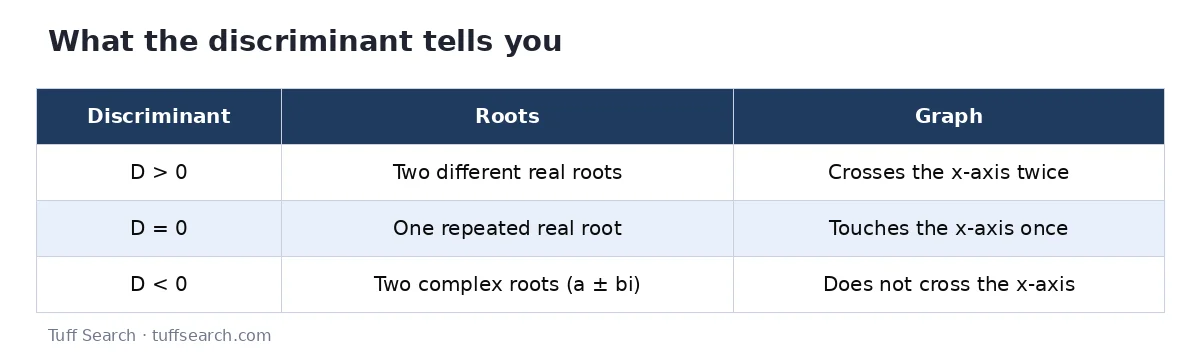
What the discriminant tells you
| Discriminant | Roots | Graph |
|---|---|---|
| D > 0 | Two different real roots | Crosses the x-axis twice |
| D = 0 | One repeated real root | Touches the x-axis once |
| D < 0 | Two complex roots (a ± bi) | Does not cross the x-axis |
Example with D < 0: x² + 2x + 5 = 0 gives D = 4 − 20 = −16, so x = (−2 ± 4i) ÷ 2 = −1 ± 2i.
Vertex and axis of symmetry
The parabola y = ax² + bx + c turns at x = −b ÷ 2a. For y = x² − 5x + 6 the vertex is at x = 2.5, y = -0.25, so the minimum value is -0.25. The roots sit an equal distance either side of this line.
A real-world example
A ball thrown up at 20 m/s from 1.5 m high follows h = −4.9t² + 20t + 1.5. Setting h = 0 and using the formula gives t ≈ 4.16 s (the negative root, -0.07 s, is ignored), so the ball lands about 4.2 seconds after it is thrown.
Other ways to solve a quadratic
- Factoring: fastest when the roots are whole numbers – x² − 5x + 6 = (x − 2)(x − 3).
- Completing the square: rewrite as (x + p)² = q; useful for finding the vertex.
- Graphing: read the x-intercepts, but only approximately.
- The formula always works, which is why the calculator uses it.
Common mistakes
- Dropping the sign of b or c.
- Dividing only √D by 2a instead of the whole numerator.
- Forgetting that −b is positive when b is negative.
- Stopping at D < 0 – the roots exist, they are complex.
Sources
- Khan Academy – Algebra 1 — khanacademy.org/math/algebra
- OpenStax – Algebra and Trigonometry 2e (Rice University) — openstax.org/details/books/algebra-and-trigonometry-2e
Questions or feedback about this calculator? Contact us – we read every message. Results are estimates for information only. Last reviewed: .

Written & built by
Zeeshan Nawaz
Calculator Developer · Tuff Search
Builds and tests Tuff Search calculators, turning published formulas and official sources into tools anyone can check.
FAQ
Frequently asked questions
Quick answers about the Quadratic Formula Calculator.
x = (−b ± √(b² − 4ac)) ÷ 2a, which gives the roots of ax² + bx + c = 0.
The equation has no real roots; it has two complex roots.
No. If a = 0 the equation is linear, not quadratic.
x = −b ÷ 2a, then substitute that x back into the equation for y.
Yes, counting a repeated root twice. When D = 0 both answers are the same.
Still have a question? Email support@tuffsearch.com
Keep exploring
Related calculators
More calculators people use alongside this one.
Zeeshan Nawaz
Calculator Developer · Tuff Search
Builds and tests Tuff Search calculators. Each tool is based on published formulas and official sources, and is checked against worked test cases before it goes live.
- Quadratic Formula CalculatorMath CalculatorsYou are here
- Dog Age CalculatorBiology
- Fuel Cost CalculatorDaily Life