
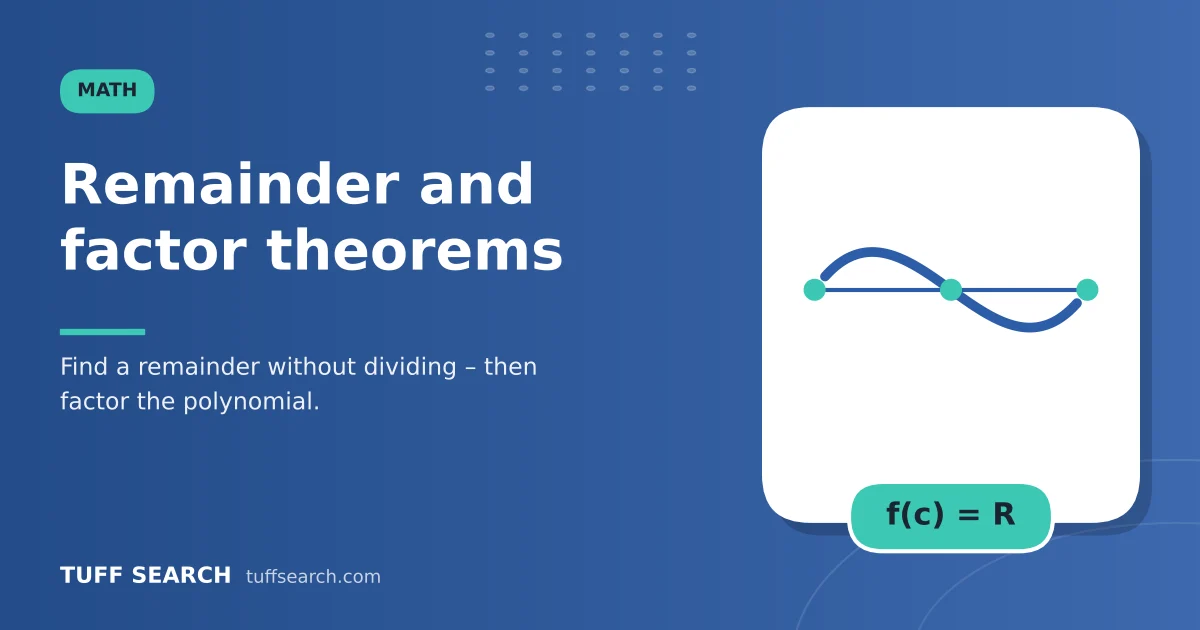
Dividing polynomials by hand is slow. Two short theorems let you skip most of the work: the remainder theorem tells you the remainder of a division instantly, and the factor theorem tells you whether a linear expression is a factor. Together with synthetic division, they are the quickest route to factoring cubics and higher-degree polynomials.
The remainder theorem
When f(x) is divided by (x − c), the remainder is f(c).
Example
find the remainder when f(x) = 2x³ − 3x² + 4x − 5 is divided by (x − 1). Substitute x = 1: f(1) = 2 − 3 + 4 − 5 = −2. The remainder is −2 – no division needed.
Watch the sign: dividing by (x + 3) means c = −3, because x + 3 = x − (−3).
The factor theorem
(x − c) is a factor of f(x) if and only if f(c) = 0.
It follows directly from the remainder theorem: a remainder of zero means the division is exact. So to test a possible factor, just evaluate the polynomial.
Try it with your numbersSynthetic Division CalculatorDivide a polynomial by (x − c) with synthetic division.Open calculatorWorked example: factor a cubic
Factor f(x) = x³ − 4x² + x + 6.
- List likely roots. For a polynomial with integer coefficients, any rational root p/q has p dividing the constant term (6) and q dividing the leading coefficient (1). Candidates: ±1, ±2, ±3, ±6.
- Test them. f(1) = 1 − 4 + 1 + 6 = 4 (not a root). f(2) = 8 − 16 + 2 + 6 = 0 – so (x − 2) is a factor.
- Divide by (x − 2) using synthetic division to get the quotient x² − 2x − 3.
- Factor the quadratic: x² − 2x − 3 = (x − 3)(x + 1).
- Result: f(x) = (x − 2)(x − 3)(x + 1), with roots 2, 3 and −1.
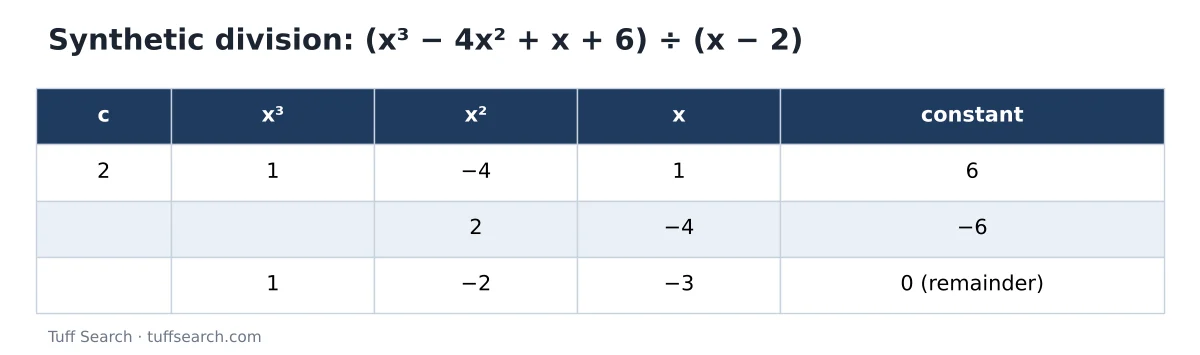
The synthetic division calculator does step 3 for any polynomial and shows the remainder, so you can test candidate roots quickly.
How synthetic division connects
Synthetic division divides by (x − c) using only the coefficients. The last number in the bottom row is the remainder, which always equals f(c). That gives you a way to check your arithmetic: evaluate f(c) directly and compare.
More examples
| Polynomial | Divisor | c | Remainder f(c) | Factor? |
|---|---|---|---|---|
| x³ − 8 | x − 2 | 2 | 0 | Yes |
| x² + 5x + 6 | x + 2 | −2 | 0 | Yes |
| x³ + 2x² − x + 4 | x + 1 | −1 | 6 | No |
| 2x³ − 3x² + 4x − 5 | x − 1 | 1 | −2 | No |
Using the theorems to find unknown coefficients
If (x − 3) is a factor of x³ − 2x² + kx − 6, then f(3) = 0: 27 − 18 + 3k − 6 = 0 → 3 + 3k = 0 → k = −1. Exam questions often use this trick.
Common mistakes
- Using the wrong sign for c: (x + 4) means c = −4.
- Forgetting zero coefficients in synthetic division – x³ − 8 has coefficients 1, 0, 0, −8.
- Stopping after finding one factor – keep factoring the quotient.
- Applying the theorem to divisors that are not linear, such as (x² + 1).
For solving several equations at once, see how to solve systems of equations.
Frequently asked questions
When a polynomial f(x) is divided by (x − c), the remainder equals f(c).
(x − c) is a factor of f(x) exactly when f(c) = 0.
Use the rational root theorem: test ± factors of the constant term divided by factors of the leading coefficient.
The last value in synthetic division is the remainder, which always equals f(c).
Related calculators
Related articles
- How to Solve Systems of Equations: 4 Methods
- Perfect Squares and Square Roots: Chart and Tricks
- Midpoint Formula Explained With Step-by-Step Examples