

Before you plan your revision, find out what the final can actually do to your grade. One short formula tells you the score you need – and whether the grade you are hoping for is still possible.
The formula
Needed final score = (target grade − current grade × (1 − final weight)) ÷ final weight. Write the weight as a decimal, so 25% is 0.25.
- Find your current grade without the final.
- Find the final’s weight in the syllabus.
- Multiply current grade by (1 − weight): these points are already locked in.
- Subtract from your target and divide by the weight.
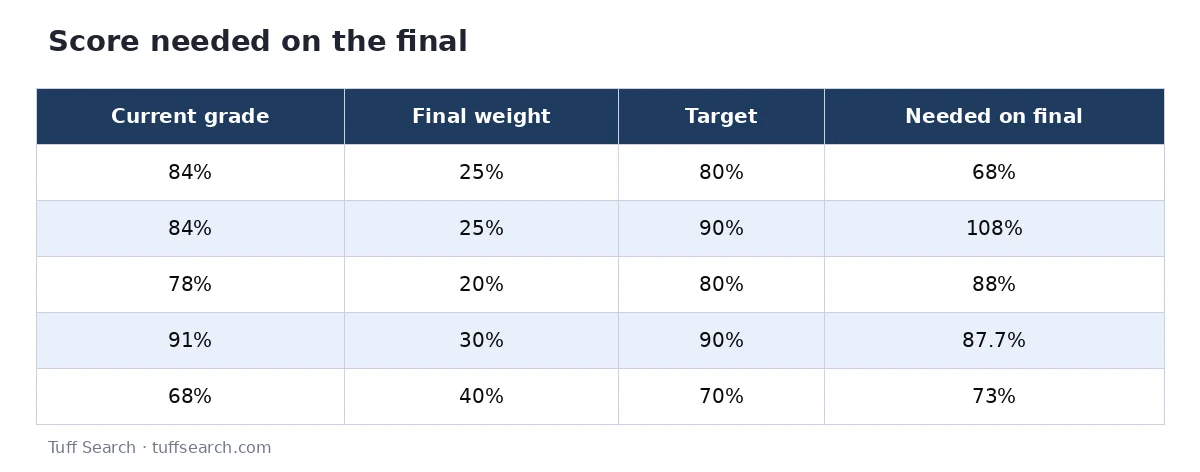
Worked examples
| Current grade | Final weight | Target | Needed on final |
|---|---|---|---|
| 84% | 25% | 80% | 68% |
| 84% | 25% | 90% | 108% |
| 78% | 20% | 80% | 88% |
| 91% | 30% | 90% | 87.7% |
| 68% | 40% | 70% | 73% |
With an 84 and a final worth 25%, you have 84 × 0.75 = 63 points locked in. An 80 overall needs (80 − 63) ÷ 0.25 = 68%. A 90 overall would need 108% – more than 100, so it cannot happen without extra credit.
How much can the final change your grade?
Your overall grade can only land between current × (1 − weight) and that plus the full weight. With an 84 and a 25% final, the range is 63% (a zero) to 88% (a perfect score). The heavier the final, the wider the range – which is good news if you are behind and a risk if you are ahead.
If your class uses points
Turn the final into a weight first: final points ÷ total course points. A 150-point final in a 600-point course is worth 25%.
Things that change the answer
- A final that replaces your lowest test score – its real weight is higher.
- Dropped scores or extra credit that are not in your current grade yet.
- Rounding: some instructors round 89.5 up to an A−, some do not. Ask.
- A minimum final-exam score required to pass, whatever your average.
Using the number
If you need less than 60%, the grade is close to safe – protect it with steady revision. If you need 85–100%, focus on the highest-value topics. If you need more than 100%, choose the best grade still reachable and aim for that.
Check the result with the forward formula
Always test your answer by going the other way: overall = current × (1 − weight) + final score × weight. With an 84, a 25% final and a 68 on the exam: 84 × 0.75 + 68 × 0.25 = 63 + 17 = 80. If the forward calculation does not return your target, a weight or a grade has been entered wrongly.
When there are two things left
If you still have a project and a final to come, treat them together first. Add their weights, find the average score you need across both, and then decide how to split it. For example, with 60% of the course done at 82, and a 15% project plus a 25% final remaining, an 85 overall needs (85 − 82 × 0.6) ÷ 0.4 = 89.5 on average across the two. Score 95 on the project and you need about 86 on the final.
How weight changes the pressure
| Final weight | Needed for 90 overall (current 88) | Needed for 80 overall (current 88) |
|---|---|---|
| 10% | 108% | 8% |
| 20% | 98% | 48% |
| 30% | 94.7% | 61.3% |
| 40% | 93% | 68% |
With a small final, moving up a grade band takes a near-perfect score, but dropping a band is also unlikely. With a heavy final, both become realistic.
Frequently asked questions
(target − current × (1 − weight)) ÷ weight.
The target is not reachable without extra credit.
You have already secured that grade.
It depends on the weight; a 20% final can move your grade by at most 20 points in theory, and usually far less.
Yes – use the midterm’s weight instead.