
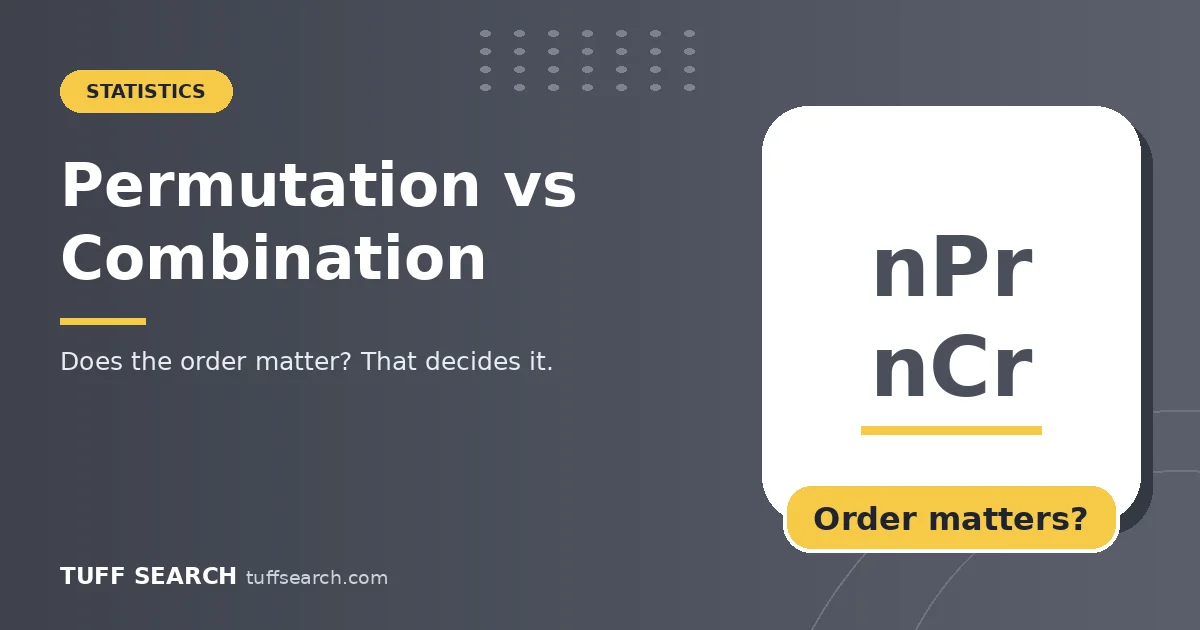
Most counting mistakes come from one decision: is this a permutation or a combination? Ask a single question – would swapping two of the chosen items give a different result? If yes, it is a permutation. If no, it is a combination.
The formulas
| Permutation | Combination | |
|---|---|---|
| Order matters? | Yes | No |
| Formula | nPr = n! ÷ (n − r)! | nCr = n! ÷ (r! (n − r)!) |
| Choose 3 from 10 | 720 | 120 |
| Typical words | arrange, rank, order, code | choose, select, group, team |
From 10 runners, the number of ways to award gold, silver and bronze is 10 × 9 × 8 = 720. The number of ways to pick 3 runners for a relay squad is 720 ÷ 3! = 120, because each group of three can be ordered in 6 ways that all count as the same squad.
How they are connected
nPr = nCr × r!. A permutation is a combination plus an ordering of the chosen items. That is why there are always at least as many permutations as combinations.
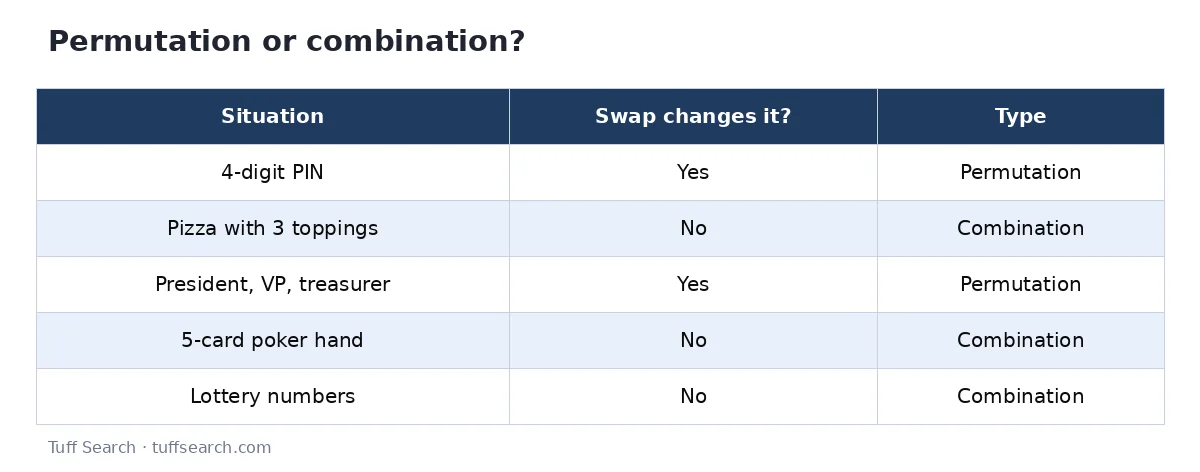
Quick test with examples
| Situation | Swap changes it? | Type |
|---|---|---|
| 4-digit PIN | Yes – 1234 ≠ 4321 | Permutation |
| Pizza with 3 toppings | No | Combination |
| President, VP, treasurer | Yes | Permutation |
| 5-card poker hand | No | Combination |
| Seating 6 people in a row | Yes | Permutation |
| Lottery numbers | No | Combination |
A note on ‘combination locks’
A combination lock is really a permutation lock: 12-24-36 opens it but 36-24-12 does not. The everyday word ‘combination’ is looser than the mathematical one.
With repetition
- Permutations with repetition: nʳ. A 4-digit PIN has 10⁴ = 10,000 possibilities.
- Combinations with repetition: C(n + r − 1, r). Three scoops from 5 flavours: C(7, 3) = 35.
Bigger numbers
The number of 5-card hands from a 52-card deck is 52C5 = 2,598,960. If order mattered it would be 52P5 = 311,875,200 – 120 times as many.
A step-by-step way to decide
- Write down what one outcome looks like (for example ‘Ana, Ben, Cy’).
- Rearrange it (‘Cy, Ana, Ben’).
- Ask: is that a different outcome in this problem?
- Different → permutation. Same → combination.
- Then check whether items can repeat, and pick the matching formula.
Mixed problems
Some questions need both. From 8 women and 6 men, a committee of 2 women and 2 men is C(8, 2) × C(6, 2) = 28 × 15 = 420 combinations. If the four are then given four different roles, multiply by 4! = 24 to get 10,080 – the roles add an ordering on top of the selection.
From counting to probability
Probabilities come from dividing one count by another. The chance of being dealt four aces in a 5-card hand is the number of such hands (48, one for each possible fifth card) divided by 2,598,960 – about 1 in 54,145. Using permutations in both numerator and denominator gives the same answer, as long as you are consistent.
Frequently asked questions
Order matters in a permutation and does not in a combination.
nPr, by a factor of r!.
A combination – the order the numbers are drawn does not matter.
Yes, because order matters; with repeated characters allowed it is nʳ.
n factorial: n × (n − 1) × … × 1.