Your cumulative GPA is the single number colleges, scholarship committees and some employers look at first. It is the average of every graded course you have taken so far, weighted by credits – which is why one great or terrible semester moves it less than you might expect.
Cumulative GPA vs semester GPA
| Semester (term) GPA | Cumulative GPA | |
|---|---|---|
| Covers | One term | Every term so far |
| Changes | Resets each term | Moves slowly as credits build |
| Used for | Dean’s list, academic probation checks | Graduation, admissions, scholarships |
Both use the same formula – total quality points divided by total credits. The only difference is which courses are included.
How to calculate cumulative GPA
- Convert each letter grade to grade points (A = 4.0, B = 3.0, and so on).
- Multiply by the course’s credits to get quality points.
- Add up quality points for every term.
- Divide by the total credits attempted.
Example
after two semesters you have a 3.0 over 30 credits (90 quality points). This term you earn a 3.6 over 15 credits (54 points). Cumulative GPA = (90 + 54) ÷ 45 = 3.2. Note that it is not the simple average of 3.0 and 3.6 – the 30-credit block counts twice as much as the 15-credit one.
Why cumulative GPA is hard to move
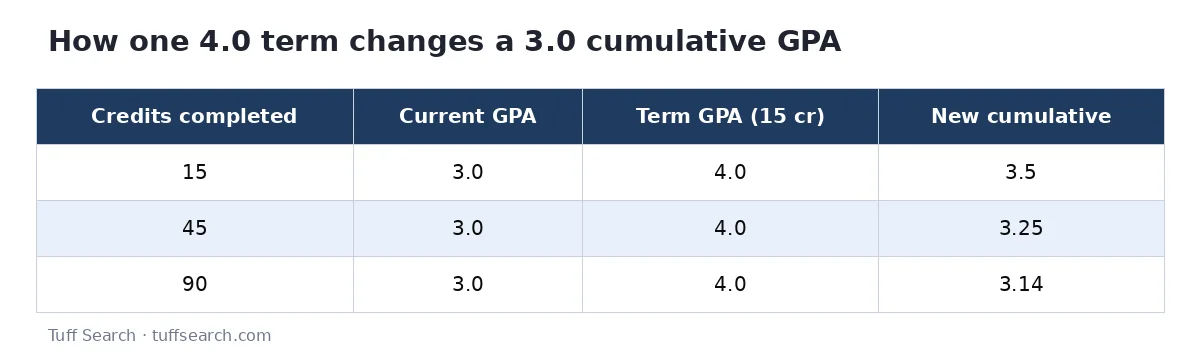
Every new credit is a smaller share of the total. A student with a 3.2 over 45 credits who wants a 3.5 after one more 15-credit term would need a 4.4 that term – impossible on a 4.0 scale. Over two terms (30 credits) the same goal needs a 3.95 average, which is hard but reachable.
| Credits completed | Current GPA | Term GPA (15 cr) | New cumulative |
|---|---|---|---|
| 15 | 3.0 | 4.0 | 3.5 |
| 45 | 3.0 | 4.0 | 3.25 |
| 90 | 3.0 | 4.0 | 3.14 |
Weighted and unweighted
An unweighted GPA uses the plain 4.0 scale. Many US high schools add extra points for honors, AP or IB courses, so a weighted cumulative GPA can be above 4.0. Colleges often recalculate GPAs using their own rules, so report whichever version an application asks for.
What usually does not count
- Pass/fail and credit/no-credit courses.
- Withdrawals (W) – though they stay on the transcript.
- Transfer credits at many colleges: the credits count, the grades often do not.
- Repeated courses – policies vary; some schools replace the old grade, others average both.
What is a good cumulative GPA?
It depends on the goal. Many colleges require a 2.0 to stay in good standing and graduate. Honors, competitive programs and scholarships set their own, higher cut-offs. Check the requirement for your specific school or program rather than relying on a general rule.
A full worked example
Suppose a first-year student takes five courses in the autumn: Biology (4 credits, B+), Calculus (4, B), English (3, A−), History (3, A) and a 1-credit lab (A). Quality points: 3.3 × 4 = 13.2, 3.0 × 4 = 12, 3.7 × 3 = 11.1, 4.0 × 3 = 12 and 4.0 × 1 = 4, a total of 52.3 over 15 credits – a term GPA of 3.49. In spring the same student earns 48 points over 16 credits (3.00). The cumulative GPA is (52.3 + 48) ÷ 31 = 3.24, slightly closer to the spring figure because spring carried one more credit.
How to plan a GPA target
- Write down your current cumulative GPA and credits completed.
- Decide the cumulative GPA you want and by when.
- Multiply the target by the total credits you will have then.
- Subtract your current quality points; divide the remainder by the credits still to take.
If the answer is above 4.0, spread the goal over more terms or adjust the target. If it is below your usual term GPA, you already have a margin. Re-run the numbers after every term – it takes two minutes and removes the guesswork.
Cumulative GPA and major GPA
Many colleges also report a major GPA, which uses only the courses in your field. Graduate programs and some employers care more about it than the overall figure, so a weak first year in general courses matters less if your major grades are strong. Transcripts usually show term, cumulative and sometimes major GPA side by side.
Frequently asked questions
Yes. Both mean your GPA across all terms.
Yes – every graded course on the transcript so far.
Earn high grades in courses with more credits; the earlier you are in your studies, the faster it moves.
Most look at both, and many recalculate using their own scale.
It lowers it, but the effect shrinks as you complete more credits.