
Protein Calculator
Last updated
Show steps
Enter your weight, activity level and goal, and this protein calculator gives a daily protein range in grams, plus how much to aim for at each meal.
How much protein do you need?
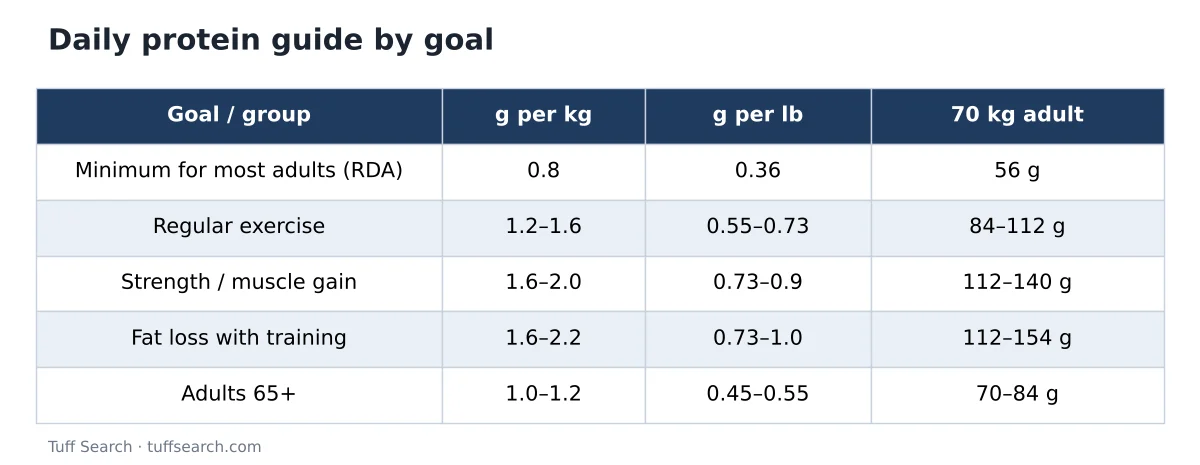
The Recommended Dietary Allowance of 0.8 g/kg, set by the US National Academies, is the amount that meets the needs of almost all healthy adults who are not very active. It is a minimum to avoid deficiency, not an optimum for muscle. Position statements from sports nutrition bodies (ACSM, the Academy of Nutrition and Dietetics and Dietitians of Canada, and the International Society of Sports Nutrition) suggest 1.2–2.0 g/kg for people who exercise, with the higher end for strength training and periods of calorie restriction. For older adults, an expert group (PROT-AGE) recommends 1.0–1.2 g/kg to help limit age-related muscle loss.
How to calculate your protein intake
- Convert your weight to kilograms if needed (pounds ÷ 2.2046).
- Pick the g/kg range that matches your activity and goal.
- Multiply: weight × lower and upper g/kg.
- Divide the daily target by the number of meals.
Example: a 70 kg adult who lifts weights three or four times a week. 70 × 1.6 = 112 g and 70 × 2.0 = 140 g, so a range of about 112–140 g a day. Spread over four meals, 112 g is 28 g per meal. A 180 lb person (81.6 kg) on the same goal needs about 131–163 g.
Protein per meal and timing
Research suggests that muscle-building responds best when protein is spread across the day – roughly 0.25–0.4 g/kg per meal (about 20–40 g for most adults) – rather than eaten mostly at dinner. Having a protein-containing meal or snack within a few hours of training is a practical way to support recovery. Total daily intake still matters most.
Protein in common foods
| Food (typical serving) | Protein (approx.) |
|---|---|
| Chicken breast, cooked, 100 g | 31 g |
| Canned tuna, drained, 100 g | 25 g |
| Greek yogurt, plain, 170 g | 15–17 g |
| Eggs, 2 large | 12–13 g |
| Lentils, cooked, 1 cup (200 g) | 18 g |
| Tofu, firm, 100 g | 12–17 g |
| Milk, 1 cup (240 ml) | 8 g |
| Peanuts, 30 g | 7 g |
Values vary by brand and preparation – check labels or the USDA FoodData Central database for exact figures. Animal proteins and soy contain all essential amino acids in useful amounts. Plant-based eaters can meet their needs by combining foods such as legumes, grains, nuts and seeds through the day, and may aim toward the upper end of the range.
Protein for weight loss
During a calorie deficit, higher protein (around 1.6–2.2 g/kg alongside strength training) helps preserve lean muscle and keeps you fuller for longer. Work out your calorie target with the calorie deficit calculator, then set protein first and fill the rest with carbohydrates and fats. If you are very overweight, some professionals base protein on a goal or adjusted body weight rather than current weight – a dietitian can advise.
Can you eat too much protein?
For healthy adults, intakes up to about 2 g/kg appear safe in research, and there is no official upper limit set by the National Academies. People with chronic kidney disease are usually advised to limit protein and should follow their doctor's advice rather than any calculator. Very high protein diets can also crowd out fibre-rich foods, so keep plenty of vegetables, fruit and whole grains in the mix.
Pregnancy and breastfeeding
Protein needs rise in pregnancy – the National Academies set the RDA at about 1.1 g/kg of pre-pregnancy weight (around 71 g a day) for the second half of pregnancy, and similar amounts while breastfeeding. Follow the advice of your midwife or doctor.
This calculator gives general nutrition information and is not medical or dietary advice. Talk to a doctor or registered dietitian before making large changes, particularly if you have kidney or liver disease, are pregnant, or are under 18.
Example daily protein plan
| Meal | Example | Protein (approx.) |
|---|---|---|
| Breakfast | Greek yogurt (170 g) with oats and a handful of nuts | 22 g |
| Lunch | Chicken breast (120 g) salad wrap | 40 g |
| Snack | 2 eggs or a glass of milk with a banana | 8–13 g |
| Dinner | Lentil and vegetable curry (1.5 cups lentils) with rice | 30 g |
| Total | ≈ 100–105 g |
This kind of day meets the target for a 70 kg person training a few times a week (about 84–112 g). Adjust portions up or down using the per-meal target from the calculator.
Plant-based protein
Vegetarians and vegans can meet protein targets with legumes (beans, lentils, chickpeas), soy foods (tofu, tempeh, edamame, soy milk), seitan, nuts, seeds and whole grains. Most plant proteins are lower in one or more essential amino acids, but eating a variety across the day balances this out. Because plant foods also contain fibre that slightly reduces digestibility, some dietitians suggest aiming toward the upper end of your range. Soy and pea protein powders are convenient if whole foods are not enough.
Do you need protein powder?
No – powders are a convenience, not a requirement. They help when you struggle to reach your target with food, have a busy schedule or have higher needs. Choose products that are third-party tested for contaminants, and count them as part of your daily total rather than on top of it.
Signs you might not be getting enough protein
True protein deficiency is uncommon in countries with a varied food supply, but low intakes are more likely in older adults with small appetites, people on restrictive diets and those recovering from illness or surgery. Possible signs include losing muscle strength, slow recovery from injuries and swelling (oedema) in severe cases. These signs have many other causes too, so talk to a doctor rather than self-diagnosing.
Sources
- National Academies – Dietary Reference Intakes for Energy, Carbohydrate, Fiber, Fat, Fatty Acids, Cholesterol, Protein, and Amino Acids — nap.nationalacademies.org/catalog/10490
- Thomas DT, Erdman KA, Burke LM (2016) – Nutrition and athletic performance, joint position of the Academy of Nutrition and Dietetics, Dietitians of Canada and ACSM (PDF) — dietitians.ca/DietitiansOfCanada/media/Documents/Resources/noap-position-paper.pdf?ext=.pdf
- Jäger R et al. (2017) – ISSN position stand: protein and exercise — jissn.biomedcentral.com/articles/10.1186/s12970-017-0177-8
- Bauer J et al. (2013) – Evidence-based recommendations for optimal dietary protein intake in older people (PROT-AGE) – PubMed — pubmed.ncbi.nlm.nih.gov/23867520
- USDA – FoodData Central — fdc.nal.usda.gov
Results are estimates for general information. Last reviewed: .

Written & built by
Zeeshan Nawaz
Calculator Developer · Tuff Search
Builds and tests Tuff Search calculators, turning published formulas and official sources into tools anyone can check.
FAQ
Frequently asked questions
Quick answers about the Protein Calculator.
At least 0.8 g per kg of body weight for most adults; 1.2–2.0 g/kg if you exercise regularly.
About 1.6–2.0 g per kg of body weight per day, spread over 3–5 meals, together with resistance training.
0.36 g/lb meets the RDA; 0.7–0.9 g/lb suits people doing strength training.
Your body absorbs nearly all the protein you eat; for muscle building, 20–40 g per meal is a practical target.
Experts suggest 1.0–1.2 g/kg for people over 65, and more if they are active or recovering from illness.
In healthy people, research has not shown harm at moderately high intakes, but people with kidney disease should follow medical advice.
Still have a question? Email support@tuffsearch.com
Keep exploring
Related calculators
More calculators people use alongside this one.
- DRI CalculatorGet your Dietary Reference Intakes – RDA, AI and upper
- Keto CalculatorCalculate daily keto macros from your age, sex, height,
- TDEE CalculatorEstimate your total daily energy expenditure with the
- Calorie Deficit CalculatorFind how many calories to eat to lose weight: your TDEE,
- Fat Intake CalculatorWork out how many grams of fat to eat per day from your
Zeeshan Nawaz
Calculator Developer · Tuff Search
Builds and tests Tuff Search calculators. Each tool is based on published formulas and official sources, and is checked against worked test cases before it goes live.
- Protein CalculatorHealthYou are here
- Dog Age CalculatorBiology
- Fuel Cost CalculatorDaily Life