
Due Date Calculator
Last updated
Show steps
Enter the first day of your last menstrual period (or your conception date, IVF transfer date or ultrasound result) and this due date calculator estimates your due date, how many weeks pregnant you are today, your trimester and important dates ahead.
How the due date is calculated
The standard method, often called Naegele's rule, adds 280 days (40 weeks) to the first day of your last menstrual period (LMP). It assumes a 28-day cycle with ovulation around day 14. For an LMP of 1 March 2026, the due date is 6 December 2026. If your cycles are longer or shorter, ovulation shifts, so the calculator adjusts: with 32-day cycles the due date moves 4 days later, to 10 December 2026.
Because pregnancy is counted from the last period, you are already considered about 2 weeks pregnant when conception happens. That is why '40 weeks pregnant' is about 38 weeks after conception.
Due date from conception, IVF or ultrasound
| Method | Rule | Example |
|---|---|---|
| Last period | LMP + 280 days (+ cycle adjustment) | 1 March → 6 December |
| Conception date | Conception + 266 days | 15 March → 6 December |
| IVF, day-5 embryo | Transfer + 261 days | 20 March → 6 December |
| IVF, day-3 embryo | Transfer + 263 days | 20 March → 8 December |
| Ultrasound | Scan date + (280 − age at scan) | Scan at 8w0d on 26 Apr → 6 Dec |
For IVF pregnancies, the American College of Obstetricians and Gynecologists (ACOG) recommends dating from the embryo age and transfer date, because these are known exactly.
When an early scan changes your due date
Measuring the embryo (crown–rump length) on a first-trimester ultrasound is the most accurate way to date a pregnancy. ACOG's guidance is to change the LMP-based due date if the scan differs by more than 5 days before 9 weeks, or by more than 7 days between 9 weeks and 13 weeks 6 days. Later scans are less precise for dating. If your provider gives you a revised date, use the ultrasound method in the calculator.
How many weeks pregnant am I?
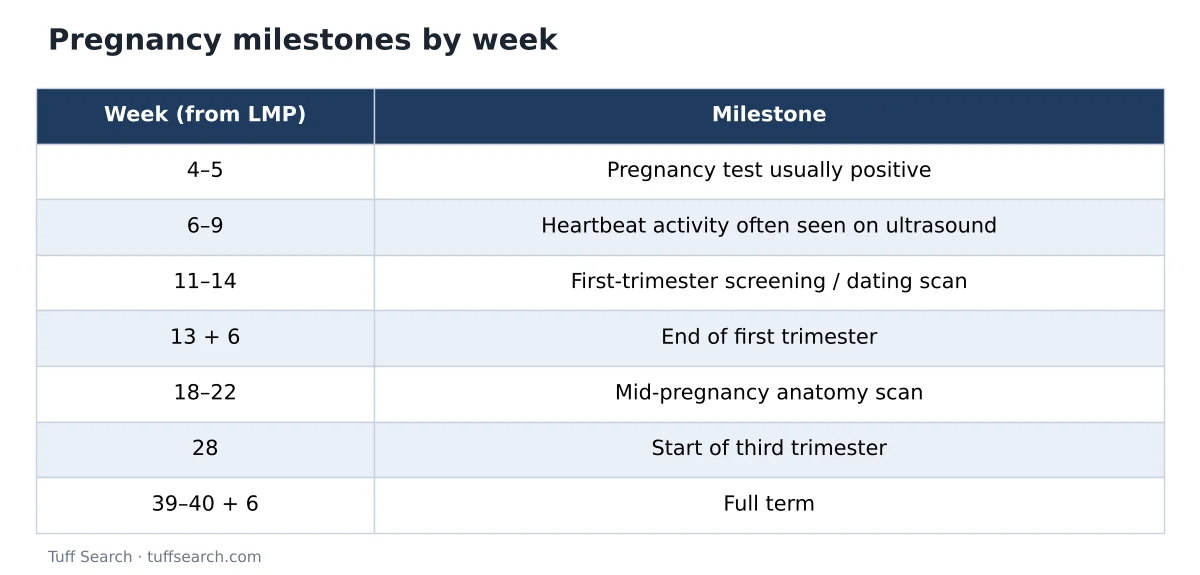
Gestational age is the number of days since the LMP, written as weeks + days. On 15 June 2026, with an LMP of 1 March 2026, it has been 106 days – 15 weeks and 1 day – which is in the second trimester. The trimesters are usually counted as weeks 1–13 + 6, 14–27 + 6 and 28 until birth.
Pregnancy milestones by week
Will my baby arrive on the due date?
Probably not exactly. The due date is the middle of a normal range, and only a small share of babies are born on it. Most arrive within about two weeks either side. ACOG defines the stages of term as:
- Early term: 37 weeks 0 days to 38 weeks 6 days
- Full term: 39 weeks 0 days to 40 weeks 6 days
- Late term: 41 weeks 0 days to 41 weeks 6 days
- Post-term: 42 weeks 0 days and later
- Babies born before 37 weeks are preterm.
First pregnancies, long cycles and some health conditions can influence when labour starts. Your care team will discuss what happens if you go past your due date.
What to do next
- Book your first prenatal appointment as soon as you know you are pregnant.
- Ask about folic acid and any medicines you take.
- Keep a note of your LMP and cycle length to share with your provider.
- Use the key dates from the calculator to plan scans and time off work.
This calculator provides an estimate for general information. It is not medical advice and does not replace dating by your doctor or midwife. Contact your care provider with any concerns during pregnancy.
Working backwards: when did I conceive?
If you know your due date, conception was most likely about 266 days (38 weeks) earlier – roughly two weeks after the start of your last period. A due date of 6 December 2026 points to conception around 15 March 2026. Because ovulation timing varies and sperm can survive for several days, this is an estimate within a window of several days, not an exact date.
Trimesters at a glance
| Trimester | Weeks | Typical highlights |
|---|---|---|
| First | 1 to 13 + 6 | Early symptoms such as nausea and tiredness; dating and screening scans |
| Second | 14 to 27 + 6 | Many people feel more energetic; anatomy scan; first movements felt |
| Third | 28 to birth | Baby gains weight; more frequent check-ups; preparing for birth |
Twins and IVF due dates
Twin and other multiple pregnancies use the same due-date calculation, but they are more likely to be born before the due date, and care teams often plan delivery earlier. Your provider will give you guidance specific to your pregnancy. For IVF with frozen embryos, use the transfer date and the embryo's age (day 3 or day 5) – the calculator handles both.
Sources
- ACOG Committee Opinion No. 700 – Methods for estimating the due date — acog.org/clinical/clinical-guidance/committee-opinion/articles/2017/05/methods-for-estimating-the-due-date
- NHS – Your pregnancy and baby guide — nhs.uk/pregnancy
- Office on Women's Health – Pregnancy tests — womenshealth.gov/a-z-topics/pregnancy-tests
Results are estimates for general information. Last reviewed: .

Written & built by
Zeeshan Nawaz
Calculator Developer · Tuff Search
Builds and tests Tuff Search calculators, turning published formulas and official sources into tools anyone can check.
FAQ
Frequently asked questions
Quick answers about the Due Date Calculator.
By adding 280 days to the first day of your last period, adjusted for your cycle length – or from conception, IVF transfer or ultrasound dates.
Yes. An early ultrasound may change it if it differs from the LMP date by more than about 5–7 days.
It gives the same estimate a provider would from your LMP, but most babies are born within two weeks either side of it.
Use your conception date if known, or ask for a dating ultrasound and enter the result.
39 weeks 0 days to 40 weeks 6 days. 37–38 weeks is early term.
First trimester to 13 weeks 6 days, second from 14 to 27 weeks 6 days, third from 28 weeks.
Still have a question? Email support@tuffsearch.com
Keep exploring
Related calculators
More calculators people use alongside this one.
- Ovulation CalculatorEstimate your ovulation day and fertile window for the
- Period CalculatorPredict your next periods, likely ovulation day and
- Chances of Having Twins CalculatorSee your chance of twins by age, IVF embryo transfer or
- Childcare Cost CalculatorEstimate daycare, nanny or after-school costs and your
Zeeshan Nawaz
Calculator Developer · Tuff Search
Builds and tests Tuff Search calculators. Each tool is based on published formulas and official sources, and is checked against worked test cases before it goes live.
- Due Date CalculatorFemaleYou are here
- Dog Age CalculatorBiology
- Fuel Cost CalculatorDaily Life