
Ovulation Calculator
Last updated
Show steps
Enter the first day of your last period and your usual cycle length, and this ovulation calculator estimates your ovulation day and fertile window for the next three cycles, with the best days to start ovulation tests.
How the ovulation calculator works
A menstrual cycle has two halves. The first (follicular phase) varies in length from person to person and month to month. The second (luteal phase), from ovulation to the next period, is more consistent – often around 12–14 days. So the calculator counts backwards from your next expected period rather than forwards from your last one.
- Next period = first day of last period + cycle length.
- Ovulation ≈ next period − luteal phase (14 days unless you enter your own).
- Fertile window = the 5 days before ovulation plus ovulation day.
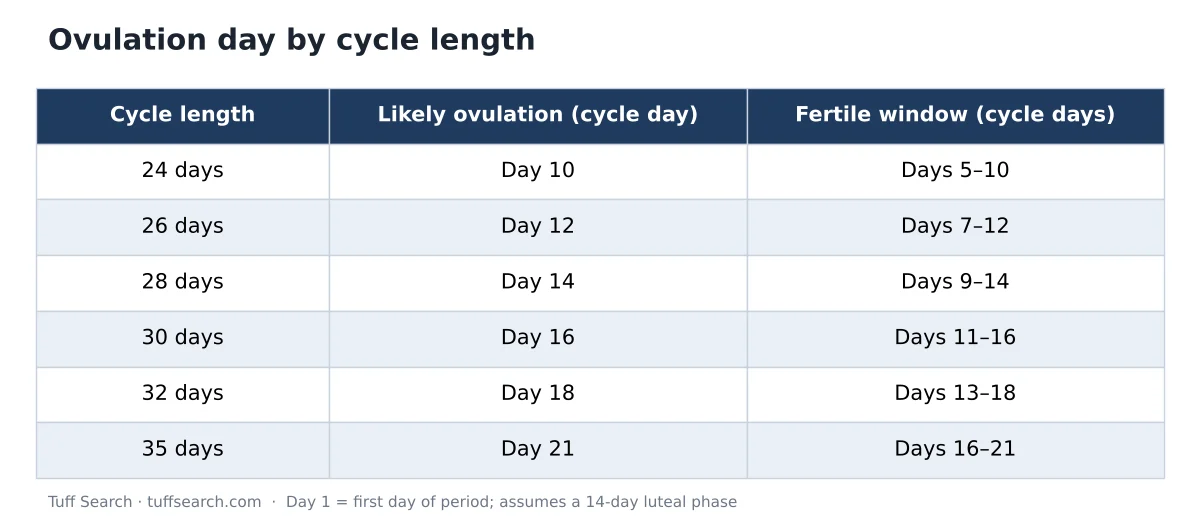
Example: last period started 1 March 2026, 28-day cycle. Next period: 29 March. Ovulation: about 15 March. Fertile window: 10 March–15 March. With a 32-day cycle, ovulation moves to about 19 March – which is why the 'day 14' rule only works for 28-day cycles.
Ovulation day by cycle length
What is the fertile window?
Sperm can survive in the reproductive tract for up to about five days, while an egg lives for roughly 12–24 hours after ovulation. A landmark study by Wilcox and colleagues (NEJM, 1995) found that pregnancies occurred only when intercourse took place in the six-day window ending on ovulation day, with the highest chance in the two days before and on ovulation. That is why the calculator highlights those days as 'peak'.
Irregular periods
If your cycle length changes from month to month, a single date can be misleading. Enter your shortest and longest recent cycles. For cycles between 26 and 34 days starting 1 March, ovulation could fall anywhere from about 13 March to 21 March, so the possible fertile window is wider – 8 March to 21 March. In this situation, ovulation tests or other signs are far more useful than the calendar alone. Very irregular, very short (under 21 days) or very long (over 35 days) cycles are worth discussing with a doctor, as conditions such as polycystic ovary syndrome (PCOS) and thyroid problems can affect ovulation.
How to confirm ovulation
| Method | What it shows | Tip |
|---|---|---|
| Ovulation (LH) test strips | LH surge 24–36 hours before ovulation | Start testing 2–3 days before the calculator's earliest date |
| Cervical mucus | Clear, stretchy, slippery mucus near ovulation | Most fertile when it looks like raw egg white |
| Basal body temperature (BBT) | Small rise after ovulation | Confirms ovulation afterwards – useful for learning your pattern |
| Fertility monitors and apps | Combine hormones or data | Accuracy varies; still estimates |
Tips when trying to conceive
- Having sex every 1–2 days through the fertile window covers the most likely days without needing an exact date.
- Track at least three cycles to learn your typical length.
- Folic acid is usually recommended before and in early pregnancy – ask your doctor or pharmacist.
- If ovulation happens, a pregnancy test is most reliable from the first day of your missed period – see our guide on when to take a pregnancy test.
When to see a doctor
Common guidance is to see a doctor if you have not conceived after 12 months of regular unprotected sex, or after 6 months if you are 35 or older – or sooner if your periods are very irregular or absent, you have known conditions such as endometriosis, or you or your partner have concerns about fertility.
This calculator gives estimates only and must not be used as a method of contraception. It is not medical advice. Cycle length, illness, stress, breastfeeding and recent hormonal contraception can all change when you ovulate.
The phases of the menstrual cycle
| Phase | Typical timing (28-day cycle) | What happens |
|---|---|---|
| Menstruation | Days 1–5 | Lining of the uterus sheds |
| Follicular phase | Days 1–13 | Follicles develop; oestrogen rises; length varies most between people |
| Ovulation | About day 14 | LH surge releases an egg |
| Luteal phase | Days 15–28 | Progesterone rises; usually 12–14 days long |
Because the follicular phase is the part that varies, someone with 35-day cycles ovulates around day 21, not day 14. Counting back from the next period is more reliable than counting forward from the last one.
Ovulation after stopping birth control or after birth
After stopping the pill, patch or ring, ovulation often returns within a few weeks to a few months; after the contraceptive injection it can take longer. After giving birth, ovulation can return before the first period – even while breastfeeding – so the calendar method cannot predict it reliably. In these situations ovulation tests or advice from a healthcare professional are more useful than a calculator.
Sources
- NHS – Periods and fertility in the menstrual cycle — nhs.uk/conditions/periods/fertility-in-the-menstrual-cycle
- Wilcox AJ, Weinberg CR, Baird DD (1995) – Timing of sexual intercourse in relation to ovulation (NEJM) — nejm.org/doi/full/10.1056/NEJM199512073332301
- Office on Women's Health – Trying to conceive — womenshealth.gov/pregnancy/you-get-pregnant/trying-conceive
- Office on Women's Health – Pregnancy tests — womenshealth.gov/a-z-topics/pregnancy-tests
Results are estimates for general information. Last reviewed: .

Written & built by
Zeeshan Nawaz
Calculator Developer · Tuff Search
Builds and tests Tuff Search calculators, turning published formulas and official sources into tools anyone can check.
FAQ
Frequently asked questions
Quick answers about the Ovulation Calculator.
Add your cycle length to the first day of your last period to find your next period, then count back 14 days.
It depends on your cycle length: about day 14 of a 28-day cycle (counting the first day of bleeding as day 1), day 18 of a 32-day cycle.
The two days before ovulation and ovulation day itself.
More than one egg can be released within about 24 hours (which can lead to fraternal twins), but not on separate occasions days apart in the same cycle.
It is a good estimate for regular cycles but cannot detect ovulation. Combine it with LH tests or body signs for more accuracy.
No. Calendar estimates are not reliable contraception.
Still have a question? Email support@tuffsearch.com
Keep exploring
Related calculators
More calculators people use alongside this one.
- Period CalculatorPredict your next periods, likely ovulation day and
- Due Date CalculatorEstimate your due date from your last period, conception
- Chances of Having Twins CalculatorSee your chance of twins by age, IVF embryo transfer or
- Hair Growth CalculatorEstimate how long it will take your hair to reach a goal
Zeeshan Nawaz
Calculator Developer · Tuff Search
Builds and tests Tuff Search calculators. Each tool is based on published formulas and official sources, and is checked against worked test cases before it goes live.
- Ovulation CalculatorFemaleYou are here
- Dog Age CalculatorBiology
- Fuel Cost CalculatorDaily Life