Many pet cats live well into their teens, and with good care some reach 20 or more. Lifespan depends on genetics, lifestyle and health care – and several of the biggest factors are in your hands. This guide covers what affects how long cats live, the life stages vets use and what to watch for as your cat ages.
How long do cats usually live?
There is no single official average, because studies use different populations, but it is common for well-cared-for indoor cats to live into their mid-teens, and many reach their late teens. The oldest cat on record, Creme Puff from Texas, reached 38. Cats that roam outdoors face extra risks that, on average, shorten their lives.
What affects a cat’s lifespan
| Factor | Why it matters |
|---|---|
| Indoor or outdoor | Outdoor cats face traffic, fights, predators and infectious diseases |
| Neutering | Reduces roaming, fighting and some cancers and infections |
| Body weight | Obesity raises the risk of diabetes, arthritis and other problems |
| Dental health | Painful teeth affect eating and overall health |
| Vet care | Vaccinations, parasite control and early detection of disease |
| Breed and genetics | Some breeds are prone to inherited conditions |
A safe compromise for cats that love the outdoors is a secure garden, a cat enclosure (“catio”) or supervised time outside.
Try it with your numbersCat Age CalculatorConvert cat years to human years with a vet-based age chart, see your cat's life stage and learn how to care for senior…Open calculatorThe four life stages
The 2021 AAHA/AAFP Feline Life Stage Guidelines group cats into four stages:
| Life stage | Cat’s age | Human-equivalent age (approx.) | Focus |
|---|---|---|---|
| Kitten | Birth to 1 year | Up to 15 | Vaccines, neutering, nutrition for growth |
| Young adult | 1–6 years | 15–40 | Annual check-ups, dental care, weight |
| Mature adult | 7–10 years | 44–56 | Weight and teeth; consider baseline blood tests |
| Senior | Over 10 years | 60+ | Check-ups every 6 months; kidney, thyroid and blood-pressure checks |
Cat years to human years
The old “one cat year equals seven human years” rule is wrong. Cats mature very fast: a 1-year-old cat is roughly a 15-year-old human, a 2-year-old about 24, and each year after that adds about four human years.
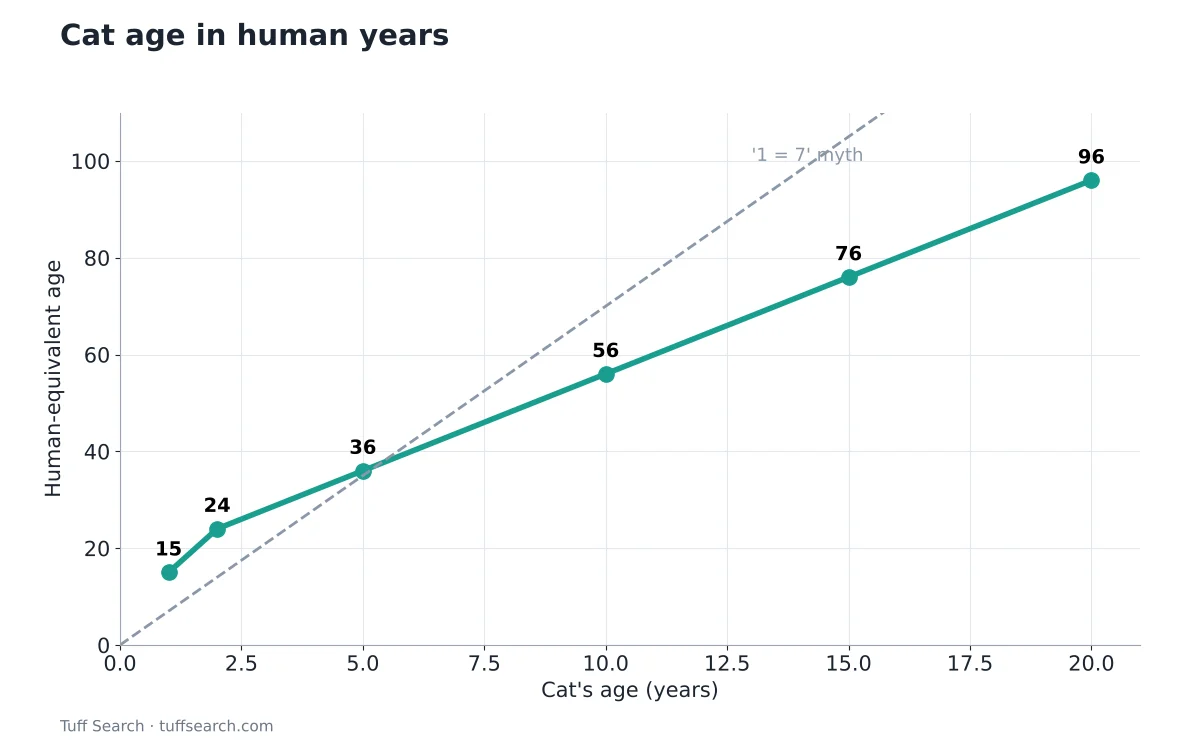
So a 10-year-old cat is about 56 in human terms and a 15-year-old about 76. Convert your own cat’s age, including months, with the cat age calculator.
Signs of ageing to watch for
- Drinking and urinating more – can signal kidney disease or diabetes
- Weight loss despite a good appetite – a common sign of an overactive thyroid
- Bad breath, dropping food or chewing on one side – dental disease
- Stiffness, reluctance to jump, or missing the litter tray – arthritis
- Confusion, night-time yowling or changes in sleep
Cats are good at hiding illness, so subtle changes are worth a vet visit.
How to help your cat live longer
- Keep her at a healthy weight – measure food rather than free-feeding.
- Provide fresh water; many cats drink more from a fountain or a wide bowl.
- Book regular check-ups – twice a year for seniors.
- Keep vaccinations and parasite control up to date.
- Brush teeth or ask your vet about dental care.
- Keep her mentally and physically active with play.
- Make life easy for older cats: low-sided litter trays, ramps and warm beds.
Thinking about kittens? The cat pregnancy calculator estimates due dates, and our guide to the cat heat cycle explains timing and spaying.
Frequently asked questions
Many indoor cats live into their mid-to-late teens with good care, and some reach 20 or more.
Over about 10 years, according to the 2021 AAHA/AAFP Feline Life Stage Guidelines.
About 56 in human-equivalent years using the standard veterinary chart.
On average, yes – they face extra risks from traffic, fights, predators and infectious disease.