
Customer Acquisition Cost (CAC) Calculator
Last updated
Show steps
Enter your marketing and sales costs for a period and the number of new customers you won, and this customer acquisition cost calculator shows your CAC. Add revenue, margin and churn to see customer lifetime value (LTV), your LTV:CAC ratio and how many months it takes to earn back the cost of each customer.
How to calculate customer acquisition cost
- Choose a period – a month or a quarter.
- Add every cost of winning new customers in that period: marketing and sales.
- Count the new customers acquired in the same period.
- Divide total cost by new customers.
Example: a business spends $30,000 on marketing and $20,000 on sales in a quarter and wins 250 new customers. CAC = $50,000 ÷ 250 = $200. Every new customer costs $200 to acquire.
What to include in CAC
| Include | Usually exclude |
|---|---|
| Ad spend (search, social, display, video) | Costs of serving existing customers (support, account management) |
| Marketing and sales salaries (share of time spent on acquisition) | Product development |
| Commissions and bonuses for new deals | General overheads unrelated to acquisition (unless you want a 'fully loaded' CAC) |
| Agency, freelancer and content costs | Discounts already reflected in revenue |
| Marketing and sales software |
Be consistent. A 'paid CAC' that counts only ad spend will look much lower than a fully loaded CAC that includes salaries and tools – both are useful, but compare like with like. For more on what CAC tells you and how to bring it down, read our customer acquisition cost guide.
Blended CAC vs paid and channel CAC
Blended CAC divides all acquisition costs by all new customers, including those who found you through search, referrals or word of mouth. It shows overall efficiency but can hide expensive channels. Paid CAC looks only at paid media and the customers it brought in: if $12,000 of ads produced 80 customers, paid CAC is $150. Channel CAC goes further – Facebook, LinkedIn, TikTok or YouTube separately – so you can move budget to the channels that work. Our ad budget calculators help you plan spend per channel.
CAC, lifetime value and payback
CAC only means something next to what a customer is worth. For a subscription business: LTV = monthly revenue per customer × gross margin ÷ monthly churn. A customer paying $50 a month at a 70% margin with 4% monthly churn is worth about 50 × 0.70 ÷ 0.04 = $875 in gross profit. With a CAC of $200, the LTV:CAC ratio is 4.4 : 1. The payback period – how long until gross profit covers the CAC – is 200 ÷ (50 × 0.70) = 5.7 months.
For ecommerce, estimate LTV from average order value × gross margin × expected orders per customer. A store with a $60 average order, 40% margin and 2.5 orders per customer has an LTV of about $60, so a CAC above $60 loses money unless repeat purchases increase.
What is a good LTV:CAC ratio?
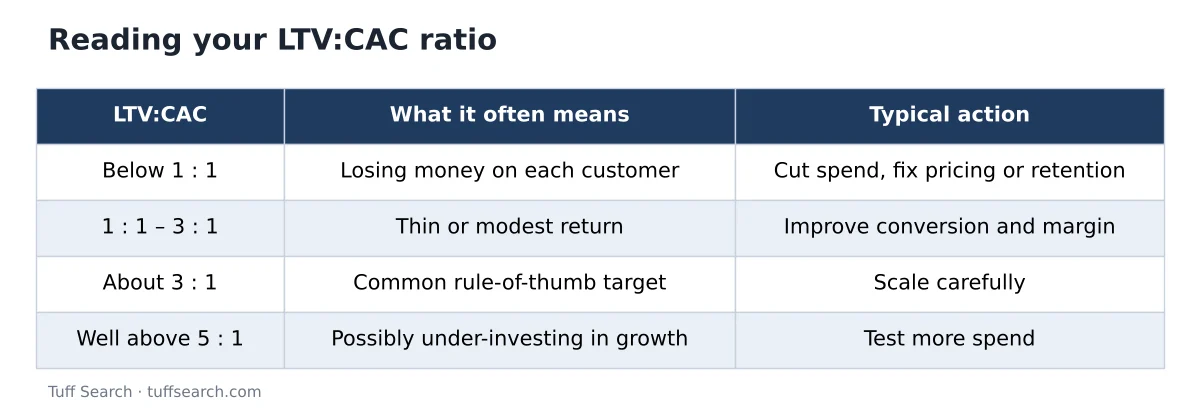
A ratio around 3:1 is a widely quoted rule of thumb, especially in SaaS, along with payback in about 12 months or less. But 'good' depends on your margins, cash position and growth goals. A young business funding growth from revenue may need fast payback more than a high ratio.
How to lower CAC
- Improve conversion rates on landing pages and checkout – more customers from the same traffic lowers CAC directly.
- Raise ad click-through rates with better targeting and creative (see our CTR and CPM guides).
- Shift budget toward channels with the lowest channel CAC.
- Invest in organic search, content and referrals, which keep bringing customers without paying per click.
- Shorten the sales cycle and qualify leads earlier.
- Raise retention so LTV grows – this improves the ratio even if CAC stays the same.
Common CAC mistakes
- Mixing periods: counting this month's customers against last month's spend. For long sales cycles, offset costs by the typical lag.
- Counting returning customers as new.
- Leaving out salaries, making CAC look far lower than it is.
- Judging CAC without LTV or margin.
CAC by channel: an example
| Channel | Spend | New customers | Channel CAC |
|---|---|---|---|
| Search ads | $8,000 | 64 | $125 |
| Social ads | $4,000 | 16 | $250 |
| Content and SEO (salaries, tools) | $6,000 | 60 | $100 |
| Referral programme | $2,000 | 40 | $50 |
| Total / blended | $20,000 | 180 | $111 |
Here the blended CAC of about $111 hides a social channel that costs more than twice as much per customer as search. Shifting part of that budget, or improving the social ads' targeting and conversion rate, would lower the overall CAC. Attribution is never perfect – customers often touch several channels – so treat channel CAC as a guide and test changes gradually.
CAC for ecommerce stores
For online shops, compare CAC with the gross profit from a customer's first order and their expected repeat orders. If your average first order is $80 at a 45% margin ($36 gross profit) and CAC is $45, you lose $9 on the first purchase and need repeat orders to profit. Raising average order value (bundles, free-shipping thresholds) and encouraging repeat purchases (email, loyalty programmes) both improve the picture without cutting acquisition spend.
Sources
- U.S. Small Business Administration – Marketing and sales — sba.gov/business-guide/manage-your-business/marketing-sales
Results are estimates for general information. Last reviewed: .

Written & built by
Zeeshan Nawaz
Calculator Developer · Tuff Search
Builds and tests Tuff Search calculators, turning published formulas and official sources into tools anyone can check.
FAQ
Frequently asked questions
Quick answers about the Customer Acquisition Cost Calculator.
CAC = total marketing and sales costs ÷ number of new customers acquired in the same period.
Ad spend, marketing and sales salaries, commissions, agency fees and the tools used to win new customers.
One that is comfortably below customer lifetime value – often a 3:1 LTV:CAC ratio – and paid back within a reasonable time.
CPA (cost per acquisition) usually measures cost per conversion in an ad platform, which may be a lead or sign-up; CAC measures cost per new paying customer across all channels.
Divide CAC by monthly gross profit per customer.
Only if a customer was acquired with no marketing or sales cost at all, such as an unprompted referral – blended CAC is rarely zero.
Still have a question? Email support@tuffsearch.com
Keep exploring
Related calculators
More calculators people use alongside this one.
- ROAS CalculatorCalculate return on ad spend, your break-even ROAS and
- Facebook Ads Cost CalculatorPlan a Facebook and Instagram ads budget from your own
- LinkedIn Ads Budget CalculatorPlan a LinkedIn Ads budget: spend, clicks, leads, cost
- SEO ROI CalculatorEstimate SEO ROI from organic traffic, conversion rate,
- CTR CalculatorCalculate click-through rate, clicks or impressions from
Zeeshan Nawaz
Calculator Developer · Tuff Search
Builds and tests Tuff Search calculators. Each tool is based on published formulas and official sources, and is checked against worked test cases before it goes live.
- Customer Acquisition Cost (CAC) CalculatorMarketingYou are here
- Dog Age CalculatorBiology
- Fuel Cost CalculatorDaily Life