Puppies grow astonishingly fast, but how long that growth lasts depends mostly on how big they will be. A toy breed can be fully grown before its first birthday, while a giant breed may keep filling out until it is two. Here is what to expect and how to estimate your puppy’s adult size.
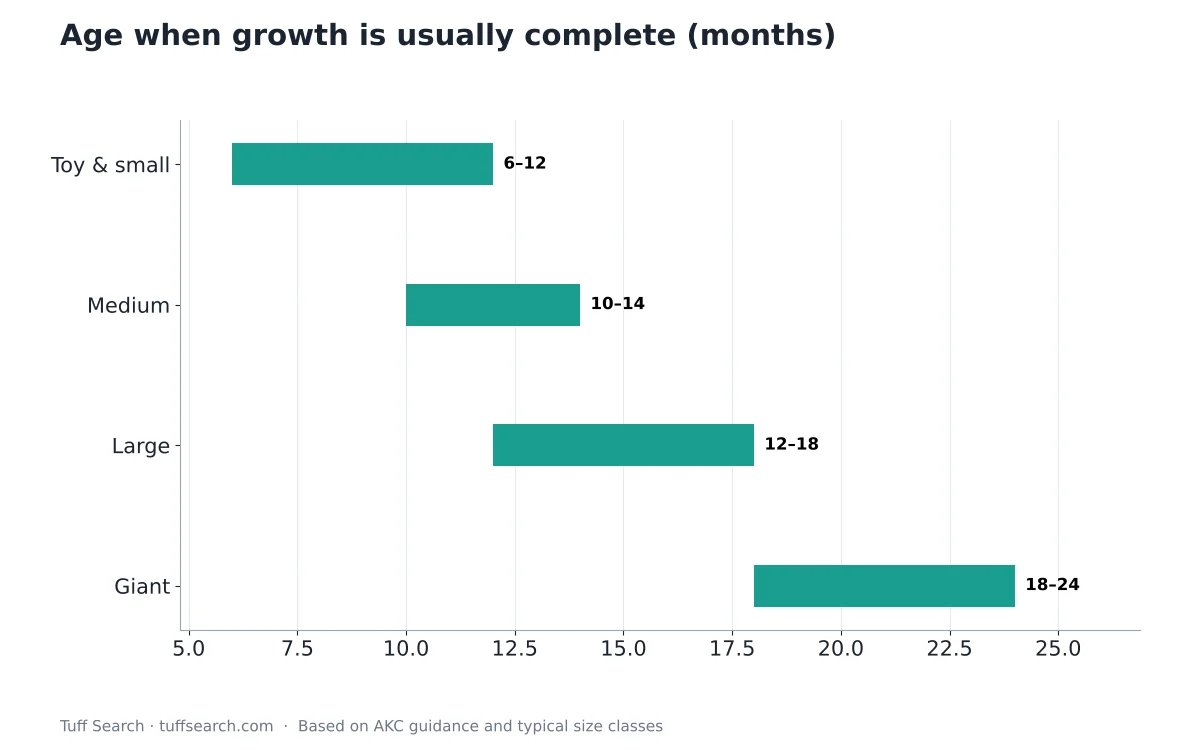
Typical ages by breed size
| Size class | Typical adult weight | Examples | Growth usually complete |
|---|---|---|---|
| Toy and small | Up to about 25 lb (11 kg) | Chihuahua, Yorkshire Terrier, Beagle, Pug | About 6–12 months |
| Medium | About 26–50 lb (12–23 kg) | Border Collie, Bulldog | About 12 months |
| Large | About 51–100 lb (23–45 kg) | Labrador, German Shepherd | About 12–18 months |
| Giant | Over 100 lb (45 kg) | Great Dane, Mastiff | About 18–24 months |
The American Kennel Club notes that small breeds often stop growing by about 6 to 8 months, medium breeds around 12 months, and giant breeds may take up to 24 months. These are averages – mixed breeds and individual dogs vary.
Height first, then weight
Many dogs reach their adult height before their adult weight. Large and giant breeds in particular look tall and lanky at around a year, then broaden through the chest and shoulders over the following months. So a dog may “stop growing” taller well before it stops gaining weight.
Try it with your numbersDog Size CalculatorEstimate your puppy's adult weight from its age and current weight, with growth timelines by size class and what…Open calculatorHow to estimate your puppy’s adult size
- Medium and large breeds: many puppies are about half their adult weight at 6 months, so doubling the 6-month weight gives a rough estimate.
- Small and toy breeds: they are often well over half their adult weight by 3–4 months, so use a smaller multiplier.
- Height: many dogs are around 75% of adult shoulder height at 6 months.
- Parents: the size of both parents is one of the best guides for purebred and mixed-breed puppies alike.
- Paws: big paws hint at a big dog, but they are not reliable on their own.
Example
a 6-month-old Labrador weighing 35 lb is likely to finish somewhere around 60–80 lb. The dog size calculator uses your puppy’s age, current weight and size class to give an estimated range.
What affects adult size
- Genetics – breed and parents matter most.
- Nutrition – feeding a balanced puppy diet supports healthy growth; overfeeding does not make a dog bigger, it makes it heavier.
- Health – parasites or illness can slow growth.
- Timing of spay or neuter – it can affect growth plate closure, especially in large breeds; ask your vet about the best timing for your dog.
When to switch to adult food
Puppy food is designed for growth. Many owners switch small breeds around their first birthday and large or giant breeds later, as growth finishes – large-breed puppy formulas also control calcium and energy to support steady growth. Your vet can advise based on your dog’s breed and body condition.
Growth and the first heat
Female dogs often have their first heat at about 6–12 months in small breeds and later in large and giant breeds – up to about 24 months – sometimes before they are fully grown. If you have an unspayed female, the dog heat cycle calculator estimates when her next season is due.
When to talk to your vet
Check with your vet if your puppy seems to stop growing very early, is much smaller than its littermates, gains weight very quickly, or limps or seems sore in its legs during growth spurts.
Frequently asked questions
Small breeds often finish growing by 6–12 months, medium breeds around 12 months, large breeds by 12–18 months and giant breeds by 18–24 months.
Double the weight at about 6 months for medium and large breeds, look at the parents’ size, or use a dog size calculator that accounts for breed size.
Many still grow a little after their first heat, especially larger breeds that have their first season before reaching full size.
Usually when growth is nearly complete – around 1 year for small breeds and later for large and giant breeds. Ask your vet.
Related calculators
Related articles
- Dog Pregnancy Week by Week: Due Date and What to Expect
- Cat Heat Cycle Explained: Signs, Length and Timing
- How Long Do Cats Live? Life Stages and Tips