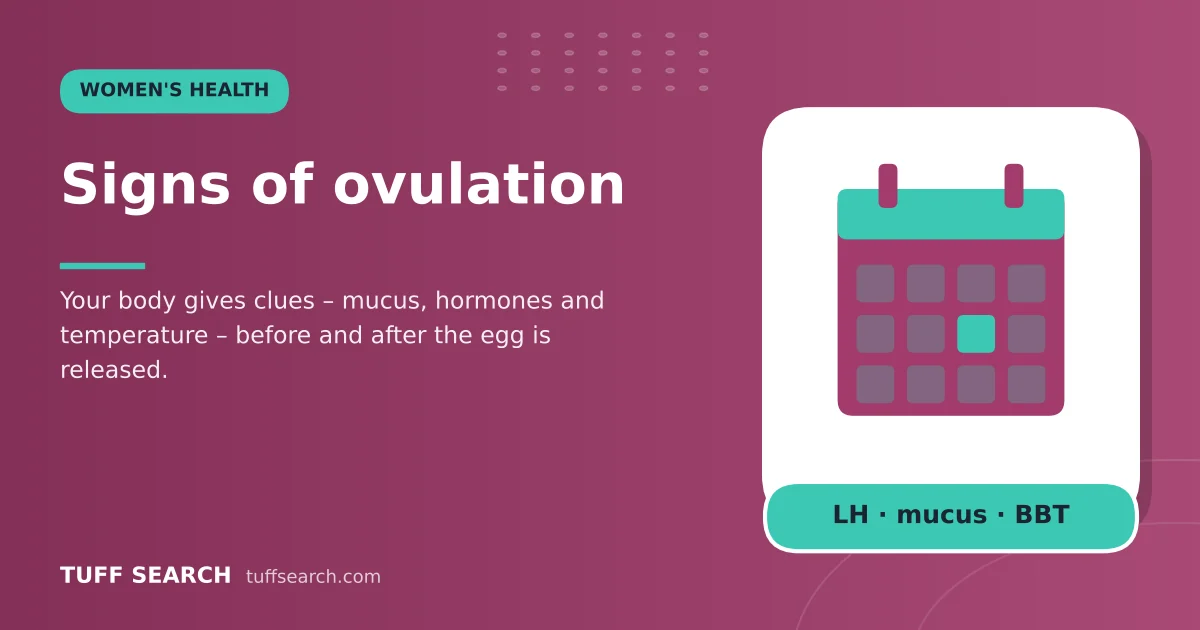
Ovulation – the release of an egg from an ovary – usually happens once per cycle, about 12–16 days before the next period. The body gives several clues that it is approaching or has just happened. Learning them helps if you are trying to conceive or simply want to understand your cycle.
1. Changes in cervical mucus
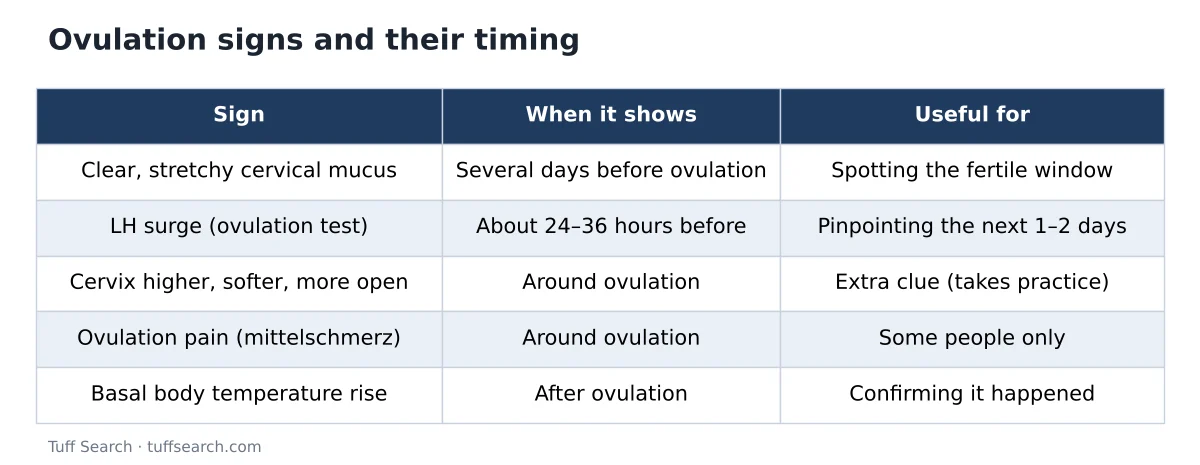
As ovulation approaches, rising oestrogen makes cervical mucus increase and change from sticky or creamy to clear, wet, slippery and stretchy – often compared with raw egg white. This is the most fertile type of mucus because it helps sperm survive and travel. After ovulation it becomes thicker and drier again.
2. A positive ovulation test (LH surge)
A surge of luteinising hormone (LH) triggers ovulation roughly 24–36 hours later. Home ovulation predictor kits detect LH in urine. Start testing a few days before you expect to ovulate and test at the same time each day; a positive result means ovulation is likely within the next day or two.
Try it with your numbersOvulation CalculatorEstimate your ovulation day and fertile window for the next three cycles from your last period and cycle length, with an irregular-cycle mode.Open calculator3. A rise in basal body temperature
Your resting temperature, taken first thing in the morning before getting up, rises slightly – commonly by around 0.3–0.5 °C (0.5–1 °F) – after ovulation because of progesterone. Because it rises afterwards, BBT confirms ovulation rather than predicting it, but charting it over several cycles shows your usual pattern.
4. Changes in the cervix
Around ovulation the cervix tends to sit higher, feel softer and be slightly more open. Checking it takes practice and clean hands, and it is a supporting sign rather than a reliable one on its own.
5. Ovulation pain
Some people feel a mild ache or twinges on one side of the lower abdomen around ovulation, known as mittelschmerz. It can last from minutes to a day or two. Severe or persistent pain is not normal and should be checked by a doctor.
6. Other possible signs
- Breast tenderness (more often after ovulation).
- Increased sex drive around the fertile days.
- Light spotting around ovulation in some people.
- Mild bloating.
These are less specific – they vary from person to person and cycle to cycle.
7. Your cycle dates
Counting back about 14 days from your next expected period gives a useful estimate, especially when combined with the signs above. Tracking your period dates with the period calculator helps you learn your usual cycle length. Our guide to how many days after your period you can get pregnant explains the fertile window in more detail.
Putting it together
A landmark study by Wilcox and colleagues found that conception occurred only when sex happened in the six days ending on the day of ovulation, with the highest chance in the last two to three of those days. Fertile mucus and a positive LH test tell you that window is open. If you do conceive, see when to take a pregnancy test for the most reliable timing.
When to see a doctor
Speak to a doctor if your periods are very irregular or absent, cycles are shorter than 21 or longer than 35 days, you never see signs of ovulation, or you have not conceived after 12 months of trying (6 months if you are 35 or over).
Important
Important: This article is general educational information, not medical or nutrition advice. Talk to a doctor or registered dietitian before changing your diet, especially if you are pregnant, under 18, or have a medical condition.
Frequently asked questions
Clear, stretchy cervical mucus and a positive LH test suggest ovulation is near; a sustained rise in morning temperature confirms it has happened.
Yes. Some people notice few or no symptoms, which is why LH tests and temperature charting are useful.
The egg is released in a single event and survives about 12–24 hours, but the fertile window lasts about six days because sperm can survive up to five days.
Some people feel mild one-sided pain (mittelschmerz). Severe pain should be checked by a doctor.
Fertility awareness methods need training and careful daily tracking to be effective. Do not rely on a calculator or occasional checks to avoid pregnancy.
Related calculators
Related articles
- How Many Days After Your Period Can You Get Pregnant?
- When to Take a Pregnancy Test for the Most Accurate Result
- How Much Water Should You Drink a Day? What the Guidelines Say