

Whether you can dunk comes down to three numbers: the height of the rim, how high you can reach standing flat-footed, and how much higher your hand needs to go to get the ball over the rim. Your height matters only because it affects your reach.
The formula
Vertical jump needed = Rim height + Clearance − Standing reach
- Rim height: a regulation basketball rim is 10 feet (120 inches) from the floor.
- Clearance: to dunk, your hand needs to get above the rim with the ball. About 6 inches is a commonly used target; palming the ball and slamming it may need more.
- Standing reach: how high your fingertips reach with one arm stretched up, standing flat-footed.
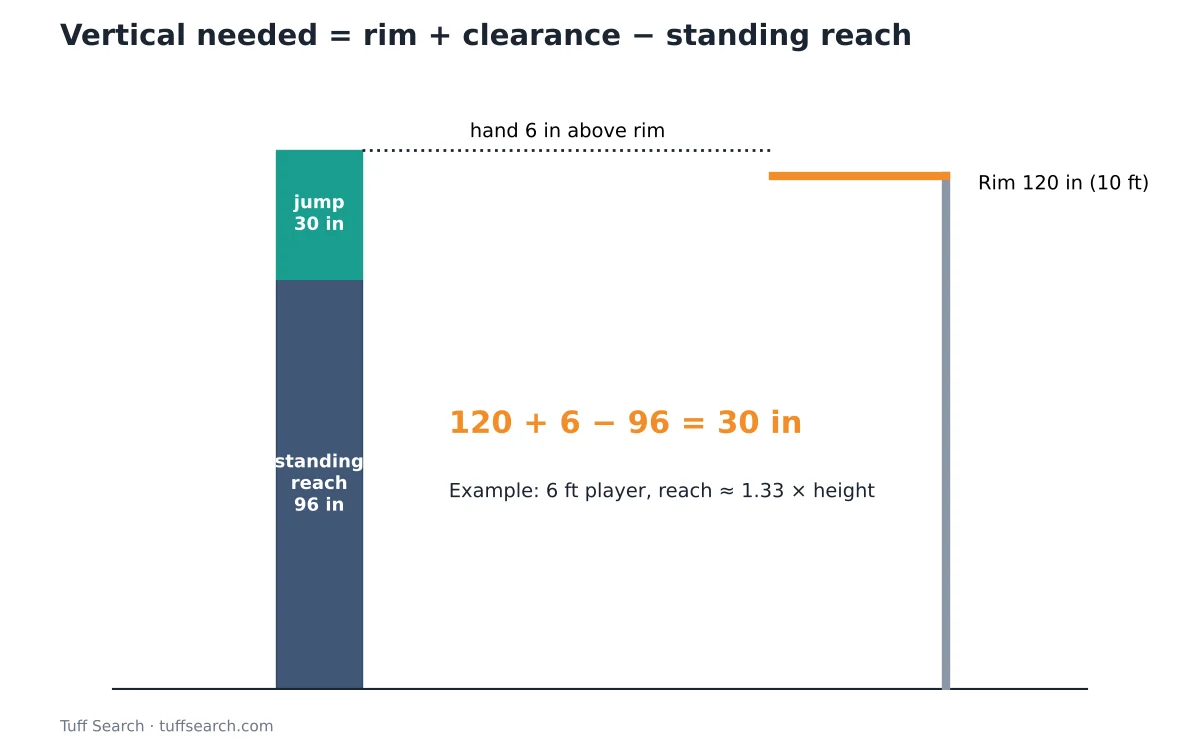
Example: 6 ft player
If you have not measured your reach yet, a rough estimate is about 1.33 times your height. For a 6 ft (72-inch) player that is about 96 inches.
Vertical needed = 120 + 6 − 96 = 30 inches.
A 5 ft 10 in (70-inch) player with an estimated reach of about 93 inches would need roughly 33 inches.
Measure your real standing reach
- Stand side-on to a wall in flat shoes.
- Reach up as high as you can with the arm nearest the wall, keeping both heels on the floor.
- Mark the highest point your fingertips touch and measure from the floor.
Arm length varies a lot, so a measured reach can be several inches different from the height-based estimate.
Measure your vertical jump
- Chalk or wet your fingertips.
- Jump as high as you can from a standing start and touch the wall at the top.
- Subtract your standing reach from the jump mark. That difference is your standing vertical.
Most people jump higher with a running approach than from a standstill, so test the way you plan to dunk.
Ways to close the gap
- Practise on a lower rim first to learn the timing and ball control.
- Start with a smaller ball such as a volleyball or a size-5 basketball.
- Build leg strength and power with a structured program, and include rest days.
- Work on your approach: the last two steps make a big difference.
Jump training places a lot of stress on knees and ankles. Warm up properly and build volume gradually; if you have an injury, get advice first.
Calculate your target
The dunk calculator uses your height or measured reach to show the vertical you need. More tools are in sports calculators.
Frequently asked questions
A regulation rim is 10 feet (120 inches) above the floor.
Roughly 30 inches if your standing reach is about 96 inches. Measure your reach for a better estimate.
Standing reach is what counts. Two people of the same height can have reaches several inches apart.
It varies. Consistent strength and plyometric training over months tends to help more than short programs.


