

Keeping score turns watching a baseball game into following every play. Scorekeepers use a simple shorthand – numbers for the fielders and letters or symbols for what happened – so a whole inning fits in a few small boxes. Once you know the system you can read any scorecard and work out stats such as batting average.
Step 1: Learn the position numbers
Every fielding position has a number. They are the same at every level of the game:
| Number | Position | Number | Position |
|---|---|---|---|
| 1 | Pitcher (P) | 6 | Shortstop (SS) |
| 2 | Catcher (C) | 7 | Left field (LF) |
| 3 | First base (1B) | 8 | Center field (CF) |
| 4 | Second base (2B) | 9 | Right field (RF) |
| 5 | Third base (3B) |
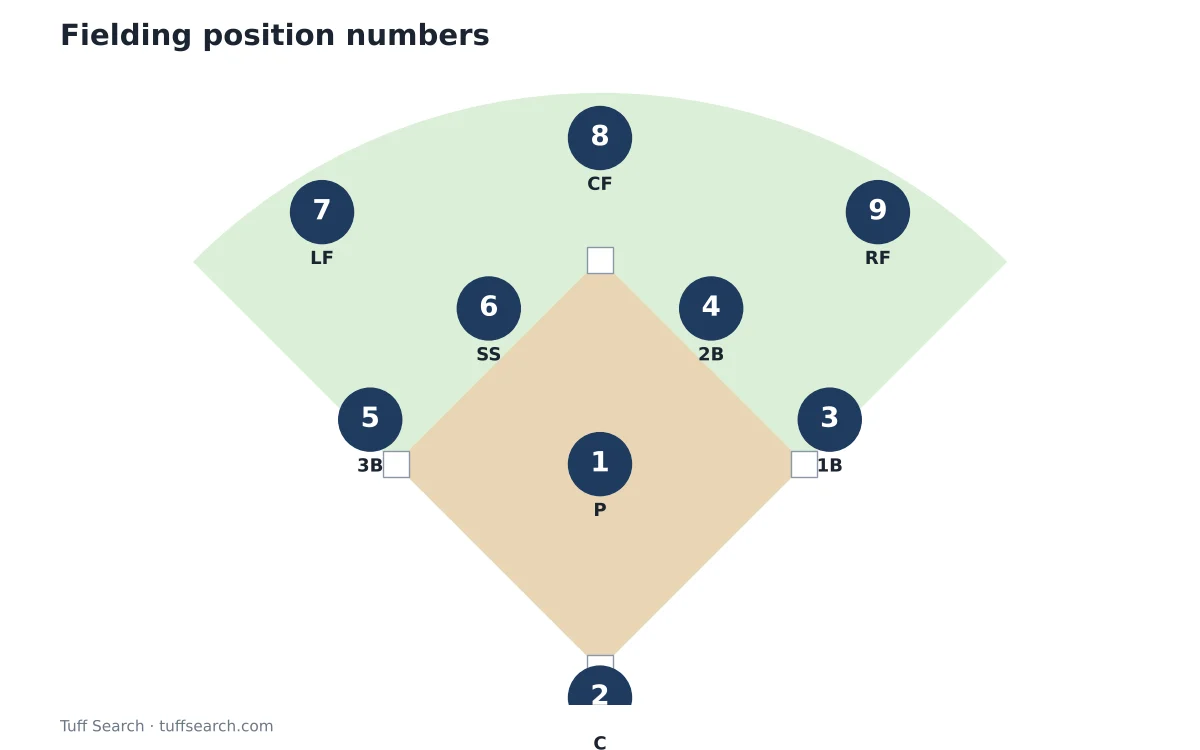
Note that shortstop is 6 and second base is 4 – the numbers follow the historical order the positions were named, not their place around the field.
Step 2: Set up the scorecard
- Write each team’s batting order down the left side, with each player’s position number.
- Each column is an inning; each box is one plate appearance.
- Most boxes have a small diamond. Draw a line along the base paths as a runner advances, and fill in the diamond when he scores.
Step 3: Record what happened
| Symbol | Meaning |
|---|---|
| 1B, 2B, 3B, HR | Single, double, triple, home run |
| BB | Base on balls (walk) |
| IBB | Intentional walk |
| HBP | Hit by pitch |
| K | Strikeout swinging |
| ꓘ (backwards K) | Strikeout looking (called third strike) |
| E + number | Error by that fielder, e.g. E6 |
| FC | Fielder’s choice |
| SAC / SF | Sacrifice bunt / sacrifice fly |
| DP | Double play |
| F, L, P + number | Fly out, line out, pop out to that fielder, e.g. F8 |
Reading common plays
- 6-3: ground ball to the shortstop, thrown to first base for the out.
- 4-3: grounder to the second baseman, thrown to first.
- F8: fly ball caught by the center fielder.
- L5: line drive caught by the third baseman.
- 6-4-3 DP: shortstop to second baseman (forcing the runner) to first baseman – a double play.
- U3: unassisted out by the first baseman, who fielded the ball and stepped on the base.
Record the out number (1, 2 or 3) in the corner of the box, and draw a line under the box after the third out of an inning.
Worked example: one inning
- Batter 1 grounds to shortstop, thrown out at first: write 6-3 and “1” for the first out.
- Batter 2 singles to left field: write 1B and draw a line to first base.
- Batter 3 walks: write BB; batter 2 moves to second.
- Batter 4 hits a double: write 2B; batter 2 scores (fill in his diamond) and batter 3 goes to third. Note 1 RBI.
- Batter 5 strikes out looking: write ꓘ and “2”.
- Batter 6 flies out to right field: write F9 and “3”. Inning over: 1 run, 2 hits, 0 errors, 2 left on base.
From scorecard to stats
Your scorebook is all you need to calculate basic batting stats. For batting average, count at-bats and hits:
Batting average = Hits ÷ At-bats
Walks, hit-by-pitches, sacrifices and catcher’s interference are plate appearances but not at-bats, so they do not count against batting average. A player with 2 hits in 4 at-bats and one walk is batting .500 for the game. Track a season, or work out on-base percentage and slugging, with the batting average calculator.
Scorekeeping tips
- Use pencil – plays are sometimes changed after review.
- Keep a pitch count for each pitcher in the margin; youth leagues often have pitch limits.
- Write substitutions with the inning they entered.
- When in doubt, write a short note and tidy it up later – there is no single official style for personal scorecards.
Frequently asked questions
Shortstop is 6. Second base is 4 and third base is 5.
A strikeout looking – the batter did not swing at the called third strike. A normal K is a strikeout swinging.
A double play: the shortstop (6) fields the ball and throws to the second baseman (4), who forces the runner and throws to first (3).
No. Walks, hit-by-pitches and sacrifices are plate appearances but not at-bats, so they do not lower batting average.


