

Your one-rep max (1RM) is the heaviest weight you can lift once with good form. Testing it directly is tiring and carries more risk, especially without a spotter. Instead, you can estimate it from a lighter set you can do for several reps.
The two most common formulas
Epley: 1RM = Weight × (1 + Reps ÷ 30)
Brzycki: 1RM = Weight × 36 ÷ (37 − Reps)
Both give similar answers for sets of about 2 to 10 reps. Brzycki tends to give slightly lower estimates; Epley slightly higher.
Worked example 1 (kilograms)
You bench 100 kg for 5 reps.
- Epley: 100 × (1 + 5 ÷ 30) = 100 × 1.1667 ≈ 116.7 kg
- Brzycki: 100 × 36 ÷ (37 − 5) = 100 × 36 ÷ 32 = 112.5 kg
Worked example 2 (pounds)
You bench 225 lb for 8 reps.
- Epley: 225 × (1 + 8 ÷ 30) = 285 lb
- Brzycki: 225 × 36 ÷ 29 ≈ 279 lb
Using your 1RM to plan training
Programs often prescribe loads as a percentage of 1RM. Using the Epley estimate of 116.7 kg:
| % of 1RM | Load (kg) | Typical use |
|---|---|---|
| 60% | 70.0 | Warm-up, technique |
| 70% | 81.7 | Higher-rep work |
| 75% | 87.5 | Hypertrophy sets |
| 80% | 93.3 | Strength sets |
| 85% | 99.2 | Heavy sets of 3–5 |
| 90% | 105.0 | Heavy doubles and triples |
| 95% | 110.8 | Near-max singles |
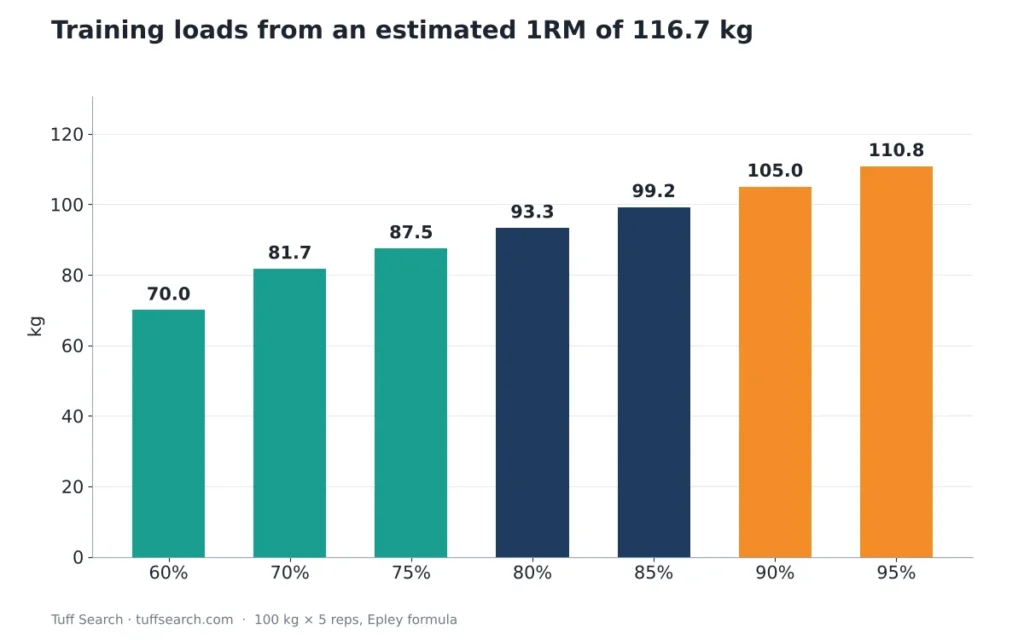
Training loads from an estimated 1RM of 116.7 kg (100 kg × 5 reps, Epley).
How to get the most accurate estimate
- Use a set of 3 to 6 reps. The further you go above 10 reps, the less reliable the estimate.
- Take the set close to failure with good form; stopping early underestimates your max.
- Warm up first, and use the same range of motion every time.
- Re-test every few weeks rather than every session.
Safety
Use a spotter or safety arms for heavy bench work. An estimated 1RM is a planning number, not a target you must lift.
How many reps can you do at each percentage?
Rearranging the Epley formula gives the share of your 1RM you can typically lift for a given number of reps:
| Reps | % of 1RM (Epley) |
|---|---|
| 2 | ≈ 94% |
| 3 | ≈ 91% |
| 5 | ≈ 86% |
| 8 | ≈ 79% |
| 10 | 75% |
Individual results vary – people with more muscular endurance can usually do more reps at the same percentage.
Try it
The bench press calculator estimates your 1RM and builds a percentage table instantly. Find more tools in sports calculators.
Frequently asked questions
No formula is exact for everyone. Epley and Brzycki give similar results for 2 to 10 reps; using the same formula every time is more important than which one you choose.
Yes, the same formulas are used for most barbell lifts, though accuracy varies between people and exercises.
Estimates assume the set was taken close to failure with consistent technique. Fatigue, form and experience with heavy singles all affect a real max.
A set of 3 to 6 reps usually gives the most reliable estimate.


