

A rowing machine – often called an erg – works your legs, back, core and arms in one smooth movement and is gentle on the joints. Good technique matters more than effort when you start, and understanding the monitor helps you train with purpose. Here is what you need to know for your first few weeks.
The rowing stroke in four parts
- The catch: shins roughly vertical, arms straight, shoulders relaxed, leaning slightly forward from the hips.
- The drive: push with your legs first. Once the legs are nearly straight, swing the body back slightly, then pull the handle to the lower ribs.
- The finish: legs straight, leaning back a little, handle at the lower ribs, elbows past the body.
- The recovery: reverse the order – arms away, body forward, then bend the knees and slide forward.
Drive: legs → body → arms | Recovery: arms → body → legs
Aim for a rhythm of roughly one count on the drive and two counts on the recovery. Most beginners rush forward on the slide; slowing the recovery makes each stroke more powerful.
Reading the monitor
| Display | What it means |
|---|---|
| Split (/500 m) | How long it would take to row 500 metres at your current pace. Lower is faster. |
| Stroke rate (s/m) | Strokes per minute. Steady rowing is usually about 18–24. |
| Watts | Power output. Calculated from your pace. |
| Distance and time | Total metres and elapsed time. |
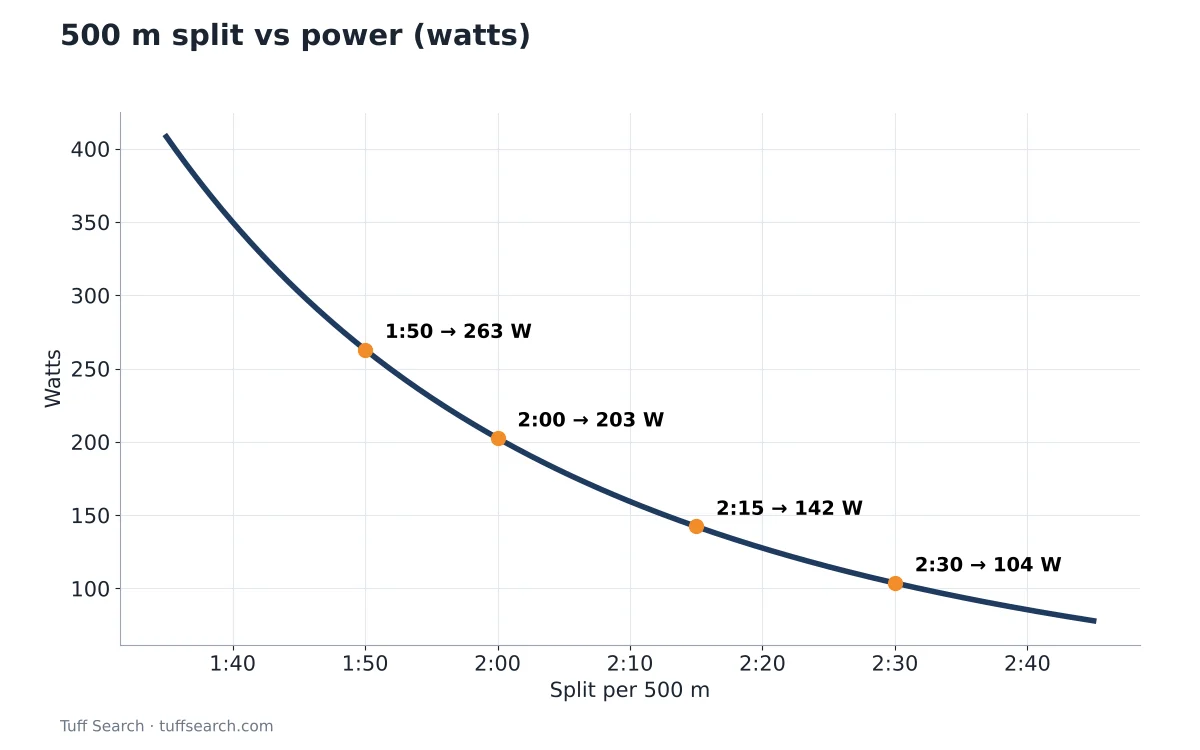
Split and watts are linked by Concept2’s formula, watts = 2.80 ÷ pace³ (pace in seconds per metre). Because power rises with the cube of speed, going a little faster takes a lot more effort:
| Split per 500 m | Watts (approx.) |
|---|---|
| 2:30 | 104 |
| 2:15 | 142 |
| 2:00 | 203 |
| 1:50 | 263 |
Convert any split to watts, or predict a 2,000 m or 5,000 m time, with the erg calculator.
Try it with your numbersErg CalculatorConvert rowing machine split, watts, pace, time and distance on a Concept2-style erg.Open calculatorWhat damper setting should you use?
The damper lever on the flywheel changes how much air flows in, which changes how heavy each stroke feels – like gears on a bike. A higher number is not “harder exercise” in a useful way; it mostly makes the stroke slower and heavier. Many coaches suggest starting around 3 to 5. Because the monitor measures how quickly the flywheel slows, your split and watts stay comparable whatever setting you choose.
Three beginner workouts
Week 1–2: Technique intervals
Row 5 × 3 minutes at an easy pace, 20–22 strokes per minute, with 1–2 minutes of rest. Focus on legs-body-arms and a slow recovery.
Week 2–3: Steady state
Row 15–20 minutes continuously at a pace where you could still hold a conversation. Note your average split – this is your baseline.
Week 3–4: Short pieces
After a 5-minute warm-up, row 6 × 250 m a little faster than your steady split, with 1 minute of rest. Keep the stroke rate below 28.
Moderate rowing counts toward the 150 minutes a week of moderate activity recommended for adults. For a sense of effort, see normal resting heart rate for simple heart-rate zones.
Common mistakes
- Pulling with the arms first – the legs should start every stroke.
- Bending the knees before the arms are away on the recovery, so the handle has to go around the knees.
- Hunching the back – keep a long spine and hinge from the hips.
- Setting the damper to 10 straight away.
- Rowing at a very high stroke rate with little power.
Tracking progress
Pick one benchmark – such as a 2,000 m row or a 20-minute row – and repeat it every few weeks. A falling average split means you are getting fitter. If you also ride, the bike pace calculator does the same job for cycling.
Frequently asked questions
It varies widely with age, size and fitness. Many beginners row steady pieces somewhere around 2:15–2:45 per 500 m; focus on improving your own average.
Many coaches suggest 3 to 5 for most people. Higher settings feel heavier but do not automatically make the workout better.
About 18–24 strokes per minute for steady rowing; higher for short, hard pieces.
Watts = 2.80 ÷ (seconds per metre)³. A 2:00 split is 0.24 seconds per metre, which is about 203 watts.
Related calculators
Related articles
- What Is a Normal Resting Heart Rate? (By Age and Fitness)
- How to Calculate Your One-Rep Max: Epley vs Brzycki
- How High Do You Need to Jump to Dunk? Reach and Vertical


