
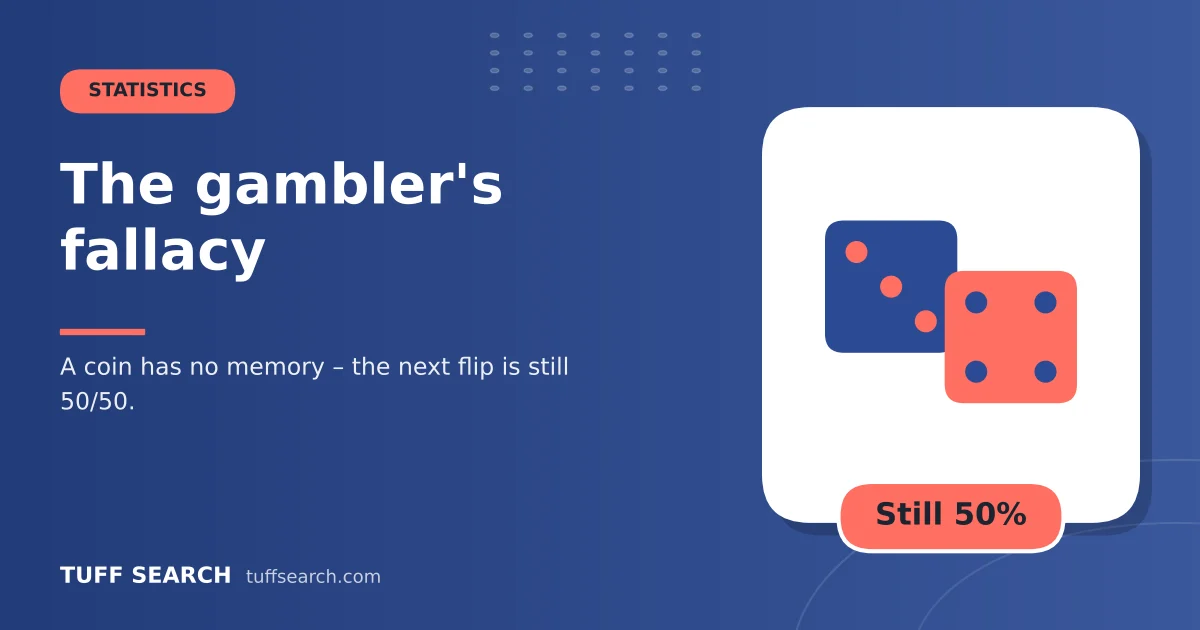
A roulette wheel has landed on black eight times in a row. Surely red is due? This feeling is so common it has a name: the gambler’s fallacy. It is the mistaken belief that past results of a random, independent process change the odds of the next one.
Independent events have no memory
Two events are independent when the outcome of one does not affect the other. Coin flips, dice rolls, roulette spins and (in most games) loot drops are independent. A fair coin lands heads with probability 1/2 on every flip, whatever happened before.
P(heads on the next flip | any previous results) = 1/2
So why do streaks feel meaningful?
Because long streaks are rare when you look ahead, but not when you are already in one. The chance of five heads in a row, starting from scratch, is (1/2)^5 = 1/32, about 3%. But if four heads have already happened, the chance the fifth is heads is simply 1/2. The rarity was already “used up” by the first four flips.

Classic examples
Roulette
In a famous episode at the Monte Carlo Casino in 1913, black came up 26 times in a row, and gamblers reportedly lost heavily betting on red. Each spin’s odds were unchanged – the wheel did not know about the streak. The gambler’s fallacy is sometimes called the Monte Carlo fallacy because of it.
Dice
If you have not rolled a six in ten tries, the chance of a six on the next roll is still 1/6. Over many rolls sixes will come up about one-sixth of the time, but there is no mechanism that makes them catch up. The dice probability calculator shows the real odds for any number of dice.
Game drop rates
A 1% drop rate means each attempt has a 1% chance. After 100 failed attempts, the next one is still 1%. Across 100 attempts, the chance of at least one drop is about 63%, not 100% – so plenty of players go 100 tries without one. See drop chance probability explained and try the drop chance calculator.
What the law of large numbers really says
Over a very large number of trials, the proportion of heads gets closer to 50%. People sometimes take this to mean that tails must be followed by heads to “balance out”. It doesn’t work that way: early imbalances are not corrected, they are diluted by the huge number of later flips. After 10 flips with 7 heads, the expected total after 1,010 flips is 7 + 500 = 507 heads – about 50.2%.
Related biases
- Hot-hand belief: the opposite error – assuming a streak will continue. In truly random processes it won’t, though in sport, form and confidence can make a real difference.
- Inverse gambler’s fallacy: seeing an unlikely result and assuming many attempts must have happened before it.
- Lottery number myths: “overdue” numbers have exactly the same chance – see lottery odds explained.
When past results do matter
The fallacy only applies to independent events. Past results matter when events are dependent:
- Drawing cards without replacement: after three aces are dealt, only one remains, so the odds change.
- Games with “pity timers” that guarantee a drop after a set number of failures.
- Biased equipment: if a die lands on six far too often over thousands of rolls, the die may be unfair – a statistical test can tell you.
How to think about streaks
- Ask whether each trial is independent.
- If it is, use the same probability for the next trial, whatever the streak.
- For several trials, use the binomial formula – the binomial distribution calculator gives the chance of exactly or at least k successes.
- Set limits before gambling – no streak changes the house edge.
Frequently asked questions
The mistaken belief that past results of an independent random event change the odds of the next one – for example, that heads is ‘due’ after several tails.
No. A fair coin has a 50% chance of heads on every flip, regardless of previous results.
After a 1913 roulette run at the Monte Carlo Casino in which black came up 26 times in a row and gamblers lost money betting on red.
When events are dependent, such as drawing cards without replacing them, or in games that guarantee a reward after a number of failures.
Related calculators
- Dice Probability Calculator
- Drop Chance Calculator
- Binomial Distribution Calculator
- Dice Average Calculator