

Lottery jackpot odds are so long that they are hard to picture. They come from one idea in maths – combinations – and once you see how they are calculated you can work out the odds of any draw. This guide uses Powerball, Mega Millions and a classic 6-from-49 game as examples.
Combinations: order doesn’t matter
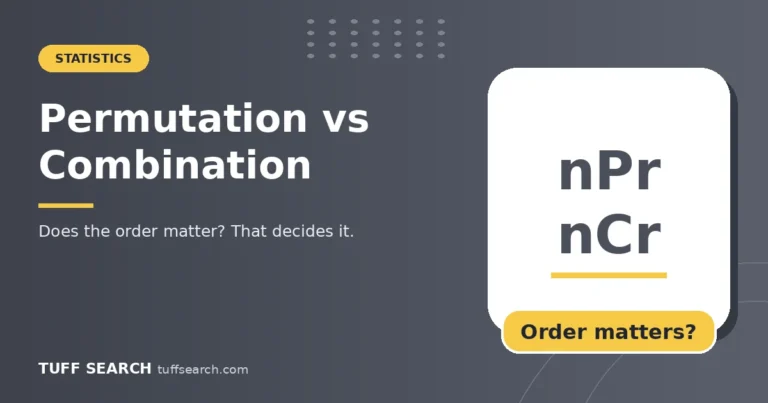
In most lotteries, the order the balls are drawn does not matter – 3, 17, 25, 40, 52 wins the same as 52, 40, 25, 17, 3. That makes each ticket a combination, and the number of possible combinations of k numbers chosen from n is:
C(n, k) = n! ÷ (k! × (n − k)!)
Here n! (“n factorial”) means n × (n − 1) × … × 1. If order did matter, you would use permutations instead – which give much bigger numbers. The permutation calculator shows both.
Example 1: a 6-from-49 lottery
Choosing 6 numbers from 1–49: C(49, 6) = 49 × 48 × 47 × 46 × 45 × 44 ÷ (6 × 5 × 4 × 3 × 2 × 1) = 13,983,816. With one ticket, the jackpot odds are 1 in 13,983,816.
Try it with your numbersPermutation CalculatorCalculate permutations (nPr) with or without repetition, circular arrangements and words with repeated letters.Open calculatorExample 2: Powerball
Powerball draws 5 white balls from 69 and 1 red Powerball from 26. The two draws are separate, so multiply:
- White balls: C(69, 5) = 11,238,513.
- Powerball: 26 choices.
- Jackpot odds: 11,238,513 × 26 = 292,201,338 – so 1 in 292,201,338.
Example 3: Mega Millions
Since the game changed in April 2025, Mega Millions draws 5 white balls from 70 and 1 gold Mega Ball from 24. C(70, 5) = 12,103,014, and 12,103,014 × 24 = 290,472,336. The published jackpot odds are 1 in 290,472,336.

| Game | Format | Jackpot odds (1 in) |
|---|---|---|
| 6 from 49 | 6 numbers from 49 | 13,983,816 |
| Mega Millions | 5 from 70 + 1 from 24 | 290,472,336 |
| Powerball | 5 from 69 + 1 from 26 | 292,201,338 |
Game rules change from time to time; check the official game rules for the current format and prize structure.
What about smaller prizes?
The odds of matching all five white balls but not the Powerball are 1 in about 11.7 million: there is exactly one winning set of white balls, and 25 of the 26 Powerball numbers are losers, so the odds are 25 in 292,201,338. Smaller prizes work the same way – count the winning combinations and divide by the total.
Does buying more tickets help?
Yes, in direct proportion: 10 different tickets give 10 chances in 292,201,338, or about 1 in 29.2 million. But the odds stay tiny. Someone buying 100 Powerball tickets every week would, on average, expect to wait about 56,000 years for a jackpot.
For repeated attempts, the chance of at least one win is 1 − (1 − p)^n, the same formula used for game loot drops. Our guide to drop chance probability and the drop chance calculator explain it in detail.
Common myths
- “Numbers that haven’t come up are due.” Each draw is independent – see the gambler’s fallacy.
- “Quick picks are less likely to win.” Every combination has the same chance.
- “Picking birthdays is fine.” It does not change your odds, but many people choose numbers up to 31, so if you win you are more likely to share the prize.
Expected value
Expected value is the average amount you would win per ticket over a very large number of plays. For lotteries it is usually well below the ticket price once you account for the tiny jackpot odds, shared prizes and taxes. Treat a lottery ticket as entertainment, not an investment, and only spend what you are happy to lose.
Frequently asked questions
1 in 292,201,338, from choosing 5 white balls out of 69 and 1 Powerball out of 26.
1 in 290,472,336 for the jackpot under the game format introduced in April 2025.
Using combinations: C(n, k) = n! ÷ (k!(n − k)!), multiplied across separate draws such as a bonus ball.
No. Every combination is equally likely to be drawn.
Related calculators
- Permutation Calculator
- Drop Chance Calculator
- Dice Probability Calculator
- Binomial Distribution Calculator
Related articles
- Drop Chance Explained: Why 1% Doesn’t Mean 100 Tries
- The Gambler’s Fallacy Explained With Examples
- Midpoint Formula Explained With Step-by-Step Examples