The Pythagorean theorem is one of the most useful results in maths: if you know two sides of a right triangle, you can always find the third. Builders use it to square corners, and it is behind every screen size, ladder safety rule and distance formula.
What the theorem says
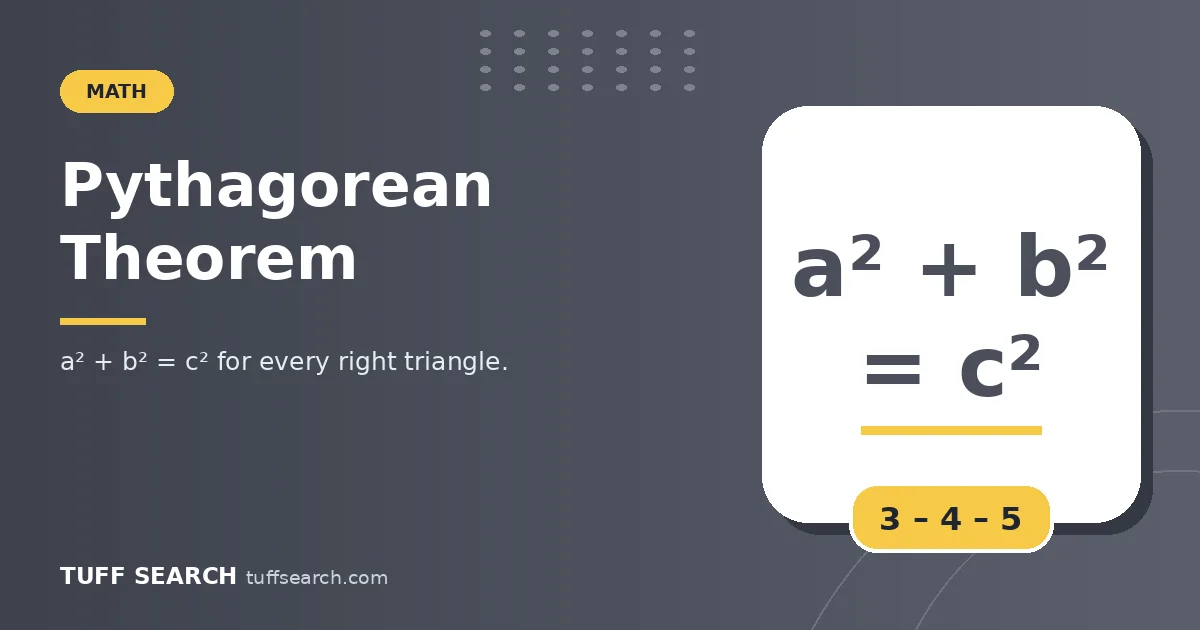
In a right triangle, the square of the hypotenuse equals the sum of the squares of the other two sides: a² + b² = c². The hypotenuse c is the side opposite the 90° angle and is always the longest side.
How to find the hypotenuse
- Square each leg.
- Add the squares.
- Take the square root.
Legs 6 and 8: 36 + 64 = 100, √100 = 10. Legs 5 and 7: 25 + 49 = 74, √74 ≈ 8.6.
How to find a missing leg
Subtract instead of adding: a = √(c² − b²). Hypotenuse 13, leg 5: 169 − 25 = 144, √144 = 12.
Why it works
Draw a square on each side of a right triangle. The two smaller squares together have exactly the same area as the largest one. There are hundreds of proofs; a classic one arranges four copies of the triangle inside a big square of side a + b and compares the leftover areas.
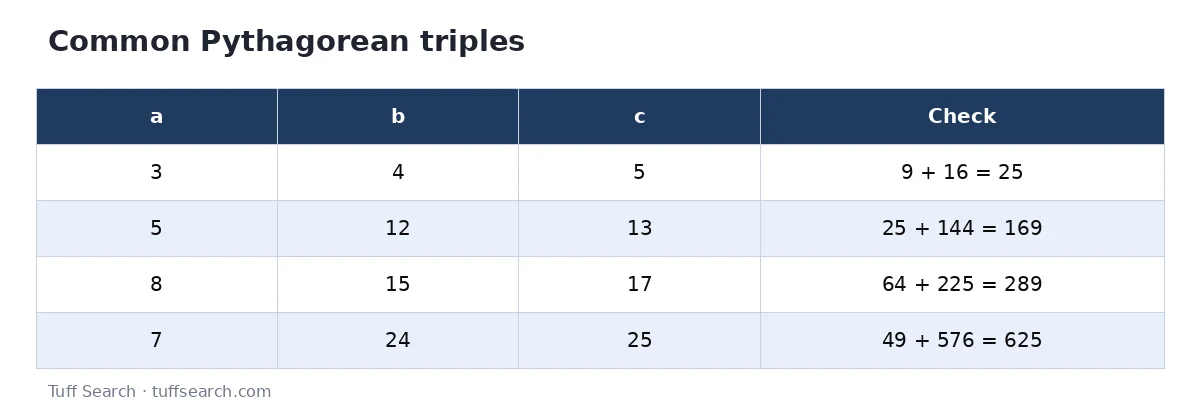
Pythagorean triples
| a | b | c | Check |
|---|---|---|---|
| 3 | 4 | 5 | 9 + 16 = 25 |
| 5 | 12 | 13 | 25 + 144 = 169 |
| 8 | 15 | 17 | 64 + 225 = 289 |
| 7 | 24 | 25 | 49 + 576 = 625 |
Any multiple of a triple also works: 6-8-10, 9-12-15, 30-40-50.
Everyday uses
- Squaring a corner: measure 3 ft along one edge and 4 ft along the other; the diagonal should be exactly 5 ft.
- Ladders: a 12 ft ladder set 3 ft from a wall reaches about 11.6 ft.
- Screens: a 55-inch 16:9 TV is about 47.9 in wide and 27 in tall.
- Distance between two points on a grid: the horizontal and vertical gaps are the legs, the straight-line distance is the hypotenuse.
When it does not apply
The theorem only holds for right triangles. You can use it as a test: if a² + b² = c² the triangle is right-angled; if a² + b² > c² all angles are acute; if a² + b² < c² one angle is obtuse.
The distance formula is the same idea
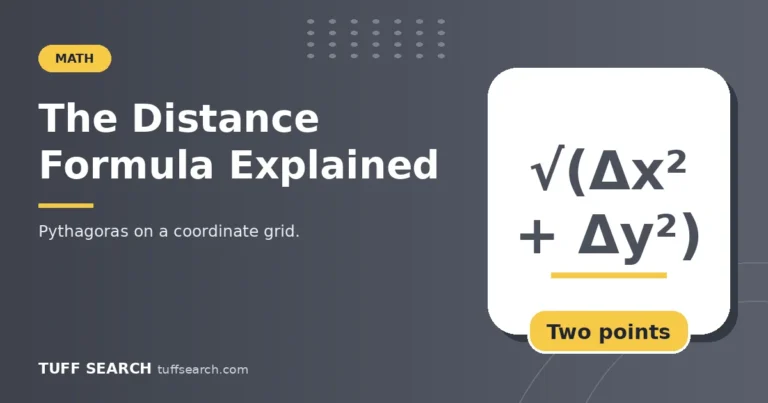
The distance between two points (x₁, y₁) and (x₂, y₂) is √((x₂ − x₁)² + (y₂ − y₁)²). The horizontal and vertical gaps are the legs of a right triangle, and the distance is its hypotenuse. From (1, 2) to (4, 6) the gaps are 3 and 4, so the distance is 5.
In three dimensions
The theorem extends to boxes: the longest diagonal of a box with sides a, b and c is √(a² + b² + c²). A 3 × 4 × 12 box has a space diagonal of √(9 + 16 + 144) = √169 = 13. This tells you, for example, the longest rod that fits inside a crate.
Special right triangles
| Triangle | Angles | Side ratio |
|---|---|---|
| Isosceles right | 45°–45°–90° | 1 : 1 : √2 |
| Half an equilateral | 30°–60°–90° | 1 : √3 : 2 |
If you spot one of these, you can write the missing side straight away: a square’s diagonal is its side times √2 (about 1.414).
Frequently asked questions
In a right triangle, the two shorter sides squared add up to the longest side squared.
Square the two legs, add them and take the square root.
No, only on right triangles.
Three whole numbers that fit a² + b² = c², like 3, 4, 5.
It is named after the Greek mathematician Pythagoras, though it was known earlier in Babylon and India.