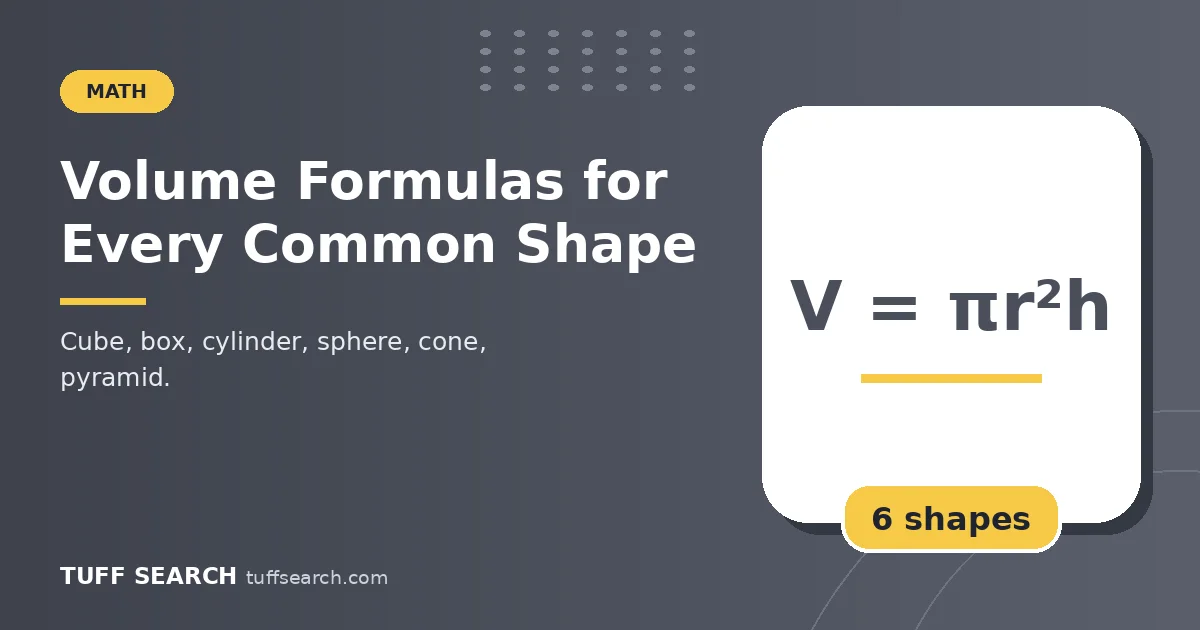
Volume tells you how much space a solid takes up or how much a container holds. This page collects the formulas for the shapes you meet most often, shows one worked example for each, and adds surface area for when you need to cover the outside.
Volume formulas
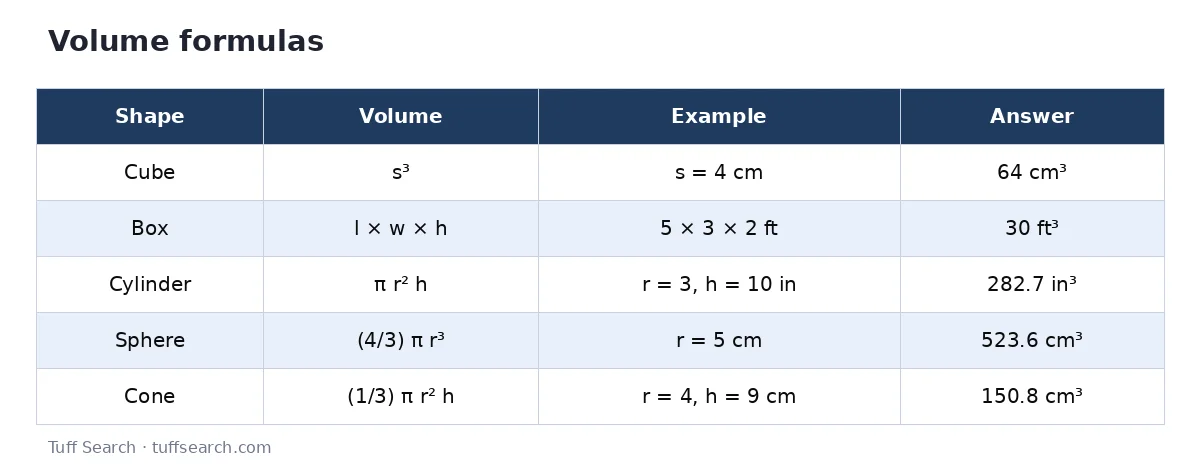
| Shape | Volume | Example | Answer |
|---|---|---|---|
| Cube | s³ | s = 4 cm | 64 cm³ |
| Rectangular box | l × w × h | 5 × 3 × 2 ft | 30 ft³ |
| Cylinder | π r² h | r = 3, h = 10 in | 282.7 in³ |
| Sphere | (4/3) π r³ | r = 5 cm | 523.6 cm³ |
| Cone | (1/3) π r² h | r = 4, h = 9 cm | 150.8 cm³ |
| Square pyramid | (1/3) b² h | b = 6, h = 8 m | 96 m³ |
The pattern behind the formulas
Prisms and cylinders are ‘base area × height’. Cones and pyramids are exactly one third of the prism or cylinder with the same base and height. A sphere’s volume is two thirds of the cylinder that just contains it.
Surface area formulas
| Shape | Surface area | Example | Answer |
|---|---|---|---|
| Cube | 6 s² | s = 4 cm | 96 cm² |
| Rectangular box | 2(lw + lh + wh) | 5 × 3 × 2 ft | 62 ft² |
| Cylinder | 2π r h + 2π r² | r = 3, h = 10 in | 245 in² |
| Sphere | 4π r² | r = 5 cm | 314.2 cm² |
Volume is in cubic units and surface area in square units. Use volume for filling (water, soil, concrete) and surface area for covering (paint, wrapping, sheet metal).
Converting to litres and gallons
1 cubic foot = 7.48 US gallons = 28.3 litres. 1 cubic metre = 1,000 litres. 1 US gallon = 231 cubic inches. The 3 in × 10 in cylinder above holds 283 ÷ 231 ≈ 1.22 gallons.
Tips for real objects
- Measure inside dimensions for capacity, outside for the space an object takes up.
- Halve the diameter to get the radius before using a round-shape formula.
- Convert everything to one unit first.
- Split awkward shapes into simple ones, find each volume and add them.
Irregular shapes
For something with no formula – a rock, a sculpture – use water displacement: the volume of water it pushes aside equals its own volume.
Worked example: a cone-topped silo
A silo is a cylinder 4 m across and 6 m tall, with a cone 1.5 m high on top. Radius = 2 m. Cylinder: π × 2² × 6 ≈ 75.4 m³. Cone: (1/3) × π × 2² × 1.5 ≈ 6.3 m³. Total ≈ 81.7 m³, or about 81,700 litres. Splitting a compound shape into familiar pieces is almost always the easiest route.
How volume scales
Double every dimension of a shape and its volume becomes 2³ = 8 times larger, while its surface area becomes only 4 times larger. That is why a 12-inch round cake has more than twice the cake of an 8-inch one of the same height, and why large tanks hold far more than their width suggests.
Less common shapes
| Shape | Volume |
|---|---|
| Triangular prism | ½ × base × height of triangle × length |
| Hemisphere | (2/3) π r³ |
| Hollow cylinder (pipe) | π h (R² − r²) |
| Ellipsoid | (4/3) π a b c |
Frequently asked questions
V = π r² h.
V = (4/3) π r³.
A cone with the same base and height fits exactly three times into the cylinder.
Cubic units such as cm³, m³, in³ or ft³, or capacity units such as litres and gallons.
Use water displacement.