A system of equations is a set of equations that share the same unknowns. Solving it means finding values that make every equation true at once. For two linear equations in x and y there are four standard methods – here is the same example solved each way, so you can pick the one that suits the problem.
Our example:
2x + 3y = 13 and x − y = −1
Method 1: Graphing
Rewrite each equation as y = mx + b and draw both lines. The solution is the point where they cross. Here y = (13 − 2x) ÷ 3 and y = x + 1, which cross at (2, 3).
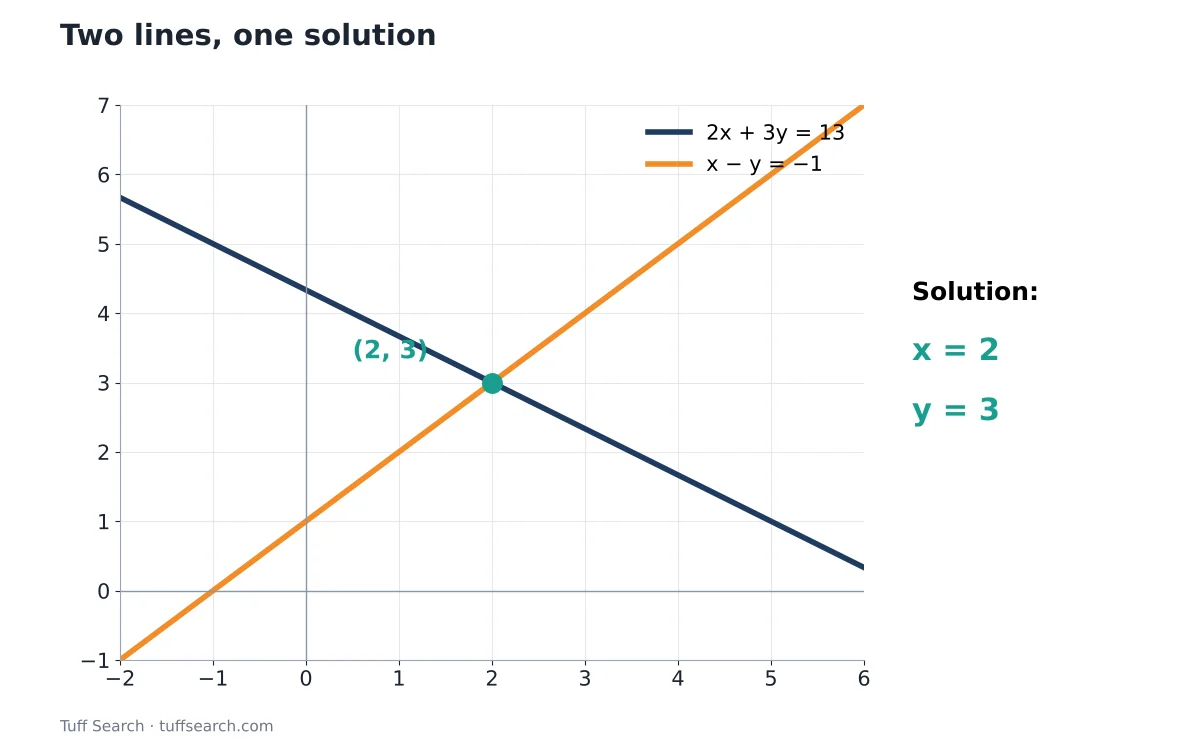
Graphing shows what a solution means, but it is only as precise as your drawing, so it is best for checking.
Method 2: Substitution
- Solve one equation for one variable. From x − y = −1: x = y − 1.
- Substitute into the other equation: 2(y − 1) + 3y = 13.
- Solve: 2y − 2 + 3y = 13 → 5y = 15 → y = 3.
- Back-substitute: x = 3 − 1 = 2.
Substitution is easiest when one equation already has a variable with a coefficient of 1.
Try it with your numbersCramer's Rule CalculatorSolve 2×2 and 3×3 systems of linear equations with Cramer's rule.Open calculatorMethod 3: Elimination
- Multiply equations so one variable has opposite coefficients. Multiply x − y = −1 by 3: 3x − 3y = −3.
- Add it to 2x + 3y = 13: the y terms cancel, leaving 5x = 10.
- Solve: x = 2.
- Substitute back: 2 − y = −1 → y = 3.
Elimination is usually fastest when the coefficients are larger or there are three equations.
Method 4: Cramer’s rule
Cramer’s rule uses determinants. For ax + by = e and cx + dy = f:
D = ad − bc x = (ed − bf) ÷ D y = (af − ec) ÷ D
- D = (2)(−1) − (3)(1) = −5.
- Dx = (13)(−1) − (3)(−1) = −13 + 3 = −10, so x = −10 ÷ −5 = 2.
- Dy = (2)(−1) − (13)(1) = −15, so y = −15 ÷ −5 = 3.
Cramer’s rule is a formula you can apply mechanically, which makes it handy for computers and for 3 × 3 systems. The Cramer’s rule calculator shows every determinant step for 2 × 2 and 3 × 3 systems.
Check your answer
Always substitute back into both original equations: 2(2) + 3(3) = 4 + 9 = 13 ✓ and 2 − 3 = −1 ✓.
When there is no single solution
| Lines | What you see | Number of solutions |
|---|---|---|
| Cross at one point | One x and one y | Exactly one |
| Parallel | Elimination gives something false, like 0 = 5; D = 0 | None |
| The same line | Elimination gives 0 = 0; D = 0 | Infinitely many |
A word problem
A school play sells 50 tickets for $520. Adult tickets cost $12 and child tickets $8. How many of each were sold?
- Let a = adult tickets, c = child tickets.
- a + c = 50 and 12a + 8c = 520.
- Substitute c = 50 − a: 12a + 8(50 − a) = 520 → 4a + 400 = 520 → a = 30.
- c = 50 − 30 = 20. Check: 12 × 30 + 8 × 20 = 360 + 160 = 520 ✓.
Which method should you use?
- Graphing – to visualise or check.
- Substitution – when a variable is already isolated or has coefficient 1.
- Elimination – for most hand calculations, especially with three equations.
- Cramer’s rule – for a formula-based approach or when using a calculator.
Working with polynomials instead? See the remainder and factor theorems.
Frequently asked questions
Graphing, substitution, elimination and matrix methods such as Cramer’s rule.
Substitution when a variable has a coefficient of 1; elimination for most other cases.
If elimination produces a false statement such as 0 = 5, or the determinant D is 0 and the lines are parallel, there is no solution.
Only systems with the same number of equations as unknowns and a non-zero determinant.
Related calculators
Related articles
- Remainder Theorem and Factor Theorem Explained
- Perfect Squares and Square Roots: Chart and Tricks
- Midpoint Formula Explained With Step-by-Step Examples