If your young cat suddenly starts yowling, rolling on the floor and rubbing against everything, she is probably in heat. Cats have a reproductive cycle quite different from dogs or people, and understanding it helps you plan spaying or breeding and know what is normal.
When does a cat have her first heat?
Most female cats reach puberty at around six months of age, according to VCA Animal Hospitals, though it can be earlier or later depending on breed, body weight and the time of year. A kitten born in spring may come into heat sooner than one born in autumn.
How the cycle works
Cats are seasonally polyestrous: they cycle repeatedly during a breeding season driven by daylight. In the Northern Hemisphere this usually runs from about January to late autumn. Indoor cats under artificial light, and cats in the tropics, may cycle all year round.
| Stage | Typical length (VCA) | What happens |
|---|---|---|
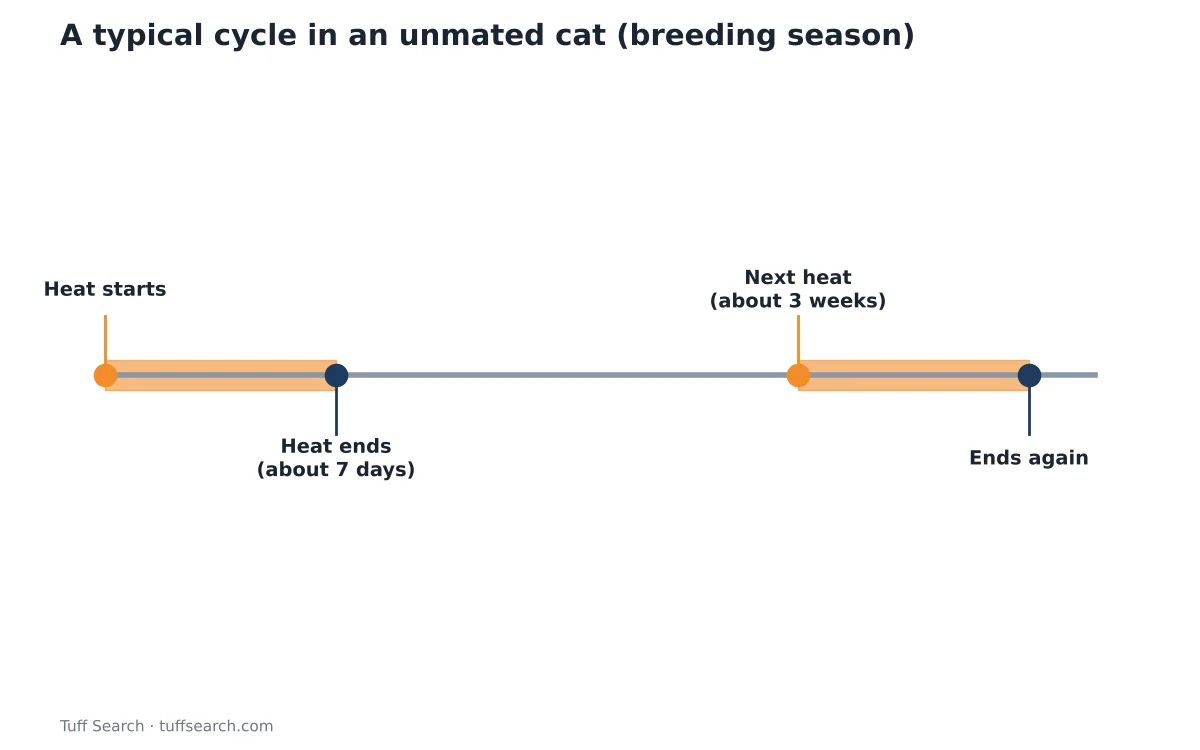
| Heat (estrus) | About 7 days on average (range 1–21) | Receptive to mating; obvious behaviour changes |
| Between heats (if not mated) | About 7 days (range 2–19) | Calm again |
| Whole cycle | About 3 weeks (range 1–6) | Repeats through the season |
Cats are induced ovulators
Unlike people and dogs, cats usually release eggs only after mating. Most need several matings within about a day to ovulate. If a cat is not mated, she does not ovulate and simply comes back into heat a couple of weeks later – which is why an unspayed indoor cat can seem to be in heat almost constantly during the season.
Try it with your numbersCat Pregnancy CalculatorFind your cat's due date from the mating date, see a week-by-week pregnancy timeline and learn the signs that labour is…Open calculatorSigns your cat is in heat
- Loud, persistent yowling or calling, often at night
- Extra affection – rubbing on people, furniture and doorways
- Rolling on the floor
- Raising her hindquarters and treading with her back legs when stroked
- Trying to get outside
- Urinating more often, or spraying urine on vertical surfaces
Visible bleeding is not a typical sign in cats, unlike dogs. If you see blood, or your cat seems unwell, contact your vet.
How to keep her comfortable
- Keep her indoors and away from unneutered males – she will try hard to get out.
- Offer play and attention; warmth, such as a heated pad, can help her settle.
- Keep litter trays clean to discourage spraying.
- Do not try to stop the heat with human medicines – speak to your vet.
Spaying
Spaying (removing the ovaries, and usually the uterus) stops heat cycles and prevents pregnancy. Many vets recommend spaying before the first heat, at around four to five months, though the right timing depends on your cat’s health. Spaying also removes the risk of pyometra (a serious womb infection) and reduces the risk of some mammary tumours. Ask your vet about the best timing.
If she has mated
Cat pregnancy lasts about 63–66 days. If you know the mating date, the cat pregnancy calculator estimates the due date and a normal birth window. For an older cat with an unknown history, the cat age calculator converts her age to human years and shows her life stage.
Frequently asked questions
About 7 days on average, but anywhere from 1 to 21 days, according to VCA Animal Hospitals.
If not mated, roughly every three weeks during the breeding season – and all year in some indoor cats.
Most at around six months, though some start earlier or later depending on breed, weight and season.
Usually not. Bleeding is not a normal sign of heat in cats; contact your vet if you see it.
Related calculators
Related articles
- How Long Do Cats Live? Life Stages and Tips
- Dog Pregnancy Week by Week: Due Date and What to Expect
- When Do Dogs Stop Growing? Ages by Breed Size