
Customer lifetime value (LTV or CLV) estimates how much a customer is worth to your business over the whole relationship. It tells you how much you can afford to spend to win a customer, which marketing channels pay off and where retention matters most.
Revenue LTV vs profit LTV
Some definitions use revenue, but for decisions you should use gross profit – revenue minus the direct cost of delivering the product. Otherwise LTV will look far larger than the money you actually have to spend on acquisition. Our guide to markup vs margin explains how to find gross margin.
LTV for subscription businesses
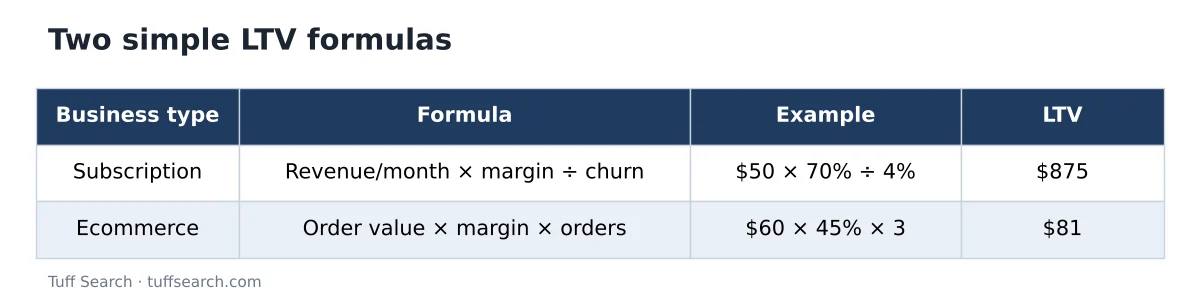
Average customer lifetime in months is roughly 1 ÷ monthly churn rate. With 4% of customers cancelling each month, the average lifetime is about 25 months. A customer paying $50 a month at a 70% gross margin generates $35 a month in gross profit, so LTV ≈ $35 × 25 = $875.
Try it with your numbersCustomer Acquisition Cost CalculatorCalculate customer acquisition cost from marketing and sales spend, then see your LTV:CAC ratio and payback period, with blended vs channel CAC.Open calculatorLTV for ecommerce
Multiply average order value by gross margin by the average number of orders a customer places. A store with a $60 average order, a 45% margin and 3 orders per customer over their lifetime has an LTV of $60 × 0.45 × 3 = $81. Use your own order history: count how many orders customers acquired a year or two ago have placed so far.
Comparing LTV with CAC
Customer acquisition cost (CAC) is what you spend in marketing and sales to win one new customer – see customer acquisition cost explained. The ratio LTV ÷ CAC shows whether growth is profitable. A ratio of about 3:1 is a widely quoted rule of thumb, especially for subscription businesses; below 1:1 means each new customer loses money. The store above, with an $81 LTV, cannot afford a $100 CAC unless it raises repeat purchases.
CAC payback period
How long until a customer’s gross profit repays their acquisition cost? Payback = CAC ÷ monthly gross profit per customer. With a $200 CAC and $35 monthly gross profit, payback takes about 5.7 months. Shorter payback means growth needs less cash up front.
How to increase customer lifetime value
- Reduce churn: better onboarding, support and product quality keep customers longer – even a small fall in churn raises LTV a lot.
- Raise average order value with bundles, upgrades and free-shipping thresholds.
- Encourage repeat purchases with email, reminders, subscriptions and loyalty programmes.
- Improve gross margin by negotiating supplier costs or adjusting pricing.
- Focus acquisition on channels that bring higher-value customers – track LTV by channel, not just CAC.
Common mistakes
- Using revenue instead of gross profit.
- Assuming today’s churn will last forever – early customers often behave differently from later ones.
- Calculating one LTV for all customers when segments differ a lot.
- Ignoring discounting: money earned years from now is worth less today, so long-lived LTV estimates should be treated cautiously.
For advertising, return on ad spend measures the revenue from each campaign – the ROAS calculator works it out – and our guide to setting a small business marketing budget shows how LTV feeds into budgeting.
Frequently asked questions
An estimate of the total gross profit a customer brings over their whole relationship with your business.
Monthly revenue per customer × gross margin ÷ monthly churn rate.
Around 3:1 is a common rule of thumb; it varies by business model and growth plans.
Gross profit is better for comparing with acquisition cost.
Reduce churn, increase order value and purchase frequency, and improve margins.
Related calculators
Related articles
- Markup vs Margin: What’s the Difference and How Do You Convert Them?
- Customer Acquisition Cost (CAC): How to Calculate It and What It Tells You
- How to Set a Small Business Marketing Budget (With Worked Examples)